
Love Letters of a Violinist, and Other Poems
Eric Mackay
THE CLASSIC COLLECTION · 1892
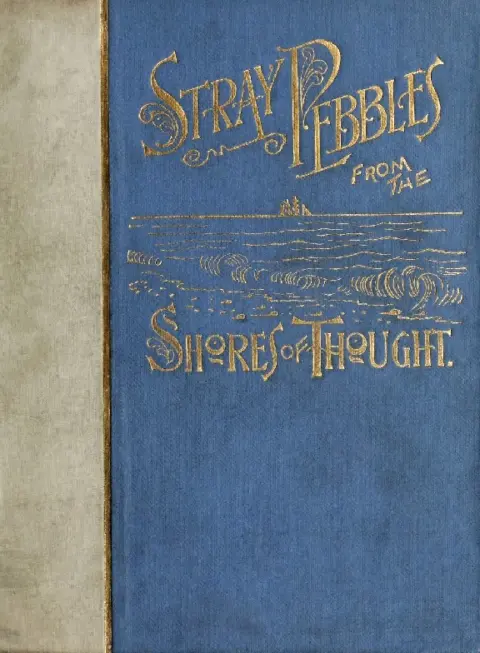
"Stray Pebbles from the Shores of Thought" by Elizabeth Porter Gould is a collection of poetry likely written during the late 19th century. The book encompasses a rich array of themes including nature, love, and reflections on human experience, showcasing the author's lyrical prowess and introspective insights. Through her work, Gould captures the beauty of the world around her and the intricacies of human emotion, creating a tapestry of feelings that resonates with readers. The collection is divided into various sections, each exploring different aspects of life and nature. In the poems dedicated to nature, she evokes vivid imagery of landscapes and seasons, expressing a deep connection to the earth and its beauty. Love poems reflect a range of emotions, from joy and longing to loss and renunciation, illustrating the complexities and the transformative power of love. The miscellaneous section offers diverse reflections, while the sonnets delve into theological and philosophical meditations. Through her heartfelt verses, Gould communicates a longing for beauty, meaning, and connection in an ever-changing world, inviting readers to ponder their own experiences and emotions.
Introduction adapted from the source catalogue; source summaries may be automatically generated.
Free to read · English · 13,505 words · No account needed
MAKE TIME FOR A GOOD BOOK
On by default. Untick to stop anonymous reading totals. Each page counts after 10 seconds in view. How this works.
Anonymous counting is on unless you have switched it off.
But thou art still a "membrane" dear
Of what we call society's cheer;
"Ordained beforehand, in advance."
('Twas "foreordained," that does enhance,)
To hurl not "epitaphs" which sting,
But a new "Erie's" dawn to bring,
Of "fluid" thoughts which counteract
The "bigamies" of fate and fact.
Alas! thy crutch of many years
Still hints "romantic" pains and fears;
A "Widow Cruise's oil jug" say,
To keep "plumbago" still at bay!
Its helpful mission has a share
In "Lines of Pleasant Places" rare.
And, by the way, not crutch alone
Finds in that book its value shown.
There in the depths of friendship's mines
Are seen thy tenderest, purest lines;
Impromptus born at love's command
To deck occasion's wise demand.
One finds no "Sarah's desert" there,
No "reprehensible" despair;
But teeming thoughts on Mounds and Press
Poured out in pure unselfishness.
This brings to mind thy Knitting-Work,
Wherein that "plaguey Ike" does lurk,
And other books with humor rife,
Done in the priming of thy life.
"Contusion of ideas." O no;
What "Angular Saxon" would say so?
"Congestive thoughts then so inane
They'd decompose the soundest brain."
Yes, there it is, thy humor still,
Not seventy years and two can kill.
'Tis free from all "harmonious" lore,
A "wholesome" not a "ringtail" store.
SENT TO THE DINNER GIVEN IN HONOR OF WALT WHITMAN'S SEVENTIETH BIRTHDAY, AT CAMDEN, N.J., MAY 31, 1889, AT 5 O'CLOCK P.M.
"Splendor of ended day floating and filling me,"[B] Comes to my mind as I think of the hour When our poet and friend will be lovingly drinking The mystical cup of the seventy years' power.
Were I the man-of-war bird he has pictured Nothing could keep me from flying that way. But, though absent in body, there's nothing can hinder My tasting the joys of that festive birthday;
For on the swift wings of the ending day's splendor
My soul will glide in to drink deep the cup's wealth.
Who knows but the poet's keen sense of pure friendship
Will feel, 'midst the joy, what I drink to his health?--
Splendor of ended day
Be but the door
Opening the endless way
Life evermore.
[B] "Song at Sunset."--W. W.
(Suggested by Arlo Bates' sonnet, "The Unknown God," published in the BOSTON COURIER of August 21, 1887.)
If Paul in Athens' street left nothing more Than what he found when deep in sacred thought, He stood and marvelled o'er what had been wrought,-- The To the Unknown God of heathen lore,-- Then were he only one on thought's wide shore To lose his name in others. But, heaven-taught, Undaunted, and in words experienced-fraught, Declared he God as known forevermore.
Your reading position is saved on this browser. Take it to another device with a library code. Reading pages adapt to text, rather than matching a printed edition.
BEHIND THE BOOK
This eBook is for the use of anyone anywhere in the United States and most other parts of the world at no cost and with almost no restrictions whatsoever. You may copy it, give it away or re-use it under the terms of the Project Gutenberg License included with this eBook or online at www.gutenberg.org. If you are not located in the United States, you will have to check the laws of the country where you are located before using this eBook. Read the source licence.
The original source file, including credits and licence, is retained by this library. Request an original-format copy at no charge. Please include the book title and Project Gutenberg identifier #44973.
KEEP YOUR CURIOSITY GOING
Eric Mackay
Edmund Gosse
Sophia Margaretta Hensley
Gilbert Parker
George MacDonald

Elizabeth Bibesco