THE CLASSIC COLLECTION✦La cuisine creoleCLASSIC FREE BOOKS
La cuisine creole
Lafcadio Hearn
THE CLASSIC COLLECTION · 1884
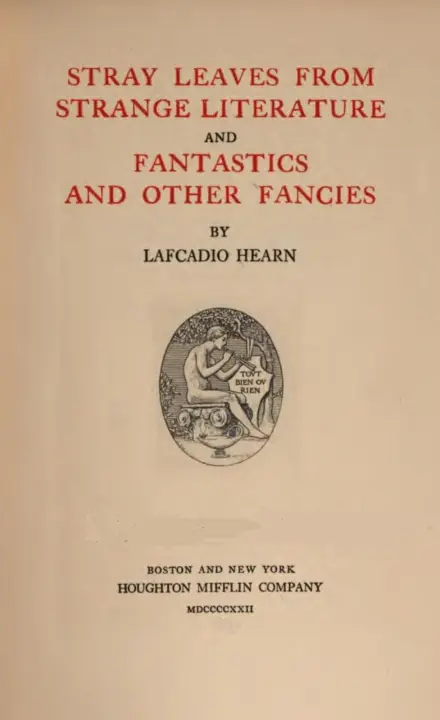
"Stray Leaves from Strange Literature" and "Fantastics and Other Fancies" by Lafcadio Hearn is a collection of literary works that explores various myths, fables, and legends, likely written in the late 19th century. This anthology showcases Hearn's fascination with exotic tales from diverse cultures, ranging from Egyptian narratives to Indian legends and Pacific Island folklore. The compilation serves as a mosaic of enchanting stories, rich in imagination and evocative language, reflecting Hearn's intent to share the unique beauty of unfamiliar literatures. The opening of the book provides an insightful note from Hearn, elucidating his process of gathering and reconstructing these tales. He likens his work to that of a merchant collecting small jewels, emphasizing the beauty and strangeness of the stories he presents. The initial sections include the "Book of Thoth," an Egyptian tale about magic and immortality, where the protagonist, Noferkephtah, uncovers a powerful book that grants immense power but leads to tragedy. This introduction sets the tone for the book's subsequent entries, which promise a journey through captivating myths and legends drawn from various global traditions, ultimately seeking to bridge the gap between cultures through the art of storytelling.
Introduction adapted from the source catalogue; source summaries may be automatically generated.
Free to read · English · 83,531 words · No account needed
MAKE TIME FOR A GOOD BOOK
On by default. Untick to stop anonymous reading totals. Each page counts after 10 seconds in view. How this works.
Anonymous counting is on unless you have switched it off.
We do not remember to have ever read a series of more brilliant articles than those which occasionally appear under the above heading in that bright little paper THE CITY ITEM. The writer, with a perfect command of the language, unites a vivid imagination. His fancy is as exuberant as the growth of tropical flowers, and is as pleasing as glowing and fascinating. We always turn to the editorial page for 'Fantastics' when we receive the ITEM. Would it be out of place to inquire who this rare genius is? It can't be that grave and dignified gentleman, M. F. Bigney. We have read many excellent sketches from his pen, but never anything like these pieces. Who is the writer that adds another to the many attractions of our prosperous and worthy exchange?
"We gladly comply," replies the ITEM editorially, "with
the request of our appreciative Claiborne contemporary.
The writer of 'Fantastics' is Mr. Lafcadio Hearne [sic],
who has been our assistant co-laborer for nearly three
years.--ED. ITEM."
]
"No," he said, "I did not stay long in Havana. I should think it would be a terrible place to live in. Somehow, in spite of all the tropical brightness, the city gave me the idea of a huge sepulchre at times. One feels in those narrow streets as though entombed. Pretty women?--I suppose so, yes; but I saw only one. It was in one of the quaint streets which make you think that the Spaniards learned to build their cities from the Moors--a chasm between lofty buildings, and balconies jutting out above to break the view of the narrow strip of blue sky. Nobody was in the street except myself; and the murmur of the city's life seemed to come from afar, like a ghostly whisper. The silence was so strange that I felt as if walking on the pavement of a church, and disturbing the religious quiet with my footsteps. I stopped before a great window--no glass, but iron bars only;--and behind the iron bars lay the only beautiful woman I saw in Havana by daylight. She could not have been more than eighteen--a real Spanish beauty--dark, bewitching, an oval face with noble features, and long eyelashes resting on the cheek. She was dead! All in white--like the phantom bride of the German tradition--white robes, white satin shoes, and one white tropical flower in her black hair, shining like a star. I do not know what it was; but its perfume came to me through the window, sweet and strange. The young woman, sleeping there all in white, against the darkness of the silent chamber within, fascinated me. I felt as if it was not right to look at her so long; yet I could not help it. Candles were burning at her head and feet; and in the stillness of the hot air their yellow flames did not even tremble. Suddenly I heard a heavy tramping at the end of the street. A battalion of Spanish soldiers were coming towards me. There was no means of proceeding; and I had no time to retreat. The street was so narrow that I was obliged to put my back to the wall in order to let them pass. They passed in dead silence--I only heard the tread of the men, mechanically regular and heavily echoing. They were all in white. Every man looked at me as he passed by; and every look was dark, sinister, suspicious. I was anxious to escape those thousands of Spanish eyes; but I could not have done it without turning my face to the wall. I do not think one of them looked at the dead girl at all; but each one looked at me, and forced me to look at him. I dared not smile,--not one of the swarthy faces smiled. The situation became really unpleasant. It was like one of those nightmares in which you are obliged to witness an endless procession of phantoms, each one of whom compels you to look at it. If I had even heard a single "Carajo Americano," I should have felt relieved; but all passed me in dead silence. I was transpierced by the black steel of at least two thousand Spanish eyes, and every eye looked at me as if I had been detected in some awful crime. Yet why they did not look at that window instead of looking at me, I cannot tell. After they had passed, I looked an instant at the dead girl again; and it seemed to me that I saw the ghost of a smile--a cynical, mocking smile about her lips. She was well avenged--if her consecrated rest had been disturbed by my heretic eyes. I can still smell the white flower; and I can see even the silk stitches in the white satin shoes--the motionless yellow tongues of the candles--the thin dead face that seemed to smile, and the thousand sinister faces that smiled not, and dared me to smile."
Your reading position is saved on this browser. Take it to another device with a library code. Reading pages adapt to text, rather than matching a printed edition.
Lafcadio Hearn
Lafcadio Hearn

Lafcadio Hearn

Lafcadio Hearn
BEHIND THE BOOK
This eBook is for the use of anyone anywhere in the United States and most other parts of the world at no cost and with almost no restrictions whatsoever. You may copy it, give it away or re-use it under the terms of the Project Gutenberg License included with this eBook or online at www.gutenberg.org. If you are not located in the United States, you will have to check the laws of the country where you are located before using this eBook. Read the source licence.
The original source file, including credits and licence, is retained by this library. Request an original-format copy at no charge. Please include the book title and Project Gutenberg identifier #55650.
KEEP YOUR CURIOSITY GOING

Maurice Baring
Francis Greenleaf Allinson & Anne C. E. (Anne Crosby Emery) Allinson
Stuart Dodgson Collingwood
Percy Keese Fitzhugh
Mary Macleod & Edmund Spenser

Cooke Don-Carlos