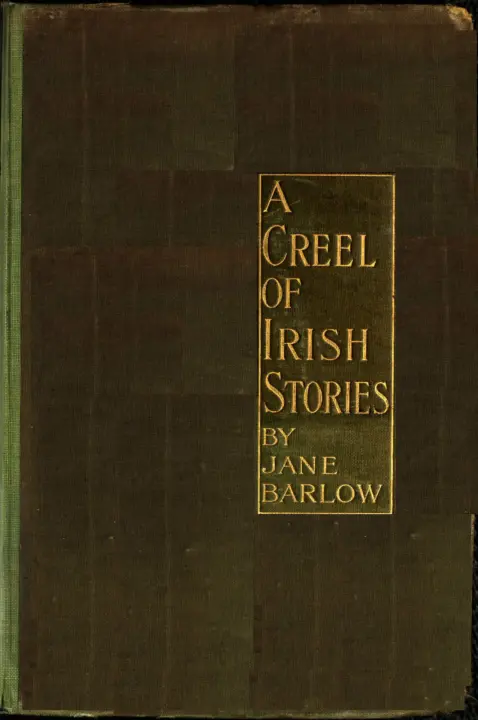
A creel of Irish stories
Jane Barlow
THE CLASSIC COLLECTION · 1895
"Strangers at Lisconnel" by Jane Barlow is a novel written in the late 19th century. The book appears to explore life in a small Irish hamlet, focusing on the inhabitants' daily struggles and relationships, with particular attention to themes of companionship, loss, and the impact of both time and change. The character of Mrs. Kilfoyle and her connections with her neighbors are introduced, hinting at personal histories intertwined with the broader community's narrative. The opening of the novel vividly sets the scene in Lisconnel, a hamlet characterized by its isolated location and the simplicity of rural life. It introduces the daily rhythms of its residents, such as Mrs. Kilfoyle and Mrs. M'Gurk, who engage in conversations reflecting on their families and the passage of time. As they await the infrequent visits from neighbors, the text conveys a sense of nostalgia and resignation, highlighting how long-standing relationships and memories shape their interactions. The dialogue brings to life the characters' personalities and hints at their deeper stories, creating an expectation of a rich exploration of their lives throughout the novel.
Introduction adapted from the source catalogue; source summaries may be automatically generated.
Free to read · English · 78,271 words · No account needed
MAKE TIME FOR A GOOD BOOK
On by default. Untick to stop anonymous reading totals. Each page counts after 10 seconds in view. How this works.
Anonymous counting is on unless you have switched it off.
"Over the hills and far away,
Over the hills and beyond the say,
Over the hills and a great way off,
And the wind it blew--"
when a thudding knock on the door seemed to beat down the shriller sounds and stop the sliding bow. Dan went to see who it was, and found standing on the threshold a tall, lean old man in a long, ragged coat, with a thick, knotted blackthorn in his hand. A few hard-frozen granules pattered in at the opened door, which admitted a glimpse of the moon, tarnished by a thin drift of scudding cloud.
"God save all here," said the old man, who was a stranger.
"Good-evenin' to you kindly, sir," responded old Felix from his fireside corner; "and wudn't you be steppin' widin?"
"I'm on'y axin' me way to the place below there--Ballybrosna beyond Duffclane," said the old man; "it's the road I must be steppin', for I'm more than a thrifle late."
But he came slowly forward into the room as if lured by the fire, at which he looked hungrily. He stooped and limped very much, and when he took off his black caubeen, the sharp gleam of his white hair seemed to comment coldly on those infirmities.
"I'm widin a mile or so of it, or maybe less, by now, I should suppose,"
he said.
"Faix, then, it's the long mile," said the fiddler. "Put half a dozen to it, and you'll be nearer; and bedad it's aisier work doin' that in your head than on your feet. Be the same token I must be leggin' it, or they'll consait I'm lost at our place." And he stepped out darkly into the veiled moonlight.
"Wirrasthrew and weary on it," the old man said to himself; and then to the others, "Is it that far as he says?"
"Ay is it, every inch," said old O'Beirne. "And too long a thramp for you altogether, sir, if I might make so free."
"For the matther of that," said the ragged old man, proudly, "I've walked the double of it, and more, times and agin, widout so much as considherin'. But your road's a bit heavy to-night, wid the snow--and could."
"That's the worst of the roads," said the little old woman, peering suddenly out of her corner; "the longer you walk them, the longer they'll grow on you, till you begin to think there's no ind to them. And after that, the best conthrivance is to keep off of them clivir and clane, the way I do. Then they're no len'th at all."
Your reading position is saved on this browser. Take it to another device with a library code. Reading pages adapt to text, rather than matching a printed edition.
BEHIND THE BOOK
This eBook is for the use of anyone anywhere in the United States and most other parts of the world at no cost and with almost no restrictions whatsoever. You may copy it, give it away or re-use it under the terms of the Project Gutenberg License included with this eBook or online at www.gutenberg.org. If you are not located in the United States, you will have to check the laws of the country where you are located before using this eBook. Read the source licence.
The original source file, including credits and licence, is retained by this library. Request an original-format copy at no charge. Please include the book title and Project Gutenberg identifier #18957.
KEEP YOUR CURIOSITY GOING
Coulson Kernahan

Maurice Baring
Frances Wright
Cécile Tormay

Frederic Jesup Stimson

W. H. P. (William Henry Pope) Jarvis