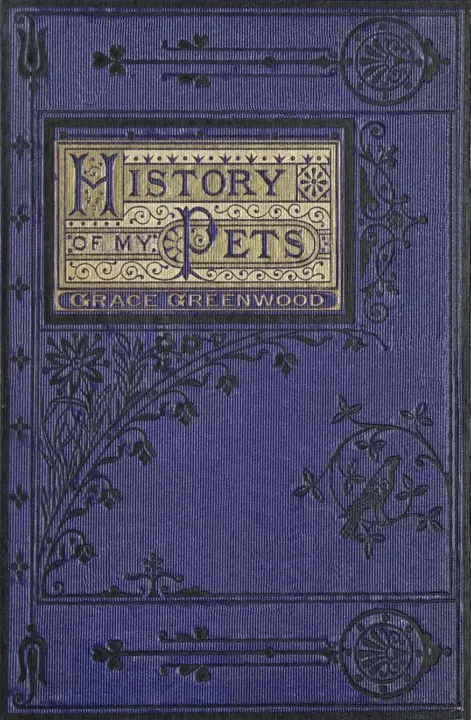
History of my pets
Grace Greenwood
THE CLASSIC COLLECTION · 1867
"Stories of Many Lands" by Grace Greenwood is a collection of children’s stories written in the late 19th century. The book explores themes of childhood experiences and cultural similarities across different nations, seeking to illustrate that children share common joys and tribulations regardless of their origins. The opening of the work features a personal dedicatory message where Greenwood addresses "little cousins" and emphasizes the enduring nature of children's innocence and playfulness across various cultures. The tone is warm and reflective, acknowledging that kids, whether they live in America, France, Italy, or elsewhere, engage in similar behaviors and enjoy life’s simple pleasures. The initial stories showcase young characters navigating their environments, with an emphasis on their shared humanity over societal status or geographic differences. It sets up a framework for readers to understand the book's intercultural connections, demonstrating that regardless of their societal positions, children universally express love, playfulness, and curiosity.
Introduction adapted from the source catalogue; source summaries may be automatically generated.
Free to read · English · 40,963 words · No account needed
MAKE TIME FOR A GOOD BOOK
On by default. Untick to stop anonymous reading totals. Each page counts after 10 seconds in view. How this works.
Anonymous counting is on unless you have switched it off.
Being told by the doctor that he thought Magee must have some brandy, Mr. Raeburn paid a visit to the jail. He found the prisoner sitting on his narrow bed, looking haggard and ill, but as sullen as ever.
"Well, Magee," said Mr. Raeburn, pleasantly, "have you made up your mind to tell all you know of the parentage of that stolen child? You have confessed that you connived at, if you did not assist in the crime, and it may go hard with you at the trial."
Patrick replied, with a furious oath, "Niver a word more will I spake about the matter, if they hang me."
"If I will endeavor to get you discharged; if I will promise to give you some decent clothes, and to furnish you with easy and constant employment, will you tell?"
"No."
"If I will give you a glass of good brandy, will you tell?"
Patrick started, and his dull eyes flashed, but with his old cunning he replied, "Show me first the brandy."
Mr. Raeburn took a flask from his pocket and poured out a glass nearly full. With a trembling, outstretched hand, the poor sot cried, "Yes, yes, yer honor, give it to me, and on my word, on my sowl, I'll tell."
The glass was given him, and he drained it with a sort of frantic relish; then almost immediately, and very hurriedly, began his story.
"Molly's father is Squire Phillips, a mighty clever lawyer and a rich man. He lives at Newburgh, on the Hudson, forninst Fishkill; you mind the town?"
"Yes, and I have heard of Mr. Phillips; go on."
"I should have said he has an office in Newburgh, but he lives on a fine place up the river, out of town, a couple of miles or so. You see, when ill-luck sent me over from Ireland, where I lived in ease and plenty, never taking up a spade but for devarsion, after a hard day following the hounds or riding steeple-chases, I lived with Mr. Phillips as gardener. But he and I niver could agree, and so parted; and soon after my Biddy, who was the cook, was discharged for taking a drop too much just. You see she fell down stairs with the tea-tray. So she had a spite against the master on my account, and against the mistress on her own account, and vowed by all the saints she 'd be aven with them. After we settled in New York, many's the trip she took up the river to prowl about the place (women is quare cratures, yer honor) for a chance to balance accounts. But she never got a shy at them till one afternoon, just before dark, she found little Miss Mary, Mistress Phillips's one child, playing alone on the river-bank, out of sight of the house; it's likely she 'd run away from a lazy nurse. My Biddy wasn't one of the kind that dilly-dallies or shilly-shallies: she pounces on the child like a hawk on a chicken, stops its mouth so it could n't as much as peep, and carries it into a wood near by and hides till dark. Then she takes it over to Fishkill, where she has friends, who lend her proper clothes for the child, and give it a drink that hushes its crying like magic just. Then she takes the night-boat for New York, and in the big, crowded city the child was as completely lost as the small chicken I likened her to would be if the hawk should drop it in a wide sea-marsh. There was a great hue and cry about 'the mysterious disappearance of the only child of John Phillips, Esq.,' (just as if no poor, hard-working man ever lost an only child!) but most of the newspapers drowned her, I believe. Biddy kept her mighty close for a time, and sheared off her curls, but niver a hound of a detective smelt at our door.
Your reading position is saved on this browser. Take it to another device with a library code. Reading pages adapt to text, rather than matching a printed edition.
BEHIND THE BOOK
This eBook is for the use of anyone anywhere in the United States and most other parts of the world at no cost and with almost no restrictions whatsoever. You may copy it, give it away or re-use it under the terms of the Project Gutenberg License included with this eBook or online at www.gutenberg.org. If you are not located in the United States, you will have to check the laws of the country where you are located before using this eBook. Read the source licence.
The original source file, including credits and licence, is retained by this library. Request an original-format copy at no charge. Please include the book title and Project Gutenberg identifier #26736.
KEEP YOUR CURIOSITY GOING

Eric Mackay

Abby Morton Diaz
Helen Hunt Jackson
Edmund Gosse
Sophia Margaretta Hensley
Mary Frances Blaisdell