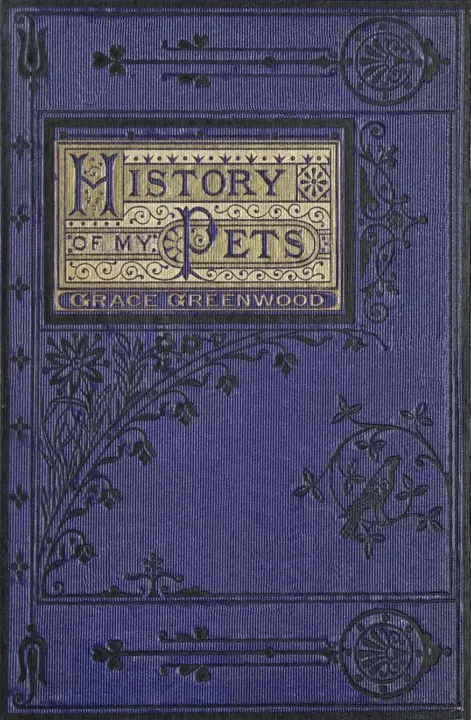
History of my pets
Grace Greenwood
THE CLASSIC COLLECTION · 1867
"Stories of Many Lands" by Grace Greenwood is a collection of children’s stories written in the late 19th century. The book explores themes of childhood experiences and cultural similarities across different nations, seeking to illustrate that children share common joys and tribulations regardless of their origins. The opening of the work features a personal dedicatory message where Greenwood addresses "little cousins" and emphasizes the enduring nature of children's innocence and playfulness across various cultures. The tone is warm and reflective, acknowledging that kids, whether they live in America, France, Italy, or elsewhere, engage in similar behaviors and enjoy life’s simple pleasures. The initial stories showcase young characters navigating their environments, with an emphasis on their shared humanity over societal status or geographic differences. It sets up a framework for readers to understand the book's intercultural connections, demonstrating that regardless of their societal positions, children universally express love, playfulness, and curiosity.
Introduction adapted from the source catalogue; source summaries may be automatically generated.
Free to read · English · 40,963 words · No account needed
MAKE TIME FOR A GOOD BOOK
On by default. Untick to stop anonymous reading totals. Each page counts after 10 seconds in view. How this works.
Anonymous counting is on unless you have switched it off.
While mamma and servants were occupied in preparations for a large dinner-party, Bessie found opportunities for packing a little basket with tiny tarts, apples, nuts, and candies; then she put on her pretty winter coat, trimmed with fur, and her new velvet hat, with a long scarlet plume, the pride of her heart, and her warm tippet and soft gloves and high Balmoral boots. Then she took from her drawer a dainty porte-monnaie, well filled with bright new pennies and small silver coin, and containing a little compartment lined with crimson satin, wherein two gold dollars dwelt together in state, like a Mongolian king and queen. Then taking her basket on her arm, and thrusting her hands into her little muff, she stole down stairs on tiptoe, and made her escape from the house, unperceived by any one.
Mr. Raeburn lived in the aristocratic part of the city of New York; and Bessie, thinking that she could not there carry out her plan in a perfectly satisfactory manner, hailed a down-town stage. Driver and passengers looked surprised to see a child taking a trip all alone; but Bessie had such an old, authoritative manner, that they supposed that all was right. After a long, long ride, she alighted somewhere in the neighborhood of the poorest and least respectable part of the city. I may as well tell you now, if you have n't guessed it, Bessie was bound on a mission, a charitable visit to the poor,--the miserably poor, of whom she had heard her father read. She anxiously looked around her for a beggar-child, who should act as her guide to some home of unmerited misfortune, where virtuous poverty pined, and wept, and waited. Alas! there were plenty of sad little mendicants on the streets that day, but Bessie was not easily satisfied. "It must be a little girl," she said to herself, "very, very poor,--pale, and thin, and ragged, and sorrowful, but still pretty, and mild-looking. And she must have a pretty name too, like the little girls that beg in magazine stories, or sell matches, and are stolen by gypsies, and sing ballads for dreadful organ-grinders, and all that." It was a long time before she found one at all to her mind, but finally she was accosted by a little girl, who looked wretched enough, to be sure,--tattered, and sickly, and starved. She was not quite up to the mark as to prettiness, though she had soft, sorrowful eyes and a delicate mouth. Hunger, cold, and ill-treatment are not very favorable to beauty. Then the name she gave was decidedly unromantic,--Molly Magee. But the poor child told a piteous story, which soon brought tears to Bessie's gentle eyes,--how her father was dead of fever, and her mother a suffering invalid; how she was obliged to beg in the streets, from morning till night, to obtain food for that poor dear mother, three darling little brothers, and two sisters, twins and blind! It was a hard case, surely, and Bessie offered at once to go home with her petitioner, to see what she could do towards alleviating the family distress. The little mendicant hesitated at first, and attempted to dissuade her, but at last, as Bessie obstinately insisted on her own plan of benevolence, she yielded, and rather sullenly led the way homeward. Ah, what a way it was! down one dirty street and up another,--through vile courts and alleys reeking with filth, swarming with idle, loud-voiced men, wretched-looking women, slatternly girls, and forlorn children. Bessie's heart grew sick and her courage failed her. If she had known the way back, she would gladly have made an inglorious retreat!
Your reading position is saved on this browser. Take it to another device with a library code. Reading pages adapt to text, rather than matching a printed edition.
BEHIND THE BOOK
This eBook is for the use of anyone anywhere in the United States and most other parts of the world at no cost and with almost no restrictions whatsoever. You may copy it, give it away or re-use it under the terms of the Project Gutenberg License included with this eBook or online at www.gutenberg.org. If you are not located in the United States, you will have to check the laws of the country where you are located before using this eBook. Read the source licence.
The original source file, including credits and licence, is retained by this library. Request an original-format copy at no charge. Please include the book title and Project Gutenberg identifier #26736.
KEEP YOUR CURIOSITY GOING

Eric Mackay

Abby Morton Diaz
Helen Hunt Jackson
Edmund Gosse
Sophia Margaretta Hensley
Mary Frances Blaisdell