
Stories in green, zinzolin, rose, purple, mauve, lilac and orange
Remy de Gourmont
THE CLASSIC COLLECTION · 1924
Stories in yellow, black, white, blue, violet and red by Remy de Gourmont is a collection of short stories written in the early 20th century. Introduced by a lyrical foreword that treats prose as a poetic art, the book arranges brief, sensuous tales around colors, using each hue to frame a mood and a theme—desire, innocence, power, and the aesthetics of seeing and feeling.
The stories move from quiet encounters to sharp revelations. Yellow follows a mute courtship by a hunter and a peasant girl that culminates in a woodland tryst, where a gold coin (yellow) unlocks her trembling joy. In Black, a man obsessing over a black dahlia with a pink heart finds its living counterpart in a woman dressed in black and white with a blush of rose; they seize the day and become lovers. White contrasts two children’s budding tenderness with the girl’s fervent first communion, where the language of sacred love rivals erotic feeling—yet after mass she sweetly returns to her earthly friend. Blue presents a proud princess who “rescues” a lady-in-waiting from marital sorrow by summoning the husband she secretly loves; she claims him while masking her conquest as benevolence, treasuring the shifting “blue” mark of passion. Violet tells of a cheerful, pious “old maid” devoted to violets who shelters a scholarship boy and, Thursday by Thursday, becomes his lover, later repeating the pattern with others—charity entwined with appetite, to the anguish of her confessor. Red opens at dawn with a milkmaid fetching a wounded partridge from gorse; blood scratches and sunrise foreshadow a rendezvous the next day, sealed by a “red clasp” of a lover’s bite—desire blazing as the day begins.
Introduction adapted from the source catalogue; source summaries may be automatically generated.
Free to read · English · 10,534 words · No account needed
MAKE TIME FOR A GOOD BOOK
On by default. Untick to stop anonymous reading totals. Each page counts after 10 seconds in view. How this works.
Anonymous counting is on unless you have switched it off.
She appeared prettier than ever, now--more natural. This sensation of naturalness he had never before experienced. Perhaps the silence had led him to reflect.
At last he spoke, mentioning the charm of the moment, the coolness of this grotto, his happiness, his repose.
She tapped her skirt awkwardly, twisted a scape of foxglove between her fingers, smiled, but gave no sign of contentment.
“It seems to me that I could love her, almost, if she would only fondle
me.”
Wishing to take out his pipe, he put his hand into the wrong pocket and
struck his purse.
“Ah!”
Secretly he extracted a gold-piece, took the child’s hand and clamped her fingers over the surprise. She opened them immediately, looked, and blushed; her bosom swelled, she heaved a deep sigh, then crushed into her friend’s arms, all aquiver with nervous sobs of joy.
On her knees before him, she kissed his eyes, his cheeks, his chin, the
corners of his lips.
She was happy.
Le charme inattendu d’un bijou rose et noir.
Baudelaire.
The most beautiful flower that Duclos had ever seen was a black dahlia.
It was in the public garden of a little town in Normandy--a garden of tulips, of daisies, of wistaria, hornbeams and orange trees--a garden where the rare plant, sprung up amidst the familiar ones, seemed truly rare, exceptional and beautiful.
How well a bunch of white violets would go in a torrid greenhouse, amidst the singularity of the orchids! How welcome is an orchid, and how strangely it strikes the eye in a spacious provincial garden, where three children are laughing, or an ecclesiastic, who has just finished his breviary, exchanges timorous words with two old ladies in black!
This garden was fresh and attractive, as elegant as a young woman who is perhaps on her way to love, for surely enough one discovers here the four-leaf clover. Its plots and its beds mingled willingly with the hothouse flowers that were out to take the air, and with the rustic blossoms that sleep outside--those that close at night the eyes which they open to the sun, those that have always a new smile to take the place of the one that has died, and those who surrender completely, all at once, in a single great kiss.
There were also numerous trees, and even ash, willows and red osiers, among the lilacs, the snowballs and the roses of Jericho. There were lawns, basins, fountains, red fishes and white fishes.
There were black flowers.
Your reading position is saved on this browser. Take it to another device with a library code. Reading pages adapt to text, rather than matching a printed edition.
Remy de Gourmont
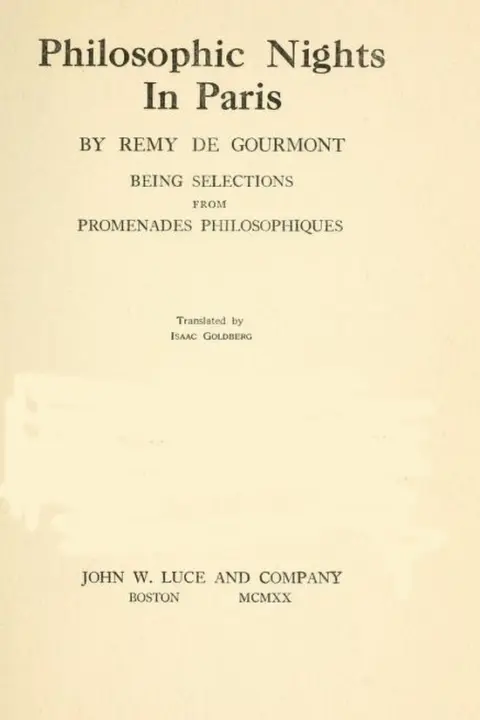
Remy de Gourmont
Remy de Gourmont
BEHIND THE BOOK
This eBook is for the use of anyone anywhere in the United States and most other parts of the world at no cost and with almost no restrictions whatsoever. You may copy it, give it away or re-use it under the terms of the Project Gutenberg License included with this eBook or online at www.gutenberg.org. If you are not located in the United States, you will have to check the laws of the country where you are located before using this eBook. Read the source licence.
The original source file, including credits and licence, is retained by this library. Request an original-format copy at no charge. Please include the book title and Project Gutenberg identifier #78436.
KEEP YOUR CURIOSITY GOING
Coulson Kernahan

Maurice Baring
Frances Wright
Cécile Tormay

Frederic Jesup Stimson

W. H. P. (William Henry Pope) Jarvis