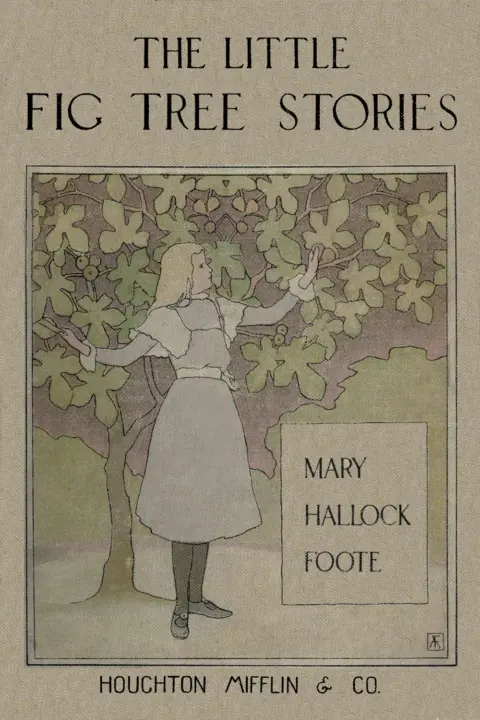
The Little Fig-tree Stories
Mary Hallock Foote
THE CLASSIC COLLECTION · 1884
"Stories by American Authors (Volume 4)" by Constance Fenimore Woolson et al. is a collection of short stories written in the late 19th century. This volume features diverse narratives from various American authors, including works like "Miss Grief" by Woolson. The stories explore themes of love, ambition, and human relationships, often set against the backdrop of societal norms and expectations. The opening of "Miss Grief" introduces us to a young, successful male writer who enjoys a comfortable and charmed life in Rome, filled with artistic pursuits and social engagements. However, his mundane existence is disrupted by the persistent visits of a mysterious woman named Miss Crief, who introduces an air of intrigue and melancholy. As she attempts to communicate her admiration for his work and to share her own literary creation, their interaction uncovers deeper themes of recognition, understanding, and the creative struggles facing those less fortunate. The encounter between the two characters raises questions about the value of art and the emotional weight carried by those who write.
Introduction adapted from the source catalogue; source summaries may be automatically generated.
Free to read · English · 44,730 words · No account needed
MAKE TIME FOR A GOOD BOOK
On by default. Untick to stop anonymous reading totals. Each page counts after 10 seconds in view. How this works.
Anonymous counting is on unless you have switched it off.
"She's too good for all of us! How did thee ever come to have such a graceless set of children, mother?"
"I'm very well satisfied," said Rachel. "But now do be quiet, and let's finish the letter. We must get to bed some time to-night!"
The wild clematis was in blossom now--the fences were white with it, and the rusty cedars were crowned with virgin wreaths, but the weeds were thick in the garden and in the potato patch. Dorothy, stretching her cramped back, looked longingly up the shadowy vista of the farm-lane, which had nothing to do but ramble off into the remotest green fields, where the daisies' faces were as white and clear as in early June.
One hot August night she came home late from the store. The stars were thick in the sky; the katydids made the night oppressive with their rasping questionings, and a hoarse revel of frogs kept the ponds from falling asleep in the shadow of the hills.
"Is thee very tired to-night, Dorothy?" her mother asked, as she took her seat on the low step of the porch. "Would thee mind turning old John out thyself?"
"No, mother, I'm not tired. But why--oh, I know!" cried Dorothy, with a quick laugh. "The dance--at Slocum's barn. I thought those boys were uncommonly helpful."
"Yes, dear, it's but natural they should want to see it. Hark! we can
hear the music from here."
They listened, and the breeze brought across the fields the sound of fiddles and the rhythmic tramp of feet, softened by the distance. Dorothy's young pulses leaped.
"Mother, is it any harm for them just to see it? They have so little fun except what they get out of teasing and shirking."
"My dear, thy father would never countenance such a scene of frivolity, or permit one of his children to look upon it."
Through our eyes and ears the world takes possession of our hearts.
"Then I'm to spare the boys this temptation, mother? Thee will trust
me to pass the barn?"
"I would trust my boys, if they were thy age Dorothy. But their resolution is tender, like their years."
It might be questioned whether the frame of mind in which the boys went to bed that night, under their mother's eye,--for Rachel could be firm in a case of conscience,--was more improving than the frivolity of Slocum's barn.
"Mother," called Dorothy, looking in at the kitchen window, where Rachel was stooping over the embers in the fireplace, to light a bedroom candle, "I want to speak to thee."
Rachel came to the window, screening the candle with her hand.
Your reading position is saved on this browser. Take it to another device with a library code. Reading pages adapt to text, rather than matching a printed edition.
Mary Hallock Foote

Nathaniel Parker Willis
H. C. (Henry Cuyler) Bunner

Constance Fenimore Woolson
BEHIND THE BOOK
This eBook is for the use of anyone anywhere in the United States and most other parts of the world at no cost and with almost no restrictions whatsoever. You may copy it, give it away or re-use it under the terms of the Project Gutenberg License included with this eBook or online at www.gutenberg.org. If you are not located in the United States, you will have to check the laws of the country where you are located before using this eBook. Read the source licence.
The original source file, including credits and licence, is retained by this library. Request an original-format copy at no charge. Please include the book title and Project Gutenberg identifier #22401.
KEEP YOUR CURIOSITY GOING
Coulson Kernahan

Maurice Baring
Frances Wright
Cécile Tormay

Frederic Jesup Stimson

W. H. P. (William Henry Pope) Jarvis