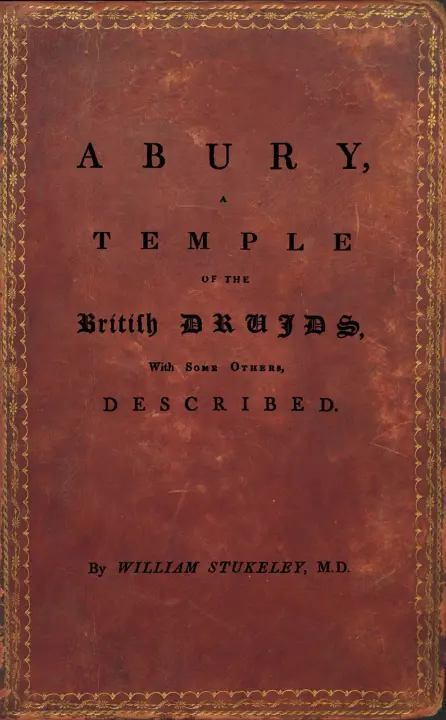
Abury, A Temple of the British Druids, With Some Others, Described
William Stukeley
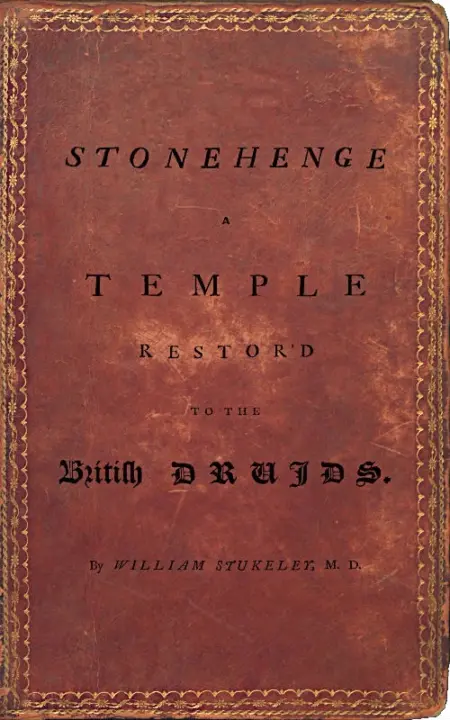
THE CLASSIC COLLECTION · 1740
"Stonehenge, a Temple Restor'd to the British Druids" by William Stukeley is a historical account written in the early 18th century. The book explores the origins and significance of Stonehenge, positing that it was built by the ancient Druids as a temple. Stukeley's investigation encompasses the physical description of the ruins, their architectural features, and the cultural context surrounding them, particularly concerning the Druids' religious practices. The opening of the text introduces Stukeley's fascination with ancient structures and outlines his systematic approach to studying the works of the Druids. He describes his summers spent measuring and contemplating the stone circles across Britain, including the famous Stonehenge. Stukeley argues that these monuments reflect a deep continuity of religious practice from ancient times, positioning the Druids within a historical lineage that traces back to patriarchal religions. His detailed reflection sets the stage for a comprehensive examination of the site's dimensions, material origins, and its place in the broader narrative of British history, revealing the book's intent to preserve and illuminate the memory of these ancient wonders.
Introduction adapted from the source catalogue; source summaries may be automatically generated.
Free to read · English · 48,776 words · No account needed
MAKE TIME FOR A GOOD BOOK
On by default. Untick to stop anonymous reading totals. Each page counts after 10 seconds in view. How this works.
Anonymous counting is on unless you have switched it off.
All this I shall prove, in the pursuit of this work. But before we come to speculation, intend to give an exact description of their several temples, and the like works; for such will be a good foundation for us to build upon. That we may proceed from things evident and more known, to those less known, and which we design to make evident, as well as we are able, and the nature of it will permit. A matter so immers’d in the dark mist of time, where very few scatter’d traces remain, must needs bespeak the reader’s candor. The dignity of the subject will excuse my boldness in attempting one so difficult. And however I succeed in accounting for these wonderful works; at least, I shall be instrumental in preserving their memory, in giving just drawings of them.
Stonehenge, by the extravagant grandeur of the work, has attracted the eyes and admiration of all ages. After the reformation, upon the revival of learning among us, the curious began to consider it more intimately, I cannot say successfully. Mr. Camden rose as the sun of antiquity, that put out former lights, and, like Cæsar, affrights all that value a reputation, from attempting any thing in his way. His great skill in Roman learning, and our English history, only enabled him to be, as it were, silent on Stonehenge. He saw with excellent judgment, that neither Roman nor English had place there, or could serve to illustrate it. He writes modestly, as his manner was; “Of these things I am not able so much to give an accurate account, as mightily to grieve, that the founders of this noble monument cannot be trac’d out.” He could not persuade himself that either Romans, Saxons or Danes had any hand in it. And as for his representation of it in picture, I verily believe, it was drawn only from fancy or memory, or by some engraver from his oral description. A. D. 1620, king James I. being at the earl of Pembroke’s seat at Wilton, and agreeably surpriz’d with the sight of Stonehenge, consulted the famous architect Inigo Jones, upon it; thinking it a matter in his way. This great man, who deservedly may be stiled the English Vitruvius, gave his opinion of it, as a Roman work; and left, I suppose, some few indigested notes in writing there-upon. From which his son-in-law John Webb compos’d an intire treatise, endeavouring to prove it. But they that are acquainted with Roman architecture, or have consider’d Stonehenge, must needs be of a different opinion. And as my Lord Bishop of London well observes, in his notes on Camden, “it cannot be safe to close with Mr. Jones, tho’ his book otherwise be a learned and ingenious piece.” Inigo Jones lived 30 years after this, and yet Mr. Webb makes an apology for his work, “that if he had surviv’d to have done it, with his own hand, it would have been better.” But ’tis very reasonably believ’d, that tho’ Inigo Jones was an extraordinary genius in architecture, yet he wanted many qualifications for an author, especially in such a work as Stonehenge. ’Tis my opinion, that had his architectonic skill been united to Mr. Camden’s learning, he could never have demonstrated Stonehenge to be a Roman work. Afterwards, Dr. Charlton publish’d a piece against Webb’s performance, and certainly has said enough to overthrow it, tho’ he could not with equal success establish his own opinion, that it was the work of the Danes. Whereas Olaus Wormius finds no such monuments among the Gothic nations: which, as Mr. Toland observes, is answer sufficient to his allegation. Webb answer’d the Doctor’s book, and by turns effectually demolish’d his opinion, but could not still vindicate his own. Yet from all their disputations, no spark was struck, towards a discovery of the real truth. What is the worst part in both performances of Mr. Webb, his representation of the real monument in his drawings, is fictitious. And, as Mr. Aubry rightly observes, “in endeavouring to retrieve a piece of architecture in Vitruvius, he abuses the reader with a false representation of the whole.” It requires no great pains to prove this, nor need we take much time to be satisfy’d in it: the work is still extant. As soon as a judicious eye comes upon the spot, we discern that Webb’s equilateral triangles forming the cell are fancies: his three entrances across the ditch are so too; and that he has turn’d the cell a sixth part from its true situation, to favour his imaginary hypothesis. But ’tis against my inclination to find fault with the labours of others, nor do I thereby seek to bribe the reader in my own favour. I had a great pleasure for several years together, in viewing and examining these noble remains of our ancestors. What I wrote about them, was for my private amusement, and that of friends. And I publish them only for the honour of my country, and in hopes that such a publication will not be unserviceable to religion; which is my ultimate view.
Your reading position is saved on this browser. Take it to another device with a library code. Reading pages adapt to text, rather than matching a printed edition.
BEHIND THE BOOK
This eBook is for the use of anyone anywhere in the United States and most other parts of the world at no cost and with almost no restrictions whatsoever. You may copy it, give it away or re-use it under the terms of the Project Gutenberg License included with this eBook or online at www.gutenberg.org. If you are not located in the United States, you will have to check the laws of the country where you are located before using this eBook. Read the source licence.
The original source file, including credits and licence, is retained by this library. Request an original-format copy at no charge. Please include the book title and Project Gutenberg identifier #61567.
KEEP YOUR CURIOSITY GOING
Cécile Tormay

Moritz Busch
John L. Ransom
Frances Wright
Cécile Tormay

Mabel Potter Daggett