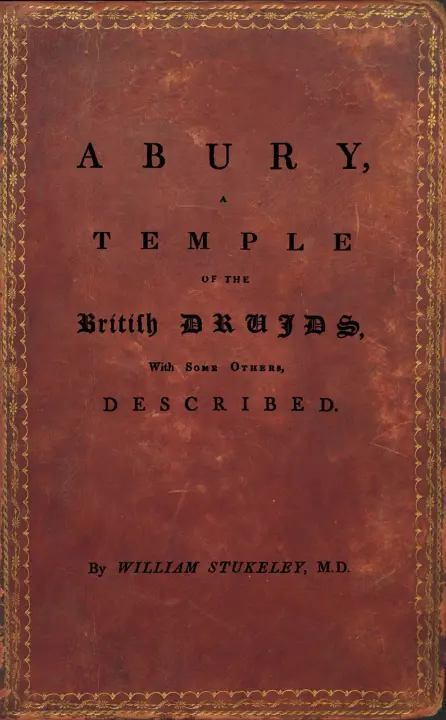
Abury, A Temple of the British Druids, With Some Others, Described
William Stukeley
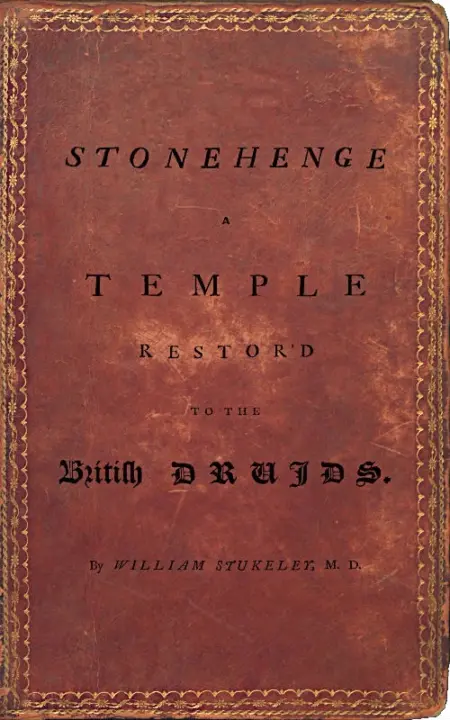
THE CLASSIC COLLECTION · 1740
"Stonehenge, a Temple Restor'd to the British Druids" by William Stukeley is a historical account written in the early 18th century. The book explores the origins and significance of Stonehenge, positing that it was built by the ancient Druids as a temple. Stukeley's investigation encompasses the physical description of the ruins, their architectural features, and the cultural context surrounding them, particularly concerning the Druids' religious practices. The opening of the text introduces Stukeley's fascination with ancient structures and outlines his systematic approach to studying the works of the Druids. He describes his summers spent measuring and contemplating the stone circles across Britain, including the famous Stonehenge. Stukeley argues that these monuments reflect a deep continuity of religious practice from ancient times, positioning the Druids within a historical lineage that traces back to patriarchal religions. His detailed reflection sets the stage for a comprehensive examination of the site's dimensions, material origins, and its place in the broader narrative of British history, revealing the book's intent to preserve and illuminate the memory of these ancient wonders.
Introduction adapted from the source catalogue; source summaries may be automatically generated.
Free to read · English · 48,776 words · No account needed
MAKE TIME FOR A GOOD BOOK
On by default. Untick to stop anonymous reading totals. Each page counts after 10 seconds in view. How this works.
Anonymous counting is on unless you have switched it off.
In 1722, my late Lord Pembroke, Earl Thomas, who was pleas’d to favour my inquiries at this place, open’d a barrow, in order to find the position of the body observ’d in these early days. He pitch’d upon one of those south of Stonehenge, close upon the road thither from Wilton: and on the east side of the road. ’Tis one of the double barrows, or where two are inclos’d in one ditch: one of those, which I suppose the later kind, and of a fine turn’d bell-fashion. It may be seen in Plate IX. On the west side, he made a section from the top to the bottom, an intire segment, from center to circumference. The manner of composition of the barrow was good earth, quite thro’, except a coat of chalk of about two foot thickness, covering it quite over, under the turf. Hence it appears, that the method of making these barrows was to dig up the turf for a great space round, till the barrow was brought to its intended bulk. Then with the chalk, dug out of the environing ditch, they powder’d it all over. So that for a considerable time, these barrows must have look’d white: even for some number of years. And the notion of sanctity annex’d to them, forbid people trampling on them, till perfectly settled and turf’d over. Hence the neatness of their form to this day. At the top or center of this barrow, not above three foot under the surface, my Lord found the skeleton of the interr’d; perfect, of a reasonable size, the head lying toward Stonehenge, or northward.
The year following, in order to prosecute this inquiry, by my Lord’s order, I begun upon a barrow north of Stonehenge, in that group south of the cursus. ’Tis one of the double barrows there: and the more easterly, and lower of the two: likewise somewhat less. It was reasonable to believe, this was the sepulture of a man and his wife: and that the lesser was the female: and so it prov’d, at least a daughter. We made a large cut on the top from east to west. After the turf taken off, we came to the layer of chalk, as before, then fine garden mould. About three foot below the surface, a layer of flints, humouring the convexity of the barrow. These flints are gather’d from the surface of the downs in some places, especially where it has been plow’d. This being about a foot thick, rested on a layer of soft mould another foot: in which was inclos’d an urn full of bones. This urn was of unbak’d clay, of a dark reddish colour: crumbled into pieces. It had been rudely wrought with small mouldings round the verge, and other circular channels on the outside, with several indentures between, made with a pointed tool, as depicted in Plate XXXII. where I have drawn all the sorts of things found in this barrow. The bones had been burnt, and crouded all together in a little heap, not so much as a hat crown would contain. The collar bone, and one side of the under-jaw are grav’d in their true magnitude. It appears to have been a girl of about 14 years old, by their bulk and the great quantity of female ornaments mix’d with the bones, all which we gather’d. Beads of all sorts, and in great number, of glass of divers colours, most yellow, one black. Many single, many in long pieces notch’d between, so as to resemble a string of beads, and these were generally of a blue colour. There were many of amber, of all shapes and sizes, flat squares, long squares, round, oblong, little and great. Likewise many of earth, of different shapes, magnitude and colour, some little and white, many large and flattish like a button, others like a pully. But all had holes to run a string thro’, either thro’ their diameter, or sides. Many of the button sort seem to have been cover’d with metal, there being a rim work’d in them, wherein to turn the edge of the covering. One of these was cover’d with a thin film of pure gold. These were the young lady’s ornaments. And had all undergone the fire: so that what would easily consume fell to pieces as soon as handled. Much of the amber burnt half thro’. This person was a heroin, for we found the head of her javelin in brass. At bottom are two holes for the pins that fastned it to the staff. Besides, there was a sharp bodkin, round at one end, square at the other, where it went into a handle. I still preserve whatever is permanent of these trinkets. But we recompos’d the ashes of the illustrious defunct, and cover’d them with earth. Leaving visible marks at top, of the barrow having been open’d, to dissuade any other from again disturbing them: and this was our practice in all the rest.
Your reading position is saved on this browser. Take it to another device with a library code. Reading pages adapt to text, rather than matching a printed edition.
BEHIND THE BOOK
This eBook is for the use of anyone anywhere in the United States and most other parts of the world at no cost and with almost no restrictions whatsoever. You may copy it, give it away or re-use it under the terms of the Project Gutenberg License included with this eBook or online at www.gutenberg.org. If you are not located in the United States, you will have to check the laws of the country where you are located before using this eBook. Read the source licence.
The original source file, including credits and licence, is retained by this library. Request an original-format copy at no charge. Please include the book title and Project Gutenberg identifier #61567.
KEEP YOUR CURIOSITY GOING
Cécile Tormay

Moritz Busch
John L. Ransom
Frances Wright
Cécile Tormay

Mabel Potter Daggett