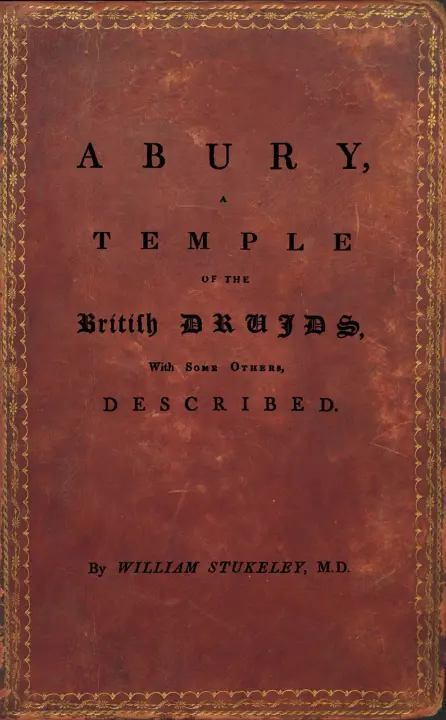
Abury, A Temple of the British Druids, With Some Others, Described
William Stukeley
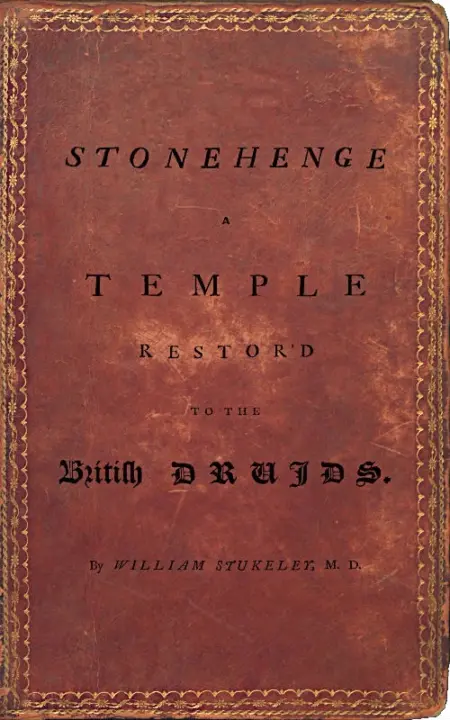
THE CLASSIC COLLECTION · 1740
"Stonehenge, a Temple Restor'd to the British Druids" by William Stukeley is a historical account written in the early 18th century. The book explores the origins and significance of Stonehenge, positing that it was built by the ancient Druids as a temple. Stukeley's investigation encompasses the physical description of the ruins, their architectural features, and the cultural context surrounding them, particularly concerning the Druids' religious practices. The opening of the text introduces Stukeley's fascination with ancient structures and outlines his systematic approach to studying the works of the Druids. He describes his summers spent measuring and contemplating the stone circles across Britain, including the famous Stonehenge. Stukeley argues that these monuments reflect a deep continuity of religious practice from ancient times, positioning the Druids within a historical lineage that traces back to patriarchal religions. His detailed reflection sets the stage for a comprehensive examination of the site's dimensions, material origins, and its place in the broader narrative of British history, revealing the book's intent to preserve and illuminate the memory of these ancient wonders.
Introduction adapted from the source catalogue; source summaries may be automatically generated.
Free to read · English · 48,776 words · No account needed
MAKE TIME FOR A GOOD BOOK
On by default. Untick to stop anonymous reading totals. Each page counts after 10 seconds in view. How this works.
Anonymous counting is on unless you have switched it off.
But when we consider the cell, as Mr. Webb names it, we find him guilty of great disingenuity, in ill conceiving the form of it, and in distorting his ground-plots, to colour it over the better. The minute you enter this adytum, as in TAB. XVIII. you discover ’tis not a hexagon, nor ever was intended for one, and there can be no greater absurdity than to imagine it one. It is in truth compos’d of certain compages of stones, which I shall call trilithons, because made, each of two upright stones, with an impost at top: and there are manifestly 5 of these trilithons remaining. But the naked eye easily discovers, they are very far from making 5 sides of a hexagon. They cannot be brought to any approach, of a truly circular polygon. 3 trilithons of the 5 are remaining entire, 2 are ruin’d indeed, in some measure, but the stones remain in situ. And nothing is easier, than to take the ground-plot, from symmetry and correspondency. We see the two trilithons on the wings or sides of the adytum, are set almost in a strait line, one of another; when in a hexagon form, they ought to make a considerable angle. If you examine them trigonometrically, the true angle of an hexagon is 120 degrees, but here is an angle of near 150. And by making it an hexagon, he supposes one trilithon entirely gone, that nearest the grand entrance, when there is not the least appearance that ever there were such stones there. No cavity in the earth, no stump or fragment visible, nor is it easy to imagine, how 3 stones of so vast a bulk could have been clean carried away, either whole or in pieces. There is no room for them to have been carried away whole, no traces of their having been thrown down, broke in pieces and so carried away. This outer side of the work being the most perfect of the whole. Of the ruins of the other trilithons, there is not the least part wanting. What has been thrown down and broke, remains upon the spot. But this trilithon in dispute, must needs have been spirited away, by nothing less than Merlin’s magic, which erected it, as the monks fable. Besides, if it were still standing, it would be very far from making this adytum a regular hexagon, to which he has accommodated his peripteros scheme: p. 87. Further, granting it was a regular hexagon, it would be very far from corresponding with that scheme, or have the least appearance, of its being taken from such a one. For our editor there, has converted the cell quite from the nature of that at Stonehenge. He has made the upper end of his cell at the letter H opposite to the grand entrance G, not a trilithon as it is notoriously at Stonehenge, but an angular interval between 2 trilithons. It is not the side of the figure, but the angle. Whereas it is most notorious at Stonehenge, that the upper end of the adytum opposite to the grand entrance, and to the whole length of the avenue and entrance between it and the area, is a trilithon; not an angle or interval. And that trilithon is exceeding stately, tho’ in ruins, one of the upright stones being fallen, the other leaning. So that here, we have the cell converted full a 6th part of the whole compass, from its true and original situation, and so in all the schemes of Mr. Webb’s book, not one excepted. In that, for instance, Scheme I, p. 56, the high altar is plac’d at D not against a trilithon, as it ought to be, opposite to the grand entrance in the front of the temple, and to the (only) entrance below, into the area, but against an angle between two. If then you suppose that hexagon remov’d back a 6th part, so as that a trilithon be set behind the high altar, as it is really in the thing its self, and upon the principal diameter of the whole work: then this absurd consequence follows, that the opposite trilithon of the cell stands in the very midst of the entrance into the cell, upon the same principal ground-line or diameter of the work, and quite obstructs the view and entrance into it. It is altogether as ridiculous, as if a dead wall was built under St. Paul’s organ-loft, which is and ought to be the chief entrance into the choir. Besides, by Webb’s ground-plots and uprights, it seems as if, when you entered this adytum, there were 3 trilithons on the right, and 3 on the left, whereas it is most obvious, there are but two on the right, and two on the left; when you advance into it, the orderly way, from the north-east grand entrance of the avenue; which he himself p. 55. owns to be the principal. But I am tired of so ungrateful a talk, which necessity alone could have extorted from me.
Your reading position is saved on this browser. Take it to another device with a library code. Reading pages adapt to text, rather than matching a printed edition.
BEHIND THE BOOK
This eBook is for the use of anyone anywhere in the United States and most other parts of the world at no cost and with almost no restrictions whatsoever. You may copy it, give it away or re-use it under the terms of the Project Gutenberg License included with this eBook or online at www.gutenberg.org. If you are not located in the United States, you will have to check the laws of the country where you are located before using this eBook. Read the source licence.
The original source file, including credits and licence, is retained by this library. Request an original-format copy at no charge. Please include the book title and Project Gutenberg identifier #61567.
KEEP YOUR CURIOSITY GOING
Cécile Tormay

Moritz Busch
John L. Ransom
Frances Wright
Cécile Tormay

Mabel Potter Daggett