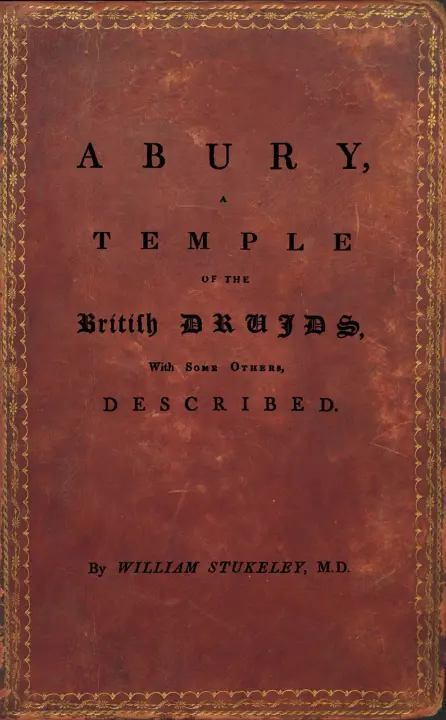
Abury, A Temple of the British Druids, With Some Others, Described
William Stukeley
THE CLASSIC COLLECTION · 1740
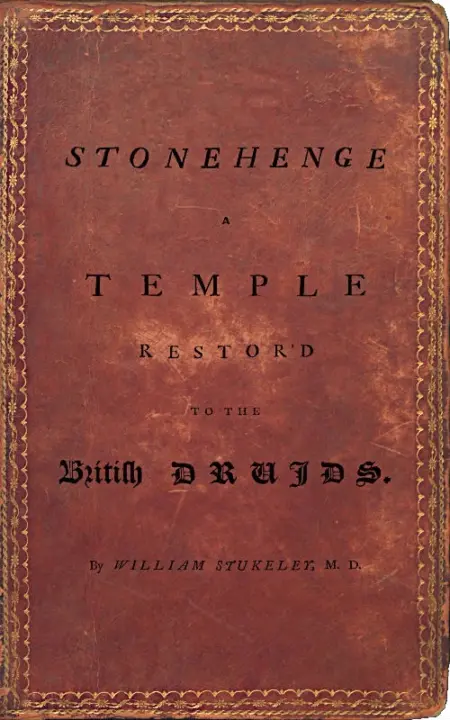
"Stonehenge, a Temple Restor'd to the British Druids" by William Stukeley is a historical account written in the early 18th century. The book explores the origins and significance of Stonehenge, positing that it was built by the ancient Druids as a temple. Stukeley's investigation encompasses the physical description of the ruins, their architectural features, and the cultural context surrounding them, particularly concerning the Druids' religious practices. The opening of the text introduces Stukeley's fascination with ancient structures and outlines his systematic approach to studying the works of the Druids. He describes his summers spent measuring and contemplating the stone circles across Britain, including the famous Stonehenge. Stukeley argues that these monuments reflect a deep continuity of religious practice from ancient times, positioning the Druids within a historical lineage that traces back to patriarchal religions. His detailed reflection sets the stage for a comprehensive examination of the site's dimensions, material origins, and its place in the broader narrative of British history, revealing the book's intent to preserve and illuminate the memory of these ancient wonders.
Introduction adapted from the source catalogue; source summaries may be automatically generated.
Free to read · English · 48,776 words · No account needed
MAKE TIME FOR A GOOD BOOK
On by default. Untick to stop anonymous reading totals. Each page counts after 10 seconds in view. How this works.
Anonymous counting is on unless you have switched it off.
The notion we ought to entertain of Stonehenge is not a little enhanc’d, by the discovery I made from frequent mensurations there. It gave me the opportunity of finding out the standard and original measure, which the people us’d, who made this and all other works of this kind. And this precludes any tedious disputation against the opinion of authors; for whoever makes any eminent building, most certainly forms it upon the common measure in use, among the people of that place. Therefore if the proportions of Stonehenge fall into fractions and uncouth numbers, when measur’d by the English, French, Roman, or Grecian foot, we may assuredly conclude, the architects were neither English, French, Roman or Greeks. Thus, for instance, when the accurate Greaves tells us, the door of the Pantheon (which is of one stone) is of English foot-measure 19 foot 602/1000 within: should we not be apt to assert at first sight, that the architect in so costly a work, did not chuse his measures at random, but intended that this dimension should be 20 feet? When we consider this building is at Rome, and that it amounts to 20 Roman feet, must we not conclude, it was erected by the Roman standard? adding too, that all the rest of the dimensions of this stately structure fall aptly and judiciously into the same scale. So as long as any vestigia of St. Paul’s cathedral remain, the English foot, by which it was built, will easily be known. I must prepare the reader for a right understanding of our Druid edifices, by informing him, that Stonehenge, and all other works of this nature in our island, are erected by that most ancient measure call’d a cubit, which we read of in the holy scriptures, and in ancient profane authors. I mean the same individual measure, call’d the Hebrew, Egyptian, Phœnician cubit; most probably deriv’d from Noah and Adam. ’Tis the same that the pyramids of Egypt and other their works are projected upon; the same as that of Moses’s tabernacle, Solomon’s temple, &c. and we may reasonably pride ourselves in possessing these visible monuments of the old measure of the world. My predecessor Bishop Cumberland shows, enough to satisfy us, that the Egyptian and Hebrew measure was the same, tho’ he has not hit upon that measure, to a nicety. My friend and collegue Dr. Arbuthnot has been more successful, in applying it to such parts of the greater pyramid, as evidently establish its proportion, to our English foot, from the measures Greaves has left us: and shows it to be 20 inches and ⅘ of English measure. Thus the Doctor observes the side of the greater pyramid at base, is 693 English feet; which amounts exactly to 400 Egyptian cubits, a full and suitable number for such a square work, and without question the originally design’d measure, the stadium of old. I have taken notice that Inigo Jones observ’d the like dimensions, in laying out the plot of Lincoln’s-Inn-fields. The Doctor adds many more instances, deduc’d in the same way, to confirm it. I add, that Greaves says, the lowermost steps of the pyramid are near 4 feet in height, which amounts to 2 cubits and 2 palms. They are 3 foot in breadth, i. e. 1 cubit 4 palms. The length of the declining first entrance is 92 feet and an half, i. e. 55 cubits. The length of the next gallery is 110 feet, which amounts to 60 cubits. There is another gallery in the pyramid, of the same length. Mr. Webb says the diameter of Stonehenge is 110 feet. This would tempt one to suspect the same measure us’d in both. Thus the diameter of the like work at Rowldrich in Oxfordshire, describ’d by Dr. Plot, is 35 yards, i. e. 110 feet, grossly measur’d. Father Brothais in his observations on upper Egypt, in our Phil. Trans. found a door-case made of one stone, in a magnificent building, it was 26½ feet in height, this is 15 cubits. Dr. Huntington, in the same Trans. says, he found the sphynx standing by the northern pyramids to be 110 feet in circuit, i. e. 60 cubits. Ptolomy in his IVth book, and Pliny XXXVI.——speak of the obelisk rais’d by king Rameses at Heliopolis, which Mr. Webb, p. 34. gives the length of in English feet, 136. This is 80 cubits. That which Augustus set up in the circus maximus at Rome upon reduction of Egypt, Webb says, is 120 feet 9 inches, which amounts to 70 cubits. Another, Augustus set up in the campus martius, which he says is 9 foot higher, i. e. 5 cubits. He speaks again of that erected by Fontana before St. Peter’s, 81 feet, which was 50 cubits. I suppose the base being injur’d, it was cut a little shorter. This at the base, he says, is 9 foot square, i. e. 5 cubits. The Vatican obelisk is 170 foot high, which is 100 cubits. 12 foot broad at bottom, which is 7 cubits; at top a third part less.
Your reading position is saved on this browser. Take it to another device with a library code. Reading pages adapt to text, rather than matching a printed edition.
BEHIND THE BOOK
This eBook is for the use of anyone anywhere in the United States and most other parts of the world at no cost and with almost no restrictions whatsoever. You may copy it, give it away or re-use it under the terms of the Project Gutenberg License included with this eBook or online at www.gutenberg.org. If you are not located in the United States, you will have to check the laws of the country where you are located before using this eBook. Read the source licence.
The original source file, including credits and licence, is retained by this library. Request an original-format copy at no charge. Please include the book title and Project Gutenberg identifier #61567.
KEEP YOUR CURIOSITY GOING
Cécile Tormay

Moritz Busch
John L. Ransom
Frances Wright
Cécile Tormay

Mabel Potter Daggett