THE CLASSIC COLLECTION✦An outlaw’s diary: the CommuneCLASSIC FREE BOOKS
An outlaw’s diary: the Commune
Cécile Tormay
THE CLASSIC COLLECTION · 1898
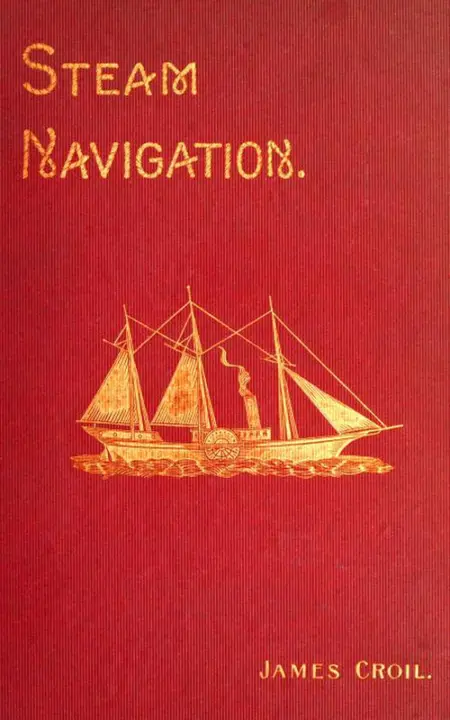
"Steam Navigation and Its Relation to the Commerce of Canada and the United States" by James Croil is a historical account written in the late 19th century. The book explores the origins, development, and impact of steam navigation on commerce between Canada and the United States, highlighting significant steam vessels and their contributions to trade and transportation. The opening of the work presents a detailed preface that outlines the motivations behind the book and acknowledges other notable writings on the subject. Croil expresses a deep passion for steam navigation, citing its revolutionary role in connecting distant lands and facilitating trade. He mentions the plethora of sources he has drawn upon to compile his narrative, indicating a meticulous approach to documenting the history of steam vessels, particularly those related to Canadian waterways. This sets the stage for a comprehensive exploration of the evolution of steam navigation that the forthcoming chapters promise to elaborate on in more detail.
Introduction adapted from the source catalogue; source summaries may be automatically generated.
Free to read · English · 81,663 words · No account needed
MAKE TIME FOR A GOOD BOOK
On by default. Untick to stop anonymous reading totals. Each page counts after 10 seconds in view. How this works.
Anonymous counting is on unless you have switched it off.
The Royal Mail Steam Packet Company, the ships of which line sail from Southampton to the West Indies, Central America, North and South Pacific, Brazil and River Plate, was founded in 1839, and has a large fleet of powerful steamers. The Danube, Nile, Clyde, Thames, Magdalena and Atrato are all over 5,000 tons, with engines of from 6,773 to 7,500 indicated horse-power. Among the smaller ships is the Trent, a namesake of the historic vessel which was boarded by the United States cruiser, San Jacinto, in 1861, when the seizure of Slidell and Mason nearly provoked a war with Great Britain. The West India and Pacific Steamship Company, with a fleet of seventeen steamers, keeps up a good line of communication between Liverpool, the West Indies, the Gulf of Mexico, and the Caribbean seas. The American and European are each 7,730 tons; the Barbadian, Cuban, Jamaican, Mexican and Tampican are from 4,020 to 4,500 tons.
The Pacific Steam Navigation Company, incorporated in 1840, conducts a line of mail steamers from Liverpool to Brazil and River Plate, continuing the voyage to the west coast of America via the Straits of Magellan. This company are the pioneers of steam navigation along the southern shores of the Pacific, and between Europe and the West Coast. They have also running in the Orient Line, from London to Australia, four of their largest steamers, viz., Orizaba, Oroya, Oruba and Orotava, all over 6,000 tons. They have a large fleet of other ships, such as the Orissa, Orcana, Potosi, Liguria, Iberia, ranging from 4,000 to 5,000 tons each, and they are building others of large dimensions.
Messrs. Lamport and Holt have a fine fleet, consisting of over sixty steamers, running from Glasgow, Liverpool, Manchester, London, Antwerp and New York, to Brazil, River Plate, and the west coast of South America. A large percentage of their steamers are capable of carrying between 5,000 and 6,000 tons of cargo, and have a speed of from 10½ to 12 knots at sea. They also carry a limited number of passengers. The largest of their steamers are the Canova, 5,000 tons; Cavour, 5,500 tons; Cervantes, 5,000 tons, and the Horace, 4,000 tons. The Wilson Line—Thomas Wilson, Sons & Co. (Limited), Hull—in addition to their North American lines of steamers, have a fortnightly service to Bombay and Kurrachee, a monthly service to Australia, and a line of steamers running to River Plate ports, to suit the trade.
The fare from Southampton to the West India Islands runs from £25 to £35; from New York, by the Atlas Line, $50; and to Bermuda, by the Quebec Steamship Company, sailing from New York every Thursday, $25.
Your reading position is saved on this browser. Take it to another device with a library code. Reading pages adapt to text, rather than matching a printed edition.
BEHIND THE BOOK
This eBook is for the use of anyone anywhere in the United States and most other parts of the world at no cost and with almost no restrictions whatsoever. You may copy it, give it away or re-use it under the terms of the Project Gutenberg License included with this eBook or online at www.gutenberg.org. If you are not located in the United States, you will have to check the laws of the country where you are located before using this eBook. Read the source licence.
The original source file, including credits and licence, is retained by this library. Request an original-format copy at no charge. Please include the book title and Project Gutenberg identifier #58849.
KEEP YOUR CURIOSITY GOING
Cécile Tormay

Moritz Busch
John L. Ransom
Frances Wright
Cécile Tormay

Mabel Potter Daggett