THE CLASSIC COLLECTION✦An outlaw’s diary: the CommuneCLASSIC FREE BOOKS
An outlaw’s diary: the Commune
Cécile Tormay
THE CLASSIC COLLECTION · 1898
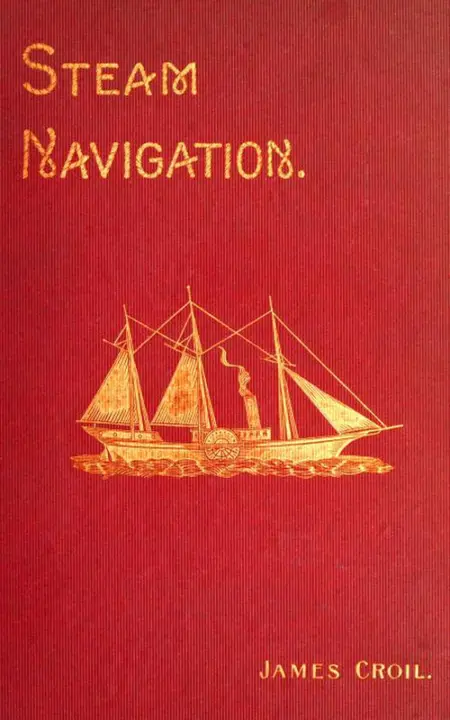
"Steam Navigation and Its Relation to the Commerce of Canada and the United States" by James Croil is a historical account written in the late 19th century. The book explores the origins, development, and impact of steam navigation on commerce between Canada and the United States, highlighting significant steam vessels and their contributions to trade and transportation. The opening of the work presents a detailed preface that outlines the motivations behind the book and acknowledges other notable writings on the subject. Croil expresses a deep passion for steam navigation, citing its revolutionary role in connecting distant lands and facilitating trade. He mentions the plethora of sources he has drawn upon to compile his narrative, indicating a meticulous approach to documenting the history of steam vessels, particularly those related to Canadian waterways. This sets the stage for a comprehensive exploration of the evolution of steam navigation that the forthcoming chapters promise to elaborate on in more detail.
Introduction adapted from the source catalogue; source summaries may be automatically generated.
Free to read · English · 81,663 words · No account needed
MAKE TIME FOR A GOOD BOOK
On by default. Untick to stop anonymous reading totals. Each page counts after 10 seconds in view. How this works.
Anonymous counting is on unless you have switched it off.
The total number of vessels on the registry books of the Dominion on December 31st, 1896, was 7,279, with a gross tonnage of 789,299 tons. Of that number 1,762 were steamboats, with a gross tonnage of 251,176 tons.[72] The steam tonnage of the Dominion is divided about as follows: Ontario, 41.1 per cent.; Quebec, 32.3 per cent.; British Columbia, 10 per cent.; Nova Scotia, 7.9 per cent.; New Brunswick, 3.8 per cent.; Manitoba, 2.6 per cent.; Prince Edward Island 2 per cent.
The total number of steamers registered and enrolled in the United States in 1896 (including steam yachts, barges, etc.), was 6,595 vessels, with a tonnage of 2,307,208 gross tons.[73]
The total number of steam vessels in the United Kingdom of Great Britain and Ireland, over 100 tons gross, recorded in Lloyds Register for 1896-97, was 6,508; their gross tonnage was 9,968,573 and their net tonnage, 6,143,282. Including the British Colonies, the number of steam vessels is 7,373 and their gross tonnage, 10,508,443 tons.[74] Of these only about 420 are built of wood, 3,883 are built of iron and the rest of steel.
According to Lloyds Register above quoted, the total number of steam vessels, over 100 tons, in the world in 1897 was 13,652, and their gross tonnage, 17,737,825 tons. The number of wooden steamers was 1,163; of iron, 7,099, and 5,390 of steel.
The British Empire owns 54 per cent. of the entire merchant marine tonnage of the world, estimated by Lloyds at 25,614,089 tons gross; she owns 62 per cent. of the entire merchant marine steam tonnage.
If to these figures were added the number of steam vessels in the navies of the world, the grand total would be very largely increased. The British navy alone would increase the number of vessels by 700 at least, and the tonnage by more than 1,500,000 tons.
Reliable statistics are not easily found and are often accounted dry reading. From a variety of causes, figures are peculiarly prone to err. But whatever may be thought of the merely numerical argument which has almost unavoidably been introduced in these pages, the indisputable fact remains, that of all the triumphs of mind over matter in this nineteenth century nothing has contributed more to the advancement of civilization and the spread of Christianity, to the wealth of nations and the convenience and comfort of the human race, than the marvellous development of steam navigation which will ever be identified with the history of the illustrious reign of Her Majesty QUEEN VICTORIA.
[62] Mr. John Ross Robertson’s “Landmarks of Toronto” (Toronto: 1896) contains an account of nearly all the steamboats that have plied on Lake Ontario and the Upper St. Lawrence from 1816 to 1895.
[63] From notes by Rev. Professor Bryce, LL. D., of Winnipeg.
[64] Mr. J. A. Thomson, Inspector of Steamboats for British Columbia, furnished the information contained in these notes.
Your reading position is saved on this browser. Take it to another device with a library code. Reading pages adapt to text, rather than matching a printed edition.
BEHIND THE BOOK
This eBook is for the use of anyone anywhere in the United States and most other parts of the world at no cost and with almost no restrictions whatsoever. You may copy it, give it away or re-use it under the terms of the Project Gutenberg License included with this eBook or online at www.gutenberg.org. If you are not located in the United States, you will have to check the laws of the country where you are located before using this eBook. Read the source licence.
The original source file, including credits and licence, is retained by this library. Request an original-format copy at no charge. Please include the book title and Project Gutenberg identifier #58849.
KEEP YOUR CURIOSITY GOING
Cécile Tormay

Moritz Busch
John L. Ransom
Frances Wright
Cécile Tormay

Mabel Potter Daggett