Four Introductory Lectures on Political Economy
Nassau William Senior
THE CLASSIC COLLECTION · 1835
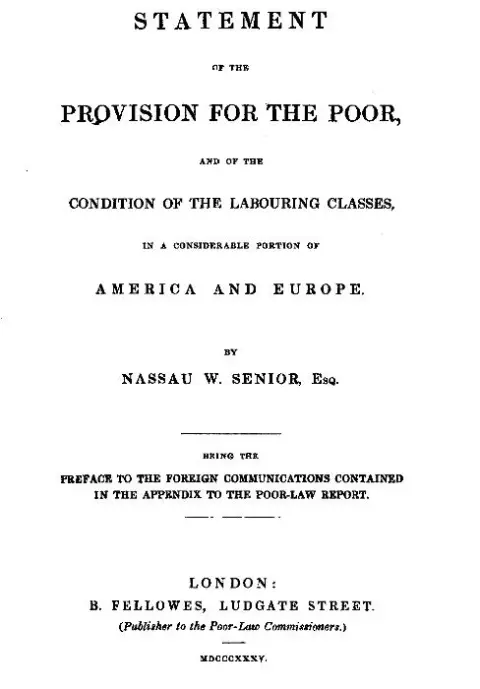
"Statement of the Provision for the Poor, and of the Condition of the Labouring Classes" by Nassau W. Senior is a historical account written in the early 19th century. This work serves as an introduction to a larger compilation of foreign communications regarding the systems of welfare and relief for the poor across various regions in America and Europe. The book aims to provide a comprehensive analysis of the laws and practices addressing poverty during that era, highlighting both successes and challenges within these systems. The opening of the text outlines the purpose behind the document, which is to inform the public and policymakers about the state of provisions for the poor across several geographic areas. It describes how commissioners under the British government sought to gather extensive information on poor laws, extending their inquiry beyond England and Wales to include insights from various nations, aided by diplomats and other authorities abroad. As they begin detailing the diverse methods of support for the impoverished, the text hints at a comparative analysis of the systems employed, illustrating the variances in approaches and outcomes regarding the welfare of working-class populations in different societal contexts.
Introduction adapted from the source catalogue; source summaries may be automatically generated.
Free to read · English · 77,778 words · No account needed
MAKE TIME FOR A GOOD BOOK
On by default. Untick to stop anonymous reading totals. Each page counts after 10 seconds in view. How this works.
Anonymous counting is on unless you have switched it off.
[6] See above for the statement of the different grounds on which a man may claim the right to obtain a settlement in a parish.
[7] The word “suppe,” here and elsewhere translated by the word soup, has, however, a far more general signification; the proper definition of it being “boiled fluid food, eaten alone, warm, with a spoon.” Thus the Germans have water-soup, beer-soup, milk-soup, bread-soup, flour-soup, wine-soup, &c.
With respect to the Bavarian institutions we have little information excepting the text of the law. The following extracts will show its general law tendency: (pp. 556, 557, 558, 559, 560, 562, 563.)
[Sidenote: Poor Law authorities.]
Each town, market, and village, is to have an institution for the poor; but if several villages wish to unite in forming one of these institutions, it is not only to be permitted, but every facility is to be afforded it.
Each provincial district (landgericht) must have an institution
of its own.
All the inhabitants of such district are obliged, according to their means, to contribute to that purpose; each person is, besides, bound to continue to support those poor relations whom the laws direct him to maintain.
The claims for relief are to be fixed according to the laws of their district (heimath gesetz.) Sometimes, in cases of great necessity, relief is allowed to strangers who do not belong to the parish.
The overseers consist (unless it is otherwise determined) of the directors, of the police, commissaries, and magistrates.
In cases where medical aid is necessary, they are to be attended by physicians, who are appointed by the state.
In towns and larger market towns, besides the above-named overseers, a council is to be formed, consisting of the clergyman and the mayor and persons deputed by the magistrates and all classes of the people, in proportion to the number of inhabitants of each place.
In smaller market-towns the clergyman and deputies from the
peasants form this council.
When several villages join together to form one of these institutions, a general committee is to be formed.
The members of the council for the institutions for the poor are to be elected in the same way as the magistrates and mayors (burgermeister).
When several parishes are joined together, a deputy is to be chosen from each, and again, several are elected from among these, who are to take immediate charge of the affairs. Each deputy is chosen for three years, and is obliged to perform his duties without remuneration; no inhabitant is allowed to refuse to perform his functions the first time he is elected; extraordinary merits in the service of the poor are to be publicly distinguished.
[Sidenote: Mode of relief.]
Your reading position is saved on this browser. Take it to another device with a library code. Reading pages adapt to text, rather than matching a printed edition.
Nassau William Senior
BEHIND THE BOOK
This eBook is for the use of anyone anywhere in the United States and most other parts of the world at no cost and with almost no restrictions whatsoever. You may copy it, give it away or re-use it under the terms of the Project Gutenberg License included with this eBook or online at www.gutenberg.org. If you are not located in the United States, you will have to check the laws of the country where you are located before using this eBook. Read the source licence.
The original source file, including credits and licence, is retained by this library. Request an original-format copy at no charge. Please include the book title and Project Gutenberg identifier #53316.
KEEP YOUR CURIOSITY GOING
Cécile Tormay

Moritz Busch
John L. Ransom
Frances Wright
Cécile Tormay

Mabel Potter Daggett