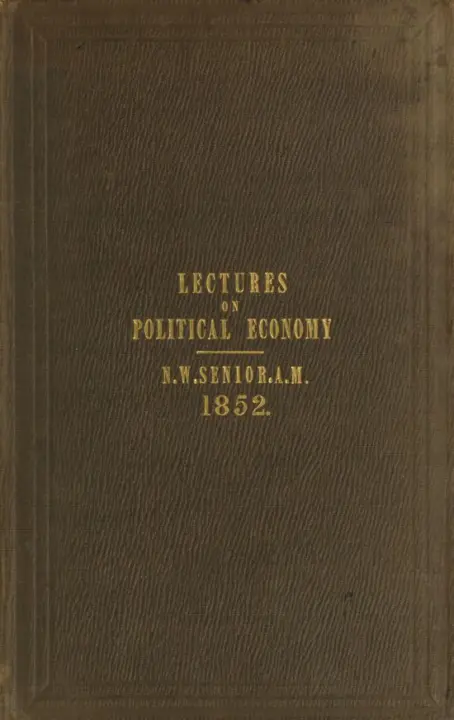
Four Introductory Lectures on Political Economy
Nassau William Senior
THE CLASSIC COLLECTION · 1835
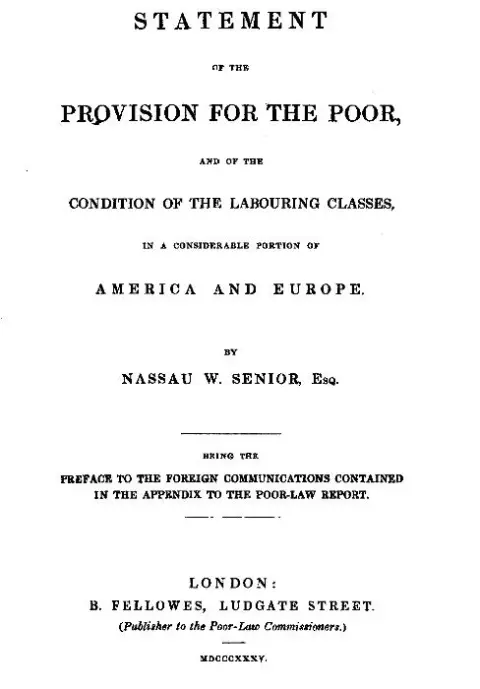
"Statement of the Provision for the Poor, and of the Condition of the Labouring Classes" by Nassau W. Senior is a historical account written in the early 19th century. This work serves as an introduction to a larger compilation of foreign communications regarding the systems of welfare and relief for the poor across various regions in America and Europe. The book aims to provide a comprehensive analysis of the laws and practices addressing poverty during that era, highlighting both successes and challenges within these systems. The opening of the text outlines the purpose behind the document, which is to inform the public and policymakers about the state of provisions for the poor across several geographic areas. It describes how commissioners under the British government sought to gather extensive information on poor laws, extending their inquiry beyond England and Wales to include insights from various nations, aided by diplomats and other authorities abroad. As they begin detailing the diverse methods of support for the impoverished, the text hints at a comparative analysis of the systems employed, illustrating the variances in approaches and outcomes regarding the welfare of working-class populations in different societal contexts.
Introduction adapted from the source catalogue; source summaries may be automatically generated.
Free to read · English · 77,778 words · No account needed
MAKE TIME FOR A GOOD BOOK
On by default. Untick to stop anonymous reading totals. Each page counts after 10 seconds in view. How this works.
Anonymous counting is on unless you have switched it off.
It is also not to be doubted, that a large proportion of this excess of State’s poor, more or less assisted during the year, consist of those who are called in the statements herewith presented, “wandering or travelling poor.” The single fact of the existence among us of this class of fellow-beings, especially considered in connexion with the facts, that nearly all of them are State’s poor, and that, to a great extent, they have been made what they are by the State’s provision for them, brings the subject before us in a bearing, in which we scarcely know whether the call is loudest to the pity we should feel for them, or the self-reproach with which we should recur to the measures we have sanctioned, and which have alike enlarged their numbers and their misery. Nor is it a matter of mere inference from our tables, that the number is very large of these wandering poor. To a considerable extent, and it is now regretted that it was not to a greater extent, the inquiry was proposed to overseers of the poor, “How many of the wandering, or travelling poor, annually pass under your notice?” And the answers, as will appear in the statements, were from 10 to 50, and 100 to 200. Nor is there a more abject class of our fellow-beings to be found in our country than is this class of the poor. Almshouses, where they are to be found, are their inns, at which they stop for refreshment. Here they find rest, when too much worn with fatigue to travel, and medical aid when they are sick. And, as they choose not to labour, they leave these stopping places, when they have regained strength to enable them to travel, and pass from town to town, demanding their portion of the State’s allowance for them as their right. And from place to place they receive a portion of this allowance, as the easiest mode of getting rid of them, and they talk of the allowance as their “rations;” and, when lodged for a time, from the necessity of the case, with town’s poor, it is their boast that they, by the State’s allowance for them, support the town’s inmates of the house. These unhappy fellow-beings often travel with females, sometimes, but not always their wives; while yet, in the towns in which they take up their temporary abode, they are almost always recognized and treated as sustaining this relation. There are exceptions, but they are few, of almshouses in which they are not permitted to live together. In winter they seek the towns in which they hope for the best accommodations and the best living, and where the smallest return will be required for what they receive. It is painful thus to speak of these human beings, lest, in bringing their degradation distinctly before the mind, we should even for a moment check the commiseration which is so strongly claimed for them. We feel bound therefore to say, that bad as they are, they are scarcely less sinned against in the treatment they receive, than they commit sin in the lawlessness of their lives. Everywhere viewed, and feeling themselves to be outcasts; possessed of nothing, except the miserable clothing which barely covers them; accustomed to beggary, and wholly dependent upon it; with no local attachments, except those which grow out of the facilities which in some places they may find for a more unrestrained indulgence than in others; with no friendships, and neither feeling nor awakening sympathy; is it surprising that they are debased and shameless, alternately insolent and servile, importunate for the means of subsistence and self-gratification, and averse from every means but that of begging to obtain them? The peculiar attraction of these unhappy fellow beings to our Commonwealth, and their preference for it over the States to the south of us, we believe is to be found in the legal provision which the State has made for them. Your Commissioners have indeed but a small amount of direct evidence of this; but the testimony of the chairman of the overseers in Egrement to this fact, derived from personal knowledge, was most unequivocal, and no doubt upon the subject existed in the minds of the overseers in many other towns. But shall we therefore condemn, or even severely blame, them? Considered and treated, in almost every place, as interlopers, strollers, vagrants; as objects of suspicion and dread, and, too often, scarcely as human beings; the cheapest methods are adopted of sending them from town to town, and often with the assurance given to them that there, and not here, are accommodations for them, and that there they may enjoy the bounty which the State has provided for them. Would such a state of things, your Commissioners ask, have existed in our Commonwealth, if a specific legal provision had not been made for this class of the poor? Or, we do not hesitate to ask, if the Government had never recognized such a class of the poor as that of State’s poor,--and, above all, if compulsory charity, in any form, had never been established by our laws, would there have been a twentieth part of the wandering poor which now exists in it, or by any means an equal proportion of poor of any kind with that which is now dependent upon the taxes which are raised for them? Your Commissioners think not.
Your reading position is saved on this browser. Take it to another device with a library code. Reading pages adapt to text, rather than matching a printed edition.
Nassau William Senior
BEHIND THE BOOK
This eBook is for the use of anyone anywhere in the United States and most other parts of the world at no cost and with almost no restrictions whatsoever. You may copy it, give it away or re-use it under the terms of the Project Gutenberg License included with this eBook or online at www.gutenberg.org. If you are not located in the United States, you will have to check the laws of the country where you are located before using this eBook. Read the source licence.
The original source file, including credits and licence, is retained by this library. Request an original-format copy at no charge. Please include the book title and Project Gutenberg identifier #53316.
KEEP YOUR CURIOSITY GOING
Cécile Tormay

Moritz Busch
John L. Ransom
Frances Wright
Cécile Tormay

Mabel Potter Daggett