Four Introductory Lectures on Political Economy
Nassau William Senior
THE CLASSIC COLLECTION · 1835
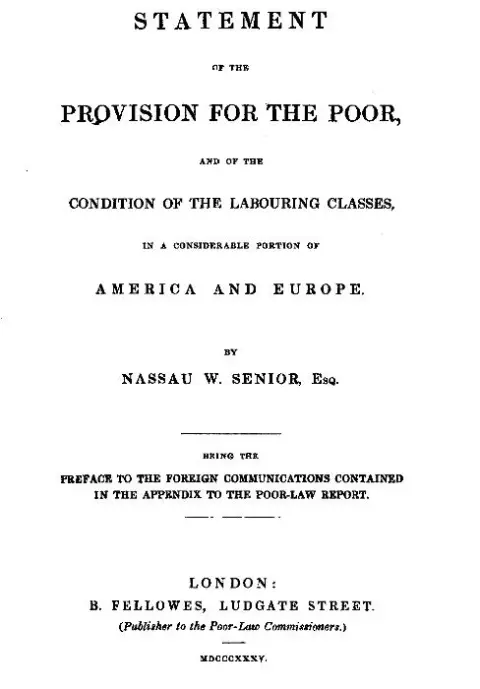
"Statement of the Provision for the Poor, and of the Condition of the Labouring Classes" by Nassau W. Senior is a historical account written in the early 19th century. This work serves as an introduction to a larger compilation of foreign communications regarding the systems of welfare and relief for the poor across various regions in America and Europe. The book aims to provide a comprehensive analysis of the laws and practices addressing poverty during that era, highlighting both successes and challenges within these systems. The opening of the text outlines the purpose behind the document, which is to inform the public and policymakers about the state of provisions for the poor across several geographic areas. It describes how commissioners under the British government sought to gather extensive information on poor laws, extending their inquiry beyond England and Wales to include insights from various nations, aided by diplomats and other authorities abroad. As they begin detailing the diverse methods of support for the impoverished, the text hints at a comparative analysis of the systems employed, illustrating the variances in approaches and outcomes regarding the welfare of working-class populations in different societal contexts.
Introduction adapted from the source catalogue; source summaries may be automatically generated.
Free to read · English · 77,778 words · No account needed
MAKE TIME FOR A GOOD BOOK
On by default. Untick to stop anonymous reading totals. Each page counts after 10 seconds in view. How this works.
Anonymous counting is on unless you have switched it off.
All indigent families, and in which there are those capable of working, but who are not able to obtain it, or whose numbers are so great that all cannot be subsisted, are relieved by the Bureaux de Charité.
The same relief is given to those who, having a habitation,
are unable of themselves, through age or infirmity, to support
themselves.
The mode of obtaining this relief is by petition, signed by some credible person, and attested by the priest or protestant clergyman. It is proportioned to the number of the family, and to the number of those able to work, and whose wages go to the maintenance of the family. The relief consists in bread, soup, wood for fuel, and sometimes, though rarely, blankets and woollen clothing; medicines for the sick, and broth.
Generally speaking, these distributions of food would be insufficient; but most indigent families are assisted by private persons, so that, on the whole, they have wherewithal to sustain life.
The annual distribution à domicile (domiciliary relief) amounts to the sum of 100,000 francs (4,000l.).
3,520 families are relieved. The number of impotent in these families, father and mother included, though able to work, amounts to 9,634, or less than a franc per head per month.
It is in proportion to these numbers that the relief is given, but it is greater in winter than the other parts of the year.
As to the medicines and broth, whenever there are sick in these families a sufficiency is given. Physicians are attached to each auxiliary bureau of every district, who visit the sick, prescribe the remedies, &c., all of which are distributed by the Sœurs de Charité (Sisters of Charity, an order of nuns who devote themselves to the care of the poor and sick, and who undertake, gratuitously, the elementary education of their children). It is a most respectable and praiseworthy institution.
The same Sisters receive in their houses the little girls of these families who are old enough to read. Books are supplied by the instructors.
In extraordinary cases, recourse is had to subscriptions and collections, which increase the means of the Bureaux de Charité; so that during long and hard winters, more clothing, &c. is distributed. It seldom happens that money is given.
There are, however, no positive regulations on these points. The whole is in the hands of the directors of this establishment. A responsible receiver is attached to it, whose accounts are submitted to the examination of the Cours des Comptes (audit office). Thus, though the distributions are left to the judgment of the directors, they are subjected to control.
Your reading position is saved on this browser. Take it to another device with a library code. Reading pages adapt to text, rather than matching a printed edition.
Nassau William Senior
BEHIND THE BOOK
This eBook is for the use of anyone anywhere in the United States and most other parts of the world at no cost and with almost no restrictions whatsoever. You may copy it, give it away or re-use it under the terms of the Project Gutenberg License included with this eBook or online at www.gutenberg.org. If you are not located in the United States, you will have to check the laws of the country where you are located before using this eBook. Read the source licence.
The original source file, including credits and licence, is retained by this library. Request an original-format copy at no charge. Please include the book title and Project Gutenberg identifier #53316.
KEEP YOUR CURIOSITY GOING
Cécile Tormay

Moritz Busch
John L. Ransom
Frances Wright
Cécile Tormay

Mabel Potter Daggett