THE CLASSIC COLLECTION✦The Story of Francis CluddeCLASSIC FREE BOOKS
The Story of Francis Cludde
Stanley John Weyman
THE CLASSIC COLLECTION · 1904
"Starvecrow Farm" by Stanley John Weyman is a novel written in the early 20th century. The story unfolds around Henrietta, a young woman who has eloped with her lover, Stewart, and is evading pursuit while on their way to a new life. However, their journey becomes fraught with unexpected dangers and revelations that challenge Henrietta’s romantic ideals and ultimately threaten her happiness. The beginning of the novel introduces us to Henrietta and Stewart traveling in a postchaise as they navigate through the perilous quicksands on the Lancashire coast. Their interactions reveal a mix of youthful excitement and underlying tension as Henrietta grapples with the weight of their choices and the uncertainty of their future together. As they approach the inn where they plan to stay, hints of danger loom, not just from possible pursuers but also from secrets that Stewart harbors. This sets the stage for a story filled with romance, conflict, and social commentary against the backdrop of early 19th-century England, leaving readers eager to discover how Henrietta's adventure unfolds and what challenges she will face.
Introduction adapted from the source catalogue; source summaries may be automatically generated.
Free to read · English · 122,157 words · No account needed
MAKE TIME FOR A GOOD BOOK
On by default. Untick to stop anonymous reading totals. Each page counts after 10 seconds in view. How this works.
Anonymous counting is on unless you have switched it off.
“Ay!” the doctor answered. “It is. That’s money, my lad!”
“Ay!”
The old man hugged himself, and rocked to and fro in an ecstasy.
“That’s money! And four pound a month,” he consulted the stick he was notching, “is forty-eight pound a year?”
“And four to it,” Tyson answered. “Who’s paying you that?”
“Na, na!”
“And what’s it to do with the dog?”
Hinkson looked knavish but frightened.
“Hist!” he said. “Here’s Bess. I’d use to wallop her, but now——”
“She wallops you,” the visitor muttered. “That’s the ticket, I expect.”
The girl entered by the mean staircase door and nodded to him coolly.
“I supposed it was you,” she said slightingly.
And for the hundredth or two-hundredth time he felt with rage that he was in the presence of a stronger nature than his own. He could treat the old man, whose greed had survived his other passions, and almost his faculties, pretty much as he pleased. But though he had sauntered through the gate a score of times with the intention of treating Bess as he had treated more than one village girl who pleased him, he had never re-crossed the threshold without a sense not only of defeat, but of inferiority. He came to strut, he remained to kneel.
He fought against that feeling now, calling his temper to his aid.
“What folly is this about the dog?” he asked.
“Father thinks,” she replied demurely, “that if thieves come it can be heard better at the gate.”
“Heard? I should think it could be heard in Bowness!”
“Just so.”
“But your father——”
“Father!” sharply, “go to bed!” And then to the visitor, “Give him a ha’penny,” she muttered. “He won’t go without!”
“But I don’t care——”
“I don’t care either—which of you goes!” she retorted. “But one of you
goes.”
Sullenly he produced a copper and put it in the old man’s quivering hand—not for the first time by several. Hinkson gripped it, and closing his hand upon it as if he feared it would be taken from him, he hobbled away, and disappeared behind the dingy hangings of the box-bed.
“And now what’s the mystery?” Tyson asked, seating himself on one of
the stools.
“There is none,” she answered, standing before him where the firelight fell on her dark face and gipsy beauty. “Call it a whim if you like. Perhaps I don’t want my lads to come in till I’ve raddled my cheeks! Or perhaps”—flippantly—“Oh, any ‘perhaps’ you like!”
“I know no lad you have but me,” he said.
Your reading position is saved on this browser. Take it to another device with a library code. Reading pages adapt to text, rather than matching a printed edition.
Stanley John Weyman
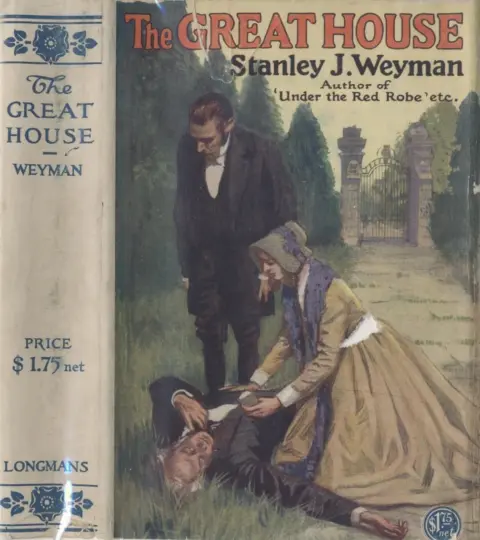
Stanley John Weyman
Stanley John Weyman
Stanley John Weyman
BEHIND THE BOOK
This eBook is for the use of anyone anywhere in the United States and most other parts of the world at no cost and with almost no restrictions whatsoever. You may copy it, give it away or re-use it under the terms of the Project Gutenberg License included with this eBook or online at www.gutenberg.org. If you are not located in the United States, you will have to check the laws of the country where you are located before using this eBook. Read the source licence.
The original source file, including credits and licence, is retained by this library. Request an original-format copy at no charge. Please include the book title and Project Gutenberg identifier #39138.
KEEP YOUR CURIOSITY GOING
Coulson Kernahan

Maurice Baring
Frances Wright
Cécile Tormay

Frederic Jesup Stimson

W. H. P. (William Henry Pope) Jarvis