THE CLASSIC COLLECTION✦An outlaw’s diary: the CommuneCLASSIC FREE BOOKS
An outlaw’s diary: the Commune
Cécile Tormay
THE CLASSIC COLLECTION · 1882
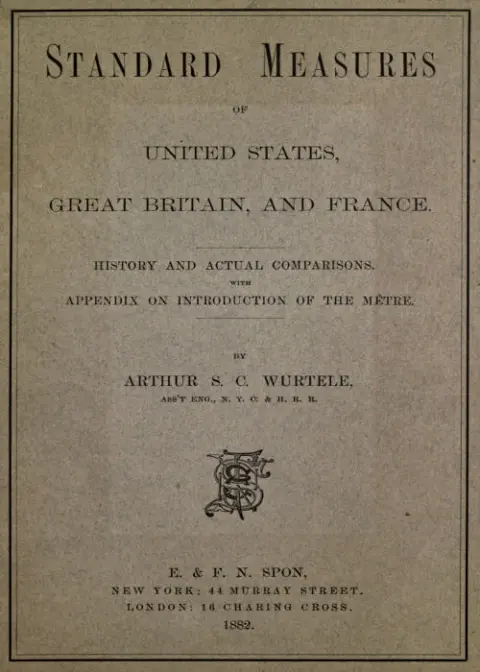
"Standard Measures of United States, Great Britain and France" by Arthur S. C. Wurtele is a scientific publication written in the early 1880s. The book explores the various systems of measurement used in the U.S., Great Britain, and France, focusing on the historical evolution and practical comparisons of standard units of length. In his work, Wurtele delves into the complexities and inconsistencies associated with measurements such as yards, meters, and toises. He provides a thorough historical account of how standards were established and refined over time in each country. Through extensive comparisons, Wurtele highlights the discrepancies between different standards while emphasizing the importance of context, such as material composition and temperature, in achieving measurement accuracy. The book concludes with a critical assessment of the practicalities of adopting the metric system in the U.S., arguing for the value of existing standards in everyday life and commerce.
Introduction adapted from the source catalogue; source summaries may be automatically generated.
Free to read · English · 4,897 words · No account needed
MAKE TIME FOR A GOOD BOOK
On by default. Untick to stop anonymous reading totals. Each page counts after 10 seconds in view. How this works.
Anonymous counting is on unless you have switched it off.
From the mean of his comparisons between the United States brass Troughton standard yard and the authentic French standard mètres used by the Coast Survey, Hassler, in 1832, deduced the value of the mètre at 39·3809172 inches, at 32° F., and by correction for expansion to United States standard temperature of 62° F., he made the mètre at 32° equal to 39·36850154 inches at 62° F.
The British imperial standard and the United States Troughton standard differ by only 0·000762 inch, which applied to the English reduction of 39·37079, would give 39·36996 as the relative value according to Troughton standard.
The difference between these reductions is probably to be attributed to the use of different rates of expansion, in correcting for standard temperatures, which vary considerably, according to high authority as follows for brass at 1° F.
Whitworth, 1876 0·00000956 = 0·00034416 in. per yard. Borda, 1799 0·000009913 = 0·00035687 “ Smeaton, 1750 0·000010417 = 0·00037501 “ Hassler 0·000010508 = 0·0003783 “ Ramsden, 1760 0·000010516 = 0·0003786 “ Faraday, 1830 0·00001059 = 0·00038124 “
And for the bronze of which the British imperial standards are made:
Airy and Sheepshanks 0·0000095 = 0·000342 in. per yard. Fizeau 0·00000975 = 0·000351 “
The correction at Ramsden’s rate is nearly identical with Hassler’s, and gives 39·3684933; at Whitworth’s rate it would give 39·36962, very nearly the same as deduced from the difference between the British Imperial standard and the United States Troughton standard. The results of Sir Joseph Whitworth were obtained by use of all late improvements for scientific precision, and they must be accepted as most reliable.
It would appear preferable to give comparisons at the same temperature in connection with the corrected result, so that international comparisons of scientific measurements may not be vitiated by accidental variations.
When the mètre standard was established in France, 1799, it was compared with Sir George Schuckburg’s standard yard by Captain Kater. The quadrant of 10,000,000 mètres, or 5,130,740 toises, was determined to be 32,808,992 English feet, giving the mètre equal to 3·2808992 English feet, or 39·37079 inches, and the toise equal to 6·3945925921 English feet.
In 1814 Wollaston and Playfair, by comparison with the platinum mètre standard at 55° F., deduced the mètre as equal to 39·3828 English inches.
During the geodetic operations of General Roy in 1802, who used 60° F. as standard temperature, Pictet’s comparisons, using means capable of measuring the 10,000th part of an inch, gave the mètre standard, which is used at 32° F. as standard temperature, at 39·3828 English inches; this corrected for temperature by Dr. Young, gave 39·371 English inches at 62° F.; which result was confirmed by Bird, Maskelyne and Laudale.
In 1823, by Act of Parliament on report of committee, the mètre is fixed as 39·37079 English inches.
In 1800 the Royal Society, by comparison with two toise standards sent by Lalande to Maskelyne, deduced the mètre as 39·3702 English inches.
Your reading position is saved on this browser. Take it to another device with a library code. Reading pages adapt to text, rather than matching a printed edition.
BEHIND THE BOOK
This eBook is for the use of anyone anywhere in the United States and most other parts of the world at no cost and with almost no restrictions whatsoever. You may copy it, give it away or re-use it under the terms of the Project Gutenberg License included with this eBook or online at www.gutenberg.org. If you are not located in the United States, you will have to check the laws of the country where you are located before using this eBook. Read the source licence.
The original source file, including credits and licence, is retained by this library. Request an original-format copy at no charge. Please include the book title and Project Gutenberg identifier #54208.
KEEP YOUR CURIOSITY GOING
Cécile Tormay

Moritz Busch
John L. Ransom
Frances Wright
Cécile Tormay

Mabel Potter Daggett