THE CLASSIC COLLECTION✦The Double Search: Studies in Atonement and PrayerCLASSIC FREE BOOKS
The Double Search: Studies in Atonement and Prayer
Rufus M. (Rufus Matthew) Jones
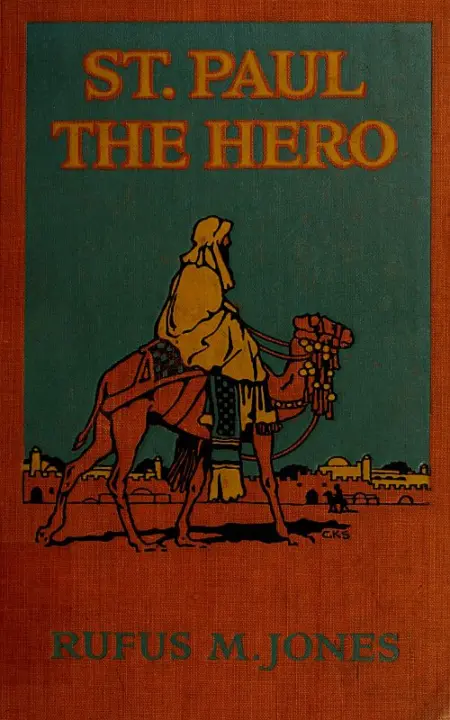
THE CLASSIC COLLECTION · 1917
"St. Paul the Hero" by Rufus M. Jones is a historical account written in the early 20th century. The book explores the life and journey of the Apostle Paul, detailing his early years, education, and transformation from a persecutor of Christians to one of the most influential figures in early Christianity. Through the narrative, readers get to know key moments from Paul's life, his struggles, triumphs, and the significant relationships he formed along the way. At the start of the narrative, we meet a young Saul, a curious and thoughtful boy from Tarsus, who learns about his Jewish heritage and the law from his father. As he grows, Saul imagines himself as one of the great heroes of his faith. He is eventually taken to Jerusalem to study under the renowned Rabbi Gamaliel, where his thirst for knowledge flourishes. Soon, news of a revolutionary teacher from Galilee reaches Saul, which stirs both confusion and contempt within him. This internal conflict intensifies when he witnesses the execution of Stephen, a follower of the Teacher, and later embarks on a mission to persecute Christians. However, a pivotal encounter on the road to Damascus alters the course of his life forever, setting him on the path to become Paul, the apostle who would spread the message of Christianity far and wide.
Introduction adapted from the source catalogue; source summaries may be automatically generated.
Free to read · English · 29,906 words · No account needed
MAKE TIME FOR A GOOD BOOK
On by default. Untick to stop anonymous reading totals. Each page counts after 10 seconds in view. How this works.
Anonymous counting is on unless you have switched it off.
He told these unseen friends of his in the far-away city how to live the new way day by day in the difficult world. He told them not to overcome evil by doing evil in return but to overcome it by being good and by doing good. He told them not to worry, or fret, or be disturbed, when things were hard and difficult, but to keep calm and steady and full of faith in the love of God, and when they had done the best they could, to leave it all with God. They were, as far as possible, to live in peace and love with all kinds of people and no matter what others did to them, they were to go right on loving them and doing good to them.
When he had sent off his great epistle, and had done all that he could to strengthen the church in Corinth and had received a large collection for Jerusalem and had gathered his friends around him, Paul said farewell to Corinth and started on his return journey, accompanied by a number of companions. He went back through Macedonia—Berœa, Thessalonica, Philippi—and then across the Ægean to Troas where he had first heard the call to go to Europe. There must have been a church there on “the plains of windy Troy,” for Paul remained seven days and held meetings far into the night, but we do not know very much about this church by the Simois River—only that one of the young men there went to sleep while the meeting was going on and fell out of a window in the third story to the ground! Here at Troas Paul found again his old friend, the writer of the Diary—“the We Narrative”—who joined the party for the journey to Jerusalem. They went part of the way by land and part of the way by sea, stopping at Assos and Mitylene, touching at the famous island of Samos, and disembarking at Miletus. Here at Miletus, the leaders of the church at Ephesus came down to see the man whom they had learned to love, to hear his message and to say farewell to him. It was probably not safe for Paul to go to Ephesus with its beasts. There were too many dangers there for him. After all his years of work and his perils in that city it was a joy to see the men and women with whom he had lived and laboured and to have one more chance to speak to them about the highest things in life. It was a very solemn time as they gathered on the seashore and Paul told them of the troubles and dangers that lay before them and before him. He then told them that they would never see each other again. They loved him as though he had been a father to each one and they all wept as he left them to go into the ship to sail for Syria. As they went on their way Paul realised, from what he heard at every port where the ship stopped, that it would be very dangerous for him in Jerusalem. He had not been in the Holy City since the great conference there with Peter and James and John. Since that time tremendous things had happened across the world. Paul had succeeded, but the more he succeeded the more the Jews hated him. They had made trouble for him in every city. They had come to regard him as a traitor and as the enemy of their race and they were eager to get rid of him forever. He knew how they felt. He saw the danger ahead. He understood that if he went to Jerusalem it would be like going into the lion’s mouth. But he was determined to go, danger or no danger, for Paul was a hero. He had a great gift to carry up to the poor and needy Christians in Jerusalem and he must have thought that he could win them over and make them see his truth at last. He believed that this was the greatest opportunity of his life. Perhaps now, after all the wonderful work around the Ægean Sea he might be able to make his own people see the truth that had meant so much to the Greeks and to the Galatians. Perhaps now he could join both branches together—those who were Jewish Christians and those who were Gentile-Christians—and have one great world church with no division in it. It was worth trying anyhow. It was worth any kind of risk. The great gift would soften their hearts and he would plead with them, and then it would be done! When prophets on the way told Paul how dangerous the risk was, he said to them: “Do not talk to me of danger. Do not try to change my course. I am ready, not only to be bound in Jerusalem, but if necessary to die there for this cause”—and on he went, like the hero he was.
Your reading position is saved on this browser. Take it to another device with a library code. Reading pages adapt to text, rather than matching a printed edition.
Rufus M. (Rufus Matthew) Jones
Rufus M. (Rufus Matthew) Jones
Rufus M. (Rufus Matthew) Jones

Rufus M. (Rufus Matthew) Jones
BEHIND THE BOOK
This eBook is for the use of anyone anywhere in the United States and most other parts of the world at no cost and with almost no restrictions whatsoever. You may copy it, give it away or re-use it under the terms of the Project Gutenberg License included with this eBook or online at www.gutenberg.org. If you are not located in the United States, you will have to check the laws of the country where you are located before using this eBook. Read the source licence.
The original source file, including credits and licence, is retained by this library. Request an original-format copy at no charge. Please include the book title and Project Gutenberg identifier #52694.
KEEP YOUR CURIOSITY GOING
Cécile Tormay

Moritz Busch
John L. Ransom
Frances Wright
Cécile Tormay

Mabel Potter Daggett