THE CLASSIC COLLECTION✦An outlaw’s diary: the CommuneCLASSIC FREE BOOKS
An outlaw’s diary: the Commune
Cécile Tormay
THE CLASSIC COLLECTION · 1917
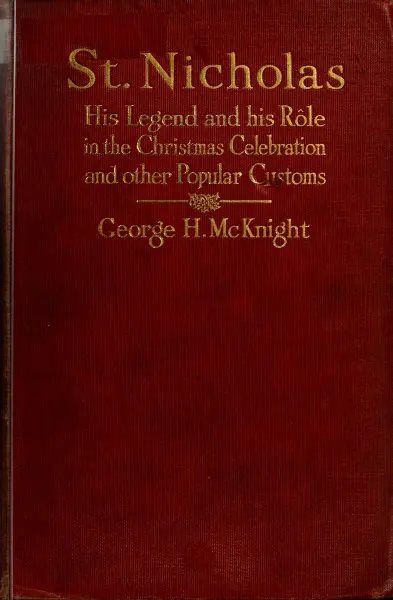
"St. Nicholas" by George H. McKnight is a historical account written in the early 20th century. The book explores the life and legacy of St. Nicholas, the bishop whose story has laid the foundation for many popular customs and the figure of Santa Claus. McKnight aims to illuminate the amiable nature of St. Nicholas and how his acts of generosity have influenced cultural celebrations and traditions related to Christmas. The opening of "St. Nicholas" introduces the author's personal journey into understanding the influence and significance of St. Nicholas, igniting a respect and affection for the figure. McKnight begins by reflecting on how St. Nicholas is celebrated in various cultures, particularly in Belgium and the Netherlands, where his festival on December 6th serves as a children’s celebration rich with gift-giving traditions that contrast with the Christmas festivities in many other regions. The text indicates a shift in focus from the saint's historical roots to his impact on Christmas customs, emphasizing the dichotomy between secular and religious celebrations throughout history.
Introduction adapted from the source catalogue; source summaries may be automatically generated.
Free to read · English · 33,399 words · No account needed
MAKE TIME FOR A GOOD BOOK
On by default. Untick to stop anonymous reading totals. Each page counts after 10 seconds in view. How this works.
Anonymous counting is on unless you have switched it off.
Praise be to Apollo who rules all, and thanks to you who have made so many countries subject and tributary.
And then, addressing the boy:
Good boy, tell us, what is thy land, what thy race; what is the faith of the people of thy country; are they gentile or Christian?
The boy:
My father, Getro by name, is prince of the people of Excoranda; he worships God, who rules the seas, who made us and thee and all things.
The king:
My god, Apollo, is the god that made me. He is true and good. He
rules the land, he reigns in the air; him alone we ought to believe
in.
The boy:
Thy god is false and evil; he is stupid, blind, deaf, and mute. Thou shouldst not worship such a god, who cannot rule even himself.
The king:
Say not such things; do not offend my god; for if thou dost make him angry, thou canst not in any way escape.
In the meantime, the directions tell us, Euphrosina shall discover that her son has been forgotten and shall return to the church. And when she shall not find the boy, she shall sing the following Miserere:
“Heu! heu! heu mihi miseræ!
Quid nunc agam? Quid quæm dicere?
Quo peccato merui perdere
natum meum, et ultra vivere?
Cur me pater infelix genuit?
Cur me mater infelix abluit?
Cur me nutrix lactare debuit?
Mortem mihi quare non præbuit?”
The consolers shall come to her and say:
In what way does this grieving aid? Cease to weep, and pray for thy son to the highest Father, and he will give him aid.
Euphrosina, not heeding the words of consolation, shall continue:
Dear son, most beloved child; child, the great part of my soul; now thou art to us the cause of sadness who wert the cause of joy.
Comforters:
Do not despair of the grace of God. He whose great mercy gave thee this boy, will return to thee either him or another.
Euphrosina:
My soul is disturbed within me. Why should death delay? When I am not able to see thee, my son, I prefer to die rather than to live.
Comforters:
Struggle, grief, and despair injure thee and do not profit thy son; instead, from thy wealth give to schoolboys and to the poor. Ask the kindness of Nicholas that he may pray for the mercy of the Father on high for thy son, that thy prayer may not fail.
Euphrosina (praying to St. Nicholas):
Your reading position is saved on this browser. Take it to another device with a library code. Reading pages adapt to text, rather than matching a printed edition.
BEHIND THE BOOK
This eBook is for the use of anyone anywhere in the United States and most other parts of the world at no cost and with almost no restrictions whatsoever. You may copy it, give it away or re-use it under the terms of the Project Gutenberg License included with this eBook or online at www.gutenberg.org. If you are not located in the United States, you will have to check the laws of the country where you are located before using this eBook. Read the source licence.
The original source file, including credits and licence, is retained by this library. Request an original-format copy at no charge. Please include the book title and Project Gutenberg identifier #42969.
KEEP YOUR CURIOSITY GOING
Cécile Tormay

Moritz Busch
John L. Ransom
Frances Wright
Cécile Tormay

Mabel Potter Daggett