THE CLASSIC COLLECTION✦An outlaw’s diary: the CommuneCLASSIC FREE BOOKS
An outlaw’s diary: the Commune
Cécile Tormay
THE CLASSIC COLLECTION · 1917
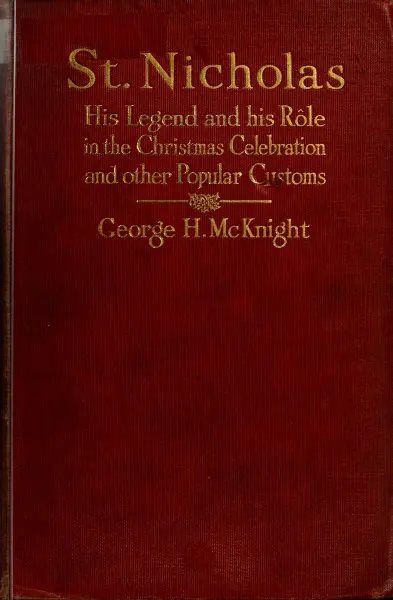
"St. Nicholas" by George H. McKnight is a historical account written in the early 20th century. The book explores the life and legacy of St. Nicholas, the bishop whose story has laid the foundation for many popular customs and the figure of Santa Claus. McKnight aims to illuminate the amiable nature of St. Nicholas and how his acts of generosity have influenced cultural celebrations and traditions related to Christmas. The opening of "St. Nicholas" introduces the author's personal journey into understanding the influence and significance of St. Nicholas, igniting a respect and affection for the figure. McKnight begins by reflecting on how St. Nicholas is celebrated in various cultures, particularly in Belgium and the Netherlands, where his festival on December 6th serves as a children’s celebration rich with gift-giving traditions that contrast with the Christmas festivities in many other regions. The text indicates a shift in focus from the saint's historical roots to his impact on Christmas customs, emphasizing the dichotomy between secular and religious celebrations throughout history.
Introduction adapted from the source catalogue; source summaries may be automatically generated.
Free to read · English · 33,399 words · No account needed
MAKE TIME FOR A GOOD BOOK
On by default. Untick to stop anonymous reading totals. Each page counts after 10 seconds in view. How this works.
Anonymous counting is on unless you have switched it off.
It was so on a time that all the province of S. Nicolas suffered great famine, in such wise that victual failed. And then this holy man heard say that certain ships laden with wheat were arrived in the haven. And anon he went thither and prayed the mariners that they would succor the perished at least with an hundred muyes of wheat of every ship. And they said: Father, we dare not, for it is meted and measured, and we must give reckoning thereof in the garners of the emperor in Alexandria. And the holy man said to them: Do this that I have said to you, and I promise, in the truth of God, that it shall not be lessened or minished when ye shall come to the garners. And when they had delivered so much out of every ship, they came into Alexandria and delivered the measure that they had received. And then they recounted the miracle to the ministers of the emperor, and worshiped and praised strongly God and his servant Nicholas. Then the holy man distributed the wheat to every man after that he had need, in such wise that it sufficed for two years, not only for to sell, but also to sow.
The art of the early Italian painters in handling narrative subjects is once more admirably illustrated in the animated presentation of this story in the paintings by Lorenzetti and by Fra Angelico.
In another of the stories included in the Golden Legend, St. Nicholas twice appears in his favorite rôle as the protector of human life. The story, with double catastrophe, goes as follows:
And in this time certain men rebelled against the emperor; and the emperor sent against them three princes, Nepotian, Ursyn, and Apollyn. And they came into the port Adriatic for the wind, which was contrary to them; and the blessed Nicholas commanded them to dine with him, for he would keep his people from the ravin that they made. And whilst they were at dinner, the consul, corrupt by money, had commanded three innocent knights to be beheaded. And when the blessed Nicholas knew this, he prayed these three princes that they would much hastily go with him. And when they were come where they should be beheaded, he found them on their knees, and blindfold, and the righter brandished his sword over their heads. Then S. Nicholas, embraced with the love of God, set him hardily against the righter, and took the sword out of his hand, and threw it from him, and unbound the innocents, and led them with him all safe. And anon he went to the judgment to the consul, and found the gates closed, which anon he opened by force. And the consul came anon and saluted him: and this holy man having this salutation in despite, said to him: Thou enemy of God, corrupter of the law, wherefore hast thou consented to so great evil and felony, how darest thou look on us? And when he had sore chidden and reproved him, he repented, and at the prayer of the three princes he received him to penance. After, when the messengers of the emperor had received his benediction, they made their gear ready and departed, and subdued their enemies to the empire without shedding blood, and sith returned to the emperor, and were worshipfully received. And after this it happed that some other in the emperor’s house had envy on the weal of these three princes, and accused them to the emperor of high treason, and did so much by prayer and by gifts that they caused the emperor to be so full of ire that he commanded them to prison, and without other demand, he commanded that they should be slain that same night. And when they knew it by their keeper, they rent their clothes and wept bitterly; and then Nepotian remembered him how S. Nicholas had delivered the three innocents, and admonested the others that they should require his aid and help. And thus as they prayed S. Nicholas appeared to them and after appeared to Constantine, the emperor, and said to him: Wherefore hast thou taken these three princes with so great wrong, and hast judged them to death without trespass? Arise up hastily, and command that they be not executed, or I shall pray to God that he move battle against thee, in which thou shalt be overthrown, and shalt be made meat to beasts. And the emperor demanded: What art thou that art entered by night into my palace and durst say to me such words? And he said to him: I am Nicholas, bishop of Mirea. And in like wise he appeared to the provost, and feared him, saying with a fearful voice: Thou that hast lost mind and wit, wherefore hast thou consented to the death of innocents? Go forth anon and do thy part to deliver them, or else thy body shall rot, and be eaten with worms, and thy meiny shall be destroyed. And he asked him: Who art thou that so menacest me? And he answered: Know thou that I am Nicholas, the bishop of the city of Mirea. Then that one awoke that other, and each told to other their dreams, and anon sent for them that were in prison, to whom the emperor said: What art magic or sorcery can ye, that ye have this night by illusion caused us to have such dreams? And they said that they were none enchanters ne knew no witchcraft, and also that they had not deserved the sentence of death. Then the emperor said to them: Know ye well a man named Nicholas? And when they heard speak of the name of the holy saint, they held up their hands toward heaven, and prayed our Lord that by the merits of S. Nicholas they might be delivered of this present peril. And when the emperor had heard of them the life and miracles of S. Nicholas, he said to them: Go ye forth, and yield ye thankings to God, which hath delivered you by the prayer of this holy man, and worship ye him; and bear ye to him of your jewels, and pray ye him that he threaten me no more, but that he pray for me and for my realm unto our Lord. And a while after, the said princes went unto the holy man, and fell down on their knees humbly at his feet, saying: Verily thou art the sergeant of God, and the very worshipper and lover of Jesu Christ. And when they had all told this said thing by order, he lift up his hands to heaven and gave thankings and praisings to God, and sent again the princes, well informed, into their countries.
Your reading position is saved on this browser. Take it to another device with a library code. Reading pages adapt to text, rather than matching a printed edition.
BEHIND THE BOOK
This eBook is for the use of anyone anywhere in the United States and most other parts of the world at no cost and with almost no restrictions whatsoever. You may copy it, give it away or re-use it under the terms of the Project Gutenberg License included with this eBook or online at www.gutenberg.org. If you are not located in the United States, you will have to check the laws of the country where you are located before using this eBook. Read the source licence.
The original source file, including credits and licence, is retained by this library. Request an original-format copy at no charge. Please include the book title and Project Gutenberg identifier #42969.
KEEP YOUR CURIOSITY GOING
Cécile Tormay

Moritz Busch
John L. Ransom
Frances Wright
Cécile Tormay

Mabel Potter Daggett