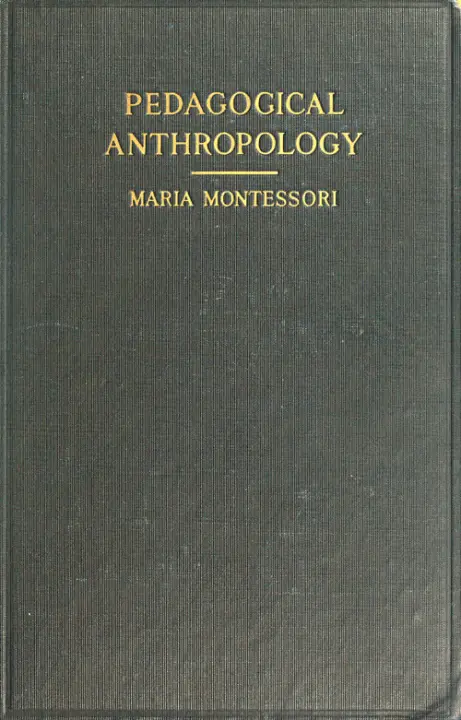
Pedagogical Anthropology
Maria Montessori
THE CLASSIC COLLECTION · 1917
"Spontaneous Activity in Education" by Maria Montessori is a scientific publication written in the early 20th century. The text delves into the principles of Montessori education focused on the need for children's freedom and the right environment to foster their natural development. It articulates the importance of allowing spontaneous engagement in learning as a means of nurturing the psychological and physical health of children. The opening portion of the work begins by examining the parallels between the physical and psychological needs of children. Montessori addresses contemporary objections to educational systems that emphasize the child's liberty, arguing that true freedom—spiritual as well as physical—encourages optimal growth. She discusses various societal misconceptions regarding child rearing and education, while emphasizing that education should not impose restrictions that hinder a child's natural development. Key points touch on the evolution of hygiene and care for infants, illustrating how societal practices have often neglected the spiritual and emotional sustenance required for holistic growth, thus establishing a framework for her educational philosophy based on freedom and respect for the child's innate capabilities.
Introduction adapted from the source catalogue; source summaries may be automatically generated.
Free to read · English · 105,225 words · No account needed
MAKE TIME FOR A GOOD BOOK
On by default. Untick to stop anonymous reading totals. Each page counts after 10 seconds in view. How this works.
Anonymous counting is on unless you have switched it off.
Volition.--Children, accustom yourselves to be pleasant to every one. You should be pleasant when you are conferring some favor, otherwise the favor will seem irksome. When you want something, do you ask for it arrogantly? If so, it will be easier to say no than yes to you. On the other hand, if you ask politely for something, will it not be difficult to refuse you?
It will perhaps be more interesting to follow a lesson actually given, and accepted as a model for teachers in general. I therefore reproduce one of the lessons which gained a prize at a competition of teachers held in Italy. [3] In this, according to the subject or theme, only one primary psychical activity was to be dealt with: viz. sensory perception. (The compositions were distinguished not by the names of the authors, but by mottoes.)
[Footnote 3: This was published in the review, La Voce delle Maestre
d'Asilo, Year viii.]
Motto.--Things are the first and best teachers.
I set myself the following limits:
To give an idea of icy cold in contrast to that of heat. [This would be amply sufficient in itself, for these ideas are not grains to pick up one after the other, but sublime psychical facts of great complexity, and, consequently, very difficult to assimilate.]
Combine with the idea to be imparted, the cultivation of a sense of compassion and pity for the very poor, to whom winter brings such severe suffering; a feeling I have already tried many times to arouse.
The above is for my own guidance; what follows is for the children.
"Children, how comfortable we are here! Everything is clean; everything is in order; I am so fond of you; you are so fond of me. Isn't this true, children?
Children.--I am, I am. Me too (correct).
Tell me, Gino, are you cold? You said no at once. Well, no, you are right; we are really very cozy here. There, in that corner (I point) there is a thing which gives out much ...
Children.--Heat. It is the stove.
But outside, where there is no stove, over there, towards the horizon (the children are to a certain extent familiar with this word), there is no warmth.
Children.--It's cold there (an answer due to the clarity of the laws
of contrast).
Last night ... while we were asleep, while your mother perhaps was mending your clothes ... dear mother, how kind she is!... well, last night, so many, many white flakes fell softly from the sky!...
Snow, snow! exclaim the children.
Children! let us say: so many snowflakes fell. How beautiful the snow is! Let us go and look at it closely.
Your reading position is saved on this browser. Take it to another device with a library code. Reading pages adapt to text, rather than matching a printed edition.
Maria Montessori
Maria Montessori
Maria Montessori
BEHIND THE BOOK
This eBook is for the use of anyone anywhere in the United States and most other parts of the world at no cost and with almost no restrictions whatsoever. You may copy it, give it away or re-use it under the terms of the Project Gutenberg License included with this eBook or online at www.gutenberg.org. If you are not located in the United States, you will have to check the laws of the country where you are located before using this eBook. Read the source licence.
The original source file, including credits and licence, is retained by this library. Request an original-format copy at no charge. Please include the book title and Project Gutenberg identifier #24727.
KEEP YOUR CURIOSITY GOING

Charles G. (Charles Griffith) Ross
Hannah Webster Foster

Emily Lawless
Edwin Hamlin Carr

Charles De Lano Hine
Andrew Ure