
Last letters from the living dead man
David Patterson (Spirit) Hatch
THE CLASSIC COLLECTION · 1898
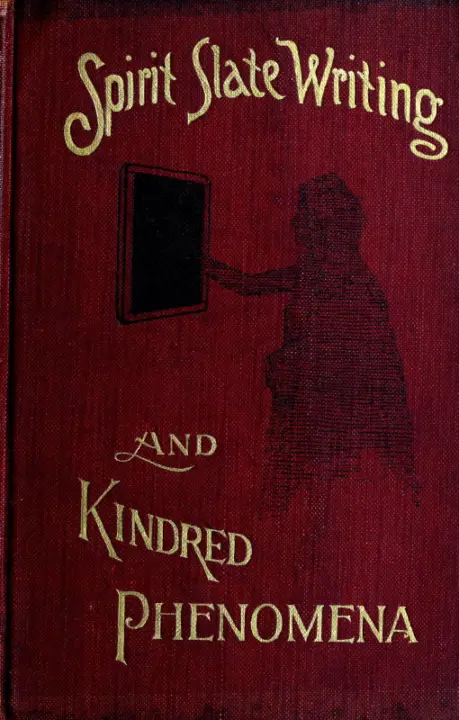
"Spirit Slate Writing and Kindred Phenomena" by William E. Robinson is a scientific publication written in the late 19th century. The work explores the various methods and tricks utilized by mediums in spiritualistic séances, particularly focusing on slate writing tests that are often misattributed to supernatural abilities. The author, who has a background in magic and illusion, aims to expose the fraudulent tactics employed by these mediums to deceive their audiences. The opening of the text presents the author's preface, where he shares his partial upbringing in beliefs surrounding spiritualism but highlights his intention to demystify the tricks used in the practice. He emphasizes that while he respects the sincere beliefs of spiritualists, it is essential to understand the psychological and mechanical methods used to create the illusion of communication with the dead. Ranging from the use of cleverly designed slates to various deceptive writing techniques, the beginning of the book sets the stage for a detailed examination of the artifice behind spirit communication.
Introduction adapted from the source catalogue; source summaries may be automatically generated.
Free to read · English · 33,268 words · No account needed
MAKE TIME FOR A GOOD BOOK
On by default. Untick to stop anonymous reading totals. Each page counts after 10 seconds in view. How this works.
Anonymous counting is on unless you have switched it off.
I will next illustrate a tie made famous by the Davenport Brothers. (Fig. 35.) The rope used is what is known in trade as a sash rope. Silver Lake or Sampson brand is the best. This is a stiff, polished or smooth, hard finished rope. With this style of rope it is an almost utter impossibility to be tied but what you can free yourself. The Davenports, on first being secured, would try and induce or lead the committee who did the tying to do so in a way which would be advantageous to the medium. See Barnum’s “Humbugs of the World,” page 136: “The brothers saw they could not wriggle out of the knots. They therefore refused to let the tying be finished.” Of course, they did not make the request pointed, or apparent, but, in the coolest natural way, and not suggestive of any conceived plan. Their method was as follows:
One of the committee, holding a piece of rope, about twelve feet long, as near the center as possible, would be requested to tie first one of the medium’s left hands, tying two or three good, hard, square knots about the wrist, the knots coming to the inside of the wrist or palm side of the hand. The medium, during this part of the tie, faces the audience. He now explains to the person who does the tying that when he, the medium, places his left hand behind his back, he will place his right hand close against it, and requests the skeptic to tie a few or as many knots on top of that hand as he may see fit. The medium, after this explanation, places his hands behind his back, and then turns around, with his back toward the audience. The committeeman now secures the right hand against the left. The medium now enters the cabinet, is seated in a chair, or on a bench, in which two holes are bored. The ends of the ropes are now passed through these holes, and knots tied in the rope close to the seat of the chair, and thence carried to the front legs of the chair, where it is fastened. Two other smaller ropes are used to tie the medium’s legs to the chair. The usual manifestations, such as ringing of bells, tooting of a horn, hands at cabinet window, etc., take place. After this is repeated a few times, the medium comes forth entirely free from the ropes, which he now holds in his hands devoid of knots. Of course, the medium is really the cause of all the demonstrations, and to accomplish the results he must free himself. Now, let us see how it is done. The first hand is tied fair and square, but when he places his two hands behind his back, that’s the time the trick is done. In placing his hands behind his back, and before turning around, with back toward the audience, he catches up a little slack of the rope, and, pressing the two hands together, manages not to lose that slack as the two hands are tied together. Another plan is employed so as to be certain not to allow this slack to get away from the medium. In the act of placing the hands behind the back, one part of the rope is allowed to go around the middle finger. The ends are then crossed, A going behind B, before the right hand is placed against left. Of course, the right hand covers the rope, or false tie, completely. When the hand is to be released, the finger has simply to bend down, and off drops the slack part of the rope, and gives plenty of room to draw the hand from the loop. With one hand free, it is easy to produce the desired manifestations, also to release the other hand, and then completely untie the rope. Now, whenever the committee cannot be influenced to tie in the above manner, they are allowed to proceed as they wish. Very few persons can tie a medium securely with the stiff rope furnished. The medium will manage, by slight contortion of his body, to secure a little slack rope, by which agency square knots can be easily upset into a slip or running knot, and, when he fails in this, the rope is deliberately cut with the little knife blade on belt, as described previously. This destroyed rope is now concealed on the medium, and he takes also from his clothes a similar rope and walks out of the cabinet with it, stating the spirits had released him. He again retires to the cabinet, and, in a short time, he is found retied, with his hands behind his back, securely fastened. Here is the explanation:
Your reading position is saved on this browser. Take it to another device with a library code. Reading pages adapt to text, rather than matching a printed edition.
BEHIND THE BOOK
This eBook is for the use of anyone anywhere in the United States and most other parts of the world at no cost and with almost no restrictions whatsoever. You may copy it, give it away or re-use it under the terms of the Project Gutenberg License included with this eBook or online at www.gutenberg.org. If you are not located in the United States, you will have to check the laws of the country where you are located before using this eBook. Read the source licence.
The original source file, including credits and licence, is retained by this library. Request an original-format copy at no charge. Please include the book title and Project Gutenberg identifier #61871.
KEEP YOUR CURIOSITY GOING
David Patterson (Spirit) Hatch
Coulson Kernahan

Ralph Waldo Emerson
Frances Wright

Edwin Abbott Abbott

Joseph Droz