THE CLASSIC COLLECTION✦Mrs. Thompson: A NovelCLASSIC FREE BOOKS
Mrs. Thompson: A Novel
W. B. (William Babington) Maxwell
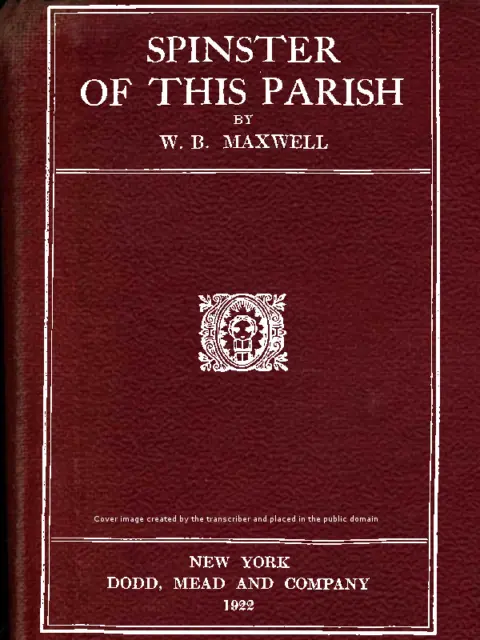
THE CLASSIC COLLECTION · 1922
"Spinster of This Parish" by W. B. Maxwell is a novel written in the early 20th century. The story revolves around the lives of Mildred Parker, a modern young woman facing the temptations and trials of love, and Miss Verinder, her seemingly old-fashioned but refined confidante. As the narrative unfolds, themes of love, societal expectations, and the contrast between youthful passion and the wisdom of experience emerge. The opening of the novel introduces Mildred, who, in a moment of desperation, seeks the counsel of Miss Verinder, an acquaintance of her family. Mildred is filled with youthful ardor as she confides her feelings about a famous actor named Alwyn Beckett, detailing the challenges posed by her parents' disapproval. The contrasting nature of their personalities is highlighted through their dialogue and actions; while Mildred exhibits a passionate and modern perspective on love, Miss Verinder embodies a more subdued, traditional viewpoint. As the connection between the two women deepens through their conversation, the stage is set for an exploration of the complexities of love and societal norms in their world.
Introduction adapted from the source catalogue; source summaries may be automatically generated.
Free to read · English · 112,547 words · No account needed
MAKE TIME FOR A GOOD BOOK
On by default. Untick to stop anonymous reading totals. Each page counts after 10 seconds in view. How this works.
Anonymous counting is on unless you have switched it off.
He shook hands with Mr. Verinder, gave the colonel a wan smile, and went. Eustace let him out, watched by Gussie; the butler standing by, looking very anxious.
When they came upstairs again Mr. Verinder was still sitting at the
table.
“Do you think Dyke had been drinking?” he asked, tapping with the
paper knife.
“No, I don’t think so,” said Eustace.
“He didn’t smell of alcohol,” said Gussie, “when I stooped over him
on the sofa.”
“That makes it all the worse,” said Mr. Verinder, stonily.
“Thank goodness,” said Eustace, “that mother and Emmeline didn’t come back before we had got rid of him.” And he lit a cigarette with fingers that trembled.
After this they had a plain perception of the force they were up against. As Mr. Verinder looked at the imposing façade of the house, he felt that, solid as he had always considered it to be, it afforded a frail protection. He sighed as he drove away from it--his menaced stronghold, his undermined fortress.
He went once again to see Mr. Williams in Spring Gardens, but without any hope that Mr. Williams would be able to help him.
“What can one do?”
Mr. Williams seemed to think that one could do nothing.
“You mean to say,” said Mr. Verinder, frowning, “that if I know this man intends to abduct my daughter--”
“Oh, you can hardly call it that, I think,” said Mr. Williams; and he moved towards his book-shelves, as if with the intention of taking out the letter A and looking up the article entitled Abduction. But then he was mechanically checked by something already in his mind. “By the way, Miss Verinder herself has been here.”
“She has, has she? What for?”
“To ask about her securities. She wants all papers sent to her bank. She said she would discontinue our arrangements, you know, and henceforth manage her affairs herself. She brought her maid with her, and they took some papers I gave her then and there straight on to the bank, I believe.”
Mr. Verinder thought that this was very significant. He said it suggested premeditated defiance and rebellion.
The solicitor said, smiling mildly, that she had not the air of “a rebel.” No, she had seemed “very quiet and sensible,” and he somehow implied that he would like to venture to add “very good-looking, too.”
In conclusion, Mr. Verinder asked, “Would you advise me to have her
watched by detectives?”
“Oh, surely not? What could be gained by that?”
Your reading position is saved on this browser. Take it to another device with a library code. Reading pages adapt to text, rather than matching a printed edition.
W. B. (William Babington) Maxwell
BEHIND THE BOOK
This eBook is for the use of anyone anywhere in the United States and most other parts of the world at no cost and with almost no restrictions whatsoever. You may copy it, give it away or re-use it under the terms of the Project Gutenberg License included with this eBook or online at www.gutenberg.org. If you are not located in the United States, you will have to check the laws of the country where you are located before using this eBook. Read the source licence.
The original source file, including credits and licence, is retained by this library. Request an original-format copy at no charge. Please include the book title and Project Gutenberg identifier #48685.
KEEP YOUR CURIOSITY GOING
Coulson Kernahan

Maurice Baring
Frances Wright
Cécile Tormay

Frederic Jesup Stimson

W. H. P. (William Henry Pope) Jarvis