THE CLASSIC COLLECTION✦The ragged edge: A tale of ward life & politicsCLASSIC FREE BOOKS
The ragged edge: A tale of ward life & politics
John T. (John Thomas) McIntyre
THE CLASSIC COLLECTION · 1922
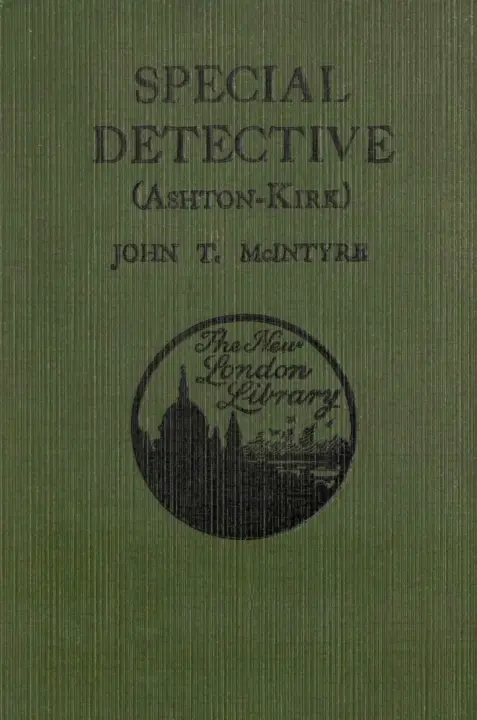
"Special Detective (Ashton-Kirk)" by John T. McIntyre is a detective novel written in the early 20th century. The book follows Ashton-Kirk, a young man with a privileged background and a fascination for crime, as he investigates a mysterious series of events surrounding his friend Frederic Campe, who is engulfed in fear and danger at Castle Schwartzberg. With elements of suspense and intrigue, the narrative hints at a dark past and multiple layers of peril involving the Campe family. The beginning of the story introduces Ashton-Kirk and sets the tone for the investigation. After receiving an urgent visit from Bat Scanlon, a friend concerned for Campe’s safety, Ashton-Kirk learns about the latter's strange behavior and a series of unsettling incidents at Schwartzberg. As uncertainty mounts, Scanlon reveals that his friend appears haunted by unseen threats. The chapter establishes an atmosphere of dread and curiosity, drawing readers into a world where something sinister lurks amidst the historic and seemingly tranquil setting of the castle.
Introduction adapted from the source catalogue; source summaries may be automatically generated.
Free to read · English · 65,194 words · No account needed
MAKE TIME FOR A GOOD BOOK
On by default. Untick to stop anonymous reading totals. Each page counts after 10 seconds in view. How this works.
Anonymous counting is on unless you have switched it off.
“It seems to me I’ve heard that, or something like it, before,” said he. “But don’t take so much credit for your exclusive information. You might not have it as safely cornered as you think.”
“The tramps----” began Kretz, but the big man stopped him impatiently.
“Tramps grandmothers!” said he bluntly. “Don’t go on with that kind of thing. I’m not an infant in arms to be fed with a bottle. If you have no real out-in-the-open talk on this subject, keep quiet about it. I passed the point where the tramps were long ago.”
Kretz stood, with frowning brows, looking at the other. Then his right
hand went up in a salute.
“Excuse!” said he.
He regarded Bat for still another moment; then he came a step nearer.
“You have known Herr Campe for a long time?”
“Quite a while.”
“Before you come he spoke much of you,” said the German. “He asked me what I thought of sending for you. I said,” candidly, the hand lifting to another salute, “not to do it.”
“Why?”
“I was not sure. It was a time when a man could not be sure. All strangers were dangerous.”
“But I was a stranger to you only. Didn’t you give Mr. Campe any credit for judgment, or knowledge of people?”
“Herr Campe,” said Kretz, “as I have said, is like a man who is sick. He does not know who his friends are. That, sir, was plain to me when----” But he stopped shortly at this, his jaws snapping as though to shut in any words which might complete the sentence. Then, after a moment, he said: “You will be careful of the strangers?”
Bat nodded.
“Excuse,” said the man, and with another salute he turned and went on his way along the river.
Scanlon returned to the castle and was admitted, much to his surprise,
by Miss Knowles.
“You must have gone a great way to-day,” she said, with a smile which showed her beautiful teeth.
“Quite a bit of a stride,” acknowledged the big man. “But then it’s a bracing morning, and a fellow should put such days to good use.”
“Kretz seems to think the same,” said she. “He asked leave to go, and I promised to keep the gate. But,” and her head shook slowly, “he didn’t cross the hills, as you did; he seemed to prefer to take the path along the river.”
“That so?” said Bat. And, mentally, he added: “Oh, golden Helen, what makes you always speak in double meanings? This is the first time I’ve seen you to-day, and you are at it already.”
Your reading position is saved on this browser. Take it to another device with a library code. Reading pages adapt to text, rather than matching a printed edition.
John T. (John Thomas) McIntyre
John T. (John Thomas) McIntyre
John T. (John Thomas) McIntyre
BEHIND THE BOOK
This eBook is for the use of anyone anywhere in the United States and most other parts of the world at no cost and with almost no restrictions whatsoever. You may copy it, give it away or re-use it under the terms of the Project Gutenberg License included with this eBook or online at www.gutenberg.org. If you are not located in the United States, you will have to check the laws of the country where you are located before using this eBook. Read the source licence.
The original source file, including credits and licence, is retained by this library. Request an original-format copy at no charge. Please include the book title and Project Gutenberg identifier #66161.
KEEP YOUR CURIOSITY GOING
Coulson Kernahan

Maurice Baring
Frances Wright
Cécile Tormay

Frederic Jesup Stimson

W. H. P. (William Henry Pope) Jarvis