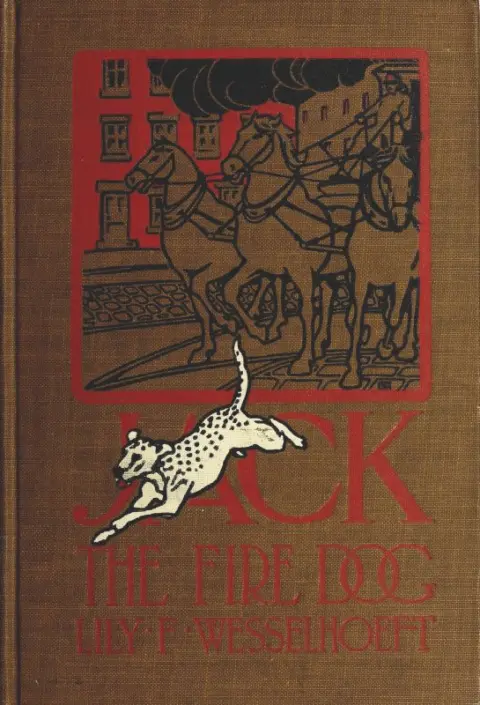
Jack, the Fire Dog
Lily F. Wesselhoeft
THE CLASSIC COLLECTION · 1902
"Sparrow the Tramp: A Fable for Children" by Lily F. Wesselhoeft is a children's fable written in the early 20th century. The story features charming characters such as the mischievous Posy and her brother Tom, who encounter various animals, including a barn-cat, a house-cat, and a sparrow. The narrative promises delightful adventures as these characters navigate various situations, often highlighting themes of kindness, curiosity, and the magic of childhood. At the start of the story, readers are introduced to the lively dynamics in the Winton household, where the children, Posy and Tom, engage in playful mischief while preparing for breakfast. Their antics spark conversations around the house, involving their pets and various animals that add to the charm of the narrative. Among the characters, the barn-cat and the house-cat engage in a rivalry, with the introduction of a cunning rat named Graywhisker who lurks in the background, plotting mischief. This opening sets the stage for an enchanting tale filled with humorous exchanges, endearing characters, and an exploration of themes related to friendship and community.
Introduction adapted from the source catalogue; source summaries may be automatically generated.
Free to read · English · 38,911 words · No account needed
MAKE TIME FOR A GOOD BOOK
On by default. Untick to stop anonymous reading totals. Each page counts after 10 seconds in view. How this works.
Anonymous counting is on unless you have switched it off.
“I’d rather hear about animals,” said Posy.
“Well then, I guess I’ll tell you about a hedgehog.”
“Oh dear!” said Posy, with a disappointed air; “well, go on, Tom.”
“Once there was a hedgehog,” began Tom, “who lived in a little hole in
the woods.”
“What?” asked Posy quickly.
“You mustn’t interrupt me, Posy,” said Tom. “I said there was once a hedgehog who lived in a little hole in the woods.”
“But it couldn’t, you know,” said Posy, with a perplexed expression.
“He could and he did,” continued Tom decidedly; “and one day he started out for a walk--”
“Why, Tom,” said Posy earnestly, “how could a hedgehog take a walk? A hedgehog is a kind of barrel, you know.”
“You mean hogshead,” said Tom; “what a little goosie you are, Posy! But no matter,” he continued, as Posy’s cheeks flushed at her mistake; “the hedgehog started out for a walk one morning, and before he’d gone very far he met an old fox who lived in a ledge of rocks near by. ‘Good-morning, sir,’ said Mr. Fox, ‘this is a fine morning to be out’--”
“Tom,” said Posy suddenly, “I do believe the barn-cat is going to bring her kittens out. Do look at her!”
The barn-cat sat in the doorway of the barn, and moved her tail gently backward and forward, occasionally uttering a low “meaw” in a very coaxing tone and looking behind her. Soon a little head appeared, and then another, and two tiger-kittens began to play with her tail. Then the barn-cat stepped down from the doorway into the yard, and went through the same performance again. The tiger-kittens came to the edge of the step and looked cautiously over. The barn-cat pretended not to see them, but kept her tail gently moving.
Then the tiger-kittens put first one paw over the edge of the step, and then another, and all at once they tumbled over into the yard. Then what a play they did have! They lay on their sides and kicked against their mother, and then they made believe frightened and galloped sideways up to her, with their backs arched and as fierce an expression as their mild little eyes were capable of producing.
“See the old cat make believe she doesn’t see ’em, and yet she watches them out of the corner of her eye all the time,” said Tom.
Then the barn-cat began to wash herself, and the kittens did the same; but they didn’t do it in a very thorough manner, for their little paws didn’t touch their faces half of the time.
Your reading position is saved on this browser. Take it to another device with a library code. Reading pages adapt to text, rather than matching a printed edition.
Lily F. Wesselhoeft
BEHIND THE BOOK
This eBook is for the use of anyone anywhere in the United States and most other parts of the world at no cost and with almost no restrictions whatsoever. You may copy it, give it away or re-use it under the terms of the Project Gutenberg License included with this eBook or online at www.gutenberg.org. If you are not located in the United States, you will have to check the laws of the country where you are located before using this eBook. Read the source licence.
The original source file, including credits and licence, is retained by this library. Request an original-format copy at no charge. Please include the book title and Project Gutenberg identifier #68899.
KEEP YOUR CURIOSITY GOING
Coulson Kernahan

Maurice Baring
Frances Wright
Cécile Tormay

Frederic Jesup Stimson

W. H. P. (William Henry Pope) Jarvis