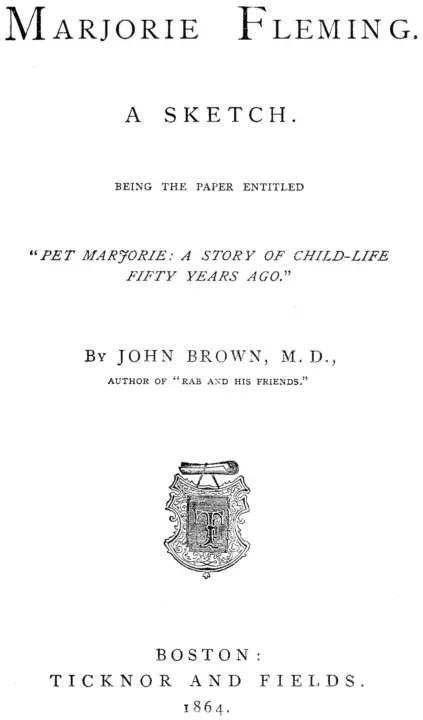
Marjorie Fleming
John Brown
THE CLASSIC COLLECTION · 1861
"Spare Hours" by John Brown is a collection of essays inspired by the author's reflections on life, humanity, and the bond between people and animals, written in the mid-19th century. The opening reflects Brown's warm and humorous style, showcasing his knack for storytelling while exploring themes of mortality, affection, and the quirks of human nature. The book features anecdotes and musings that highlight Brown's deep connection to the world around him, calling attention to the wisdom found in everyday experiences. At the start of the collection, Brown introduces the charming story of a young ass who wanders into a lady's parlor, leading to a series of comedic and poignant events that illustrate the unpredictable nature of life. As the narrative unfolds, readers encounter colorful characters, including a steadfast doctor and a beloved dog named Rab, who symbolize loyalty and affection. The author skillfully balances humor with deeper philosophical insights about life, death, and the importance of companionship, setting the tone for the heartfelt essays that follow.
Introduction adapted from the source catalogue; source summaries may be automatically generated.
Free to read · English · 123,720 words · No account needed
MAKE TIME FOR A GOOD BOOK
On by default. Untick to stop anonymous reading totals. Each page counts after 10 seconds in view. How this works.
Anonymous counting is on unless you have switched it off.
We remember well our first hearing Dr. Chalmers. We were in a moorland district in Tweeddale, rejoicing in the country, after nine months of the High School. We heard that the famous preacher was to be at a neighboring parish church, and off we set, a cartful of irrepressible youngsters. "Calm was all nature as a resting wheel." The crows, instead of making wing, were impudent and sat still; the cart-horses were standing, knowing the day, at the field-gates, gossiping and gazing, idle and happy; the moor was stretching away in the pale sunlight--vast, dim, melancholy, like a sea; everywhere were to be seen the gathering people, "sprinklings of blithe company;" the country-side seemed moving to one centre. As we entered the kirk we saw a notorious character, a drover, who had much of the brutal look of what he worked in, with the knowing eye of a man of the city, a sort of big Peter Bell--
"He had a hardness in his eye,
He had a hardness in his cheek."
He was our terror, and we not only wondered, but were afraid when we saw him going in. The kirk was full as it could hold. How different in looks to a brisk town congregation! There was a fine leisureliness and vague stare; all the dignity and vacancy of animals; eyebrows raised and mouths open, as is the habit with those who speak little and look much, and at far-off objects. The minister comes in, homely in his dress and gait, but having a great look about him, like a mountain among hills. The High School boys thought him like a "big one of ourselves," he looks vaguely round upon his audience, as if he saw in it one great object, not many. We shall never forget his smile! its general benignity;--how he let the light of his countenance fall on us! He read a few verses quietly; then prayed briefly, solemnly, with his eyes wide open all the time, but not seeing. Then he gave out his text; we forget it, but its subject was, "Death reigns." He stated slowly, calmly, the simple meaning of the words; what death was, and how and why it reigned; then suddenly he started, and looked like a man who had seen some great sight, and was breathless to declare it; he told us how death reigned--everywhere, at all times, in all places; how we all knew it, how we would yet know more of it. The drover, who had sat down in the table-seat opposite, was gazing up in a state of stupid excitement; he seemed restless, but never kept his eye from the speaker. The tide set in--everything added to its power, deep called to deep, imagery and illustration poured in: and every now and then the theme,--the simple, terrible statement, was repeated in some lucid interval. After overwhelming us with proofs of the reign of Death, and transferring to us his intense urgency and emotion; and after shrieking, as if in despair, these words, "Death is a tremendous necessity,"--he suddenly looked beyond us as if into some distant region, and cried out, "Behold a mightier!--who is this? He cometh from Edom, with dyed garments from Bozrah, glorious in his apparel, speaking in righteousness, travelling in the greatness of his strength, mighty to save." Then, in a few plain sentences, he stated the truth as to sin entering, and death by sin, and death passing upon all. Then he took fire once more, and enforced, with redoubled energy and richness, the freeness, the simplicity, the security, the sufficiency of the great method of justification. How astonished and impressed we all were! He was at the full thunder of his power; the whole man was in an agony of earnestness. The drover was weeping like a child, the tears running down his ruddy, coarse cheeks--his face opened out and smoothed like an infant's; his whole body stirred with emotion. We all had insensibly been drawn out of our seats, and were converging towards the wonderful speaker. And when he sat down, after warning each one of us to remember who it was, and what it was, that followed death on his pale horse,[51] and how alone we could escape--we all sunk back into our seats. How beautiful to our eyes did the thunderer look--exhausted--but sweet and pure! How he poured out his soul before his God in giving thanks for sending the Abolisher of Death! Then, a short psalm, and all was ended.
Your reading position is saved on this browser. Take it to another device with a library code. Reading pages adapt to text, rather than matching a printed edition.
BEHIND THE BOOK
This eBook is for the use of anyone anywhere in the United States and most other parts of the world at no cost and with almost no restrictions whatsoever. You may copy it, give it away or re-use it under the terms of the Project Gutenberg License included with this eBook or online at www.gutenberg.org. If you are not located in the United States, you will have to check the laws of the country where you are located before using this eBook. Read the source licence.
The original source file, including credits and licence, is retained by this library. Request an original-format copy at no charge. Please include the book title and Project Gutenberg identifier #27153.
KEEP YOUR CURIOSITY GOING

David Patterson (Spirit) Hatch

David Patterson (Spirit) Hatch

David Patterson (Spirit) Hatch
John L. Ransom

Ralph Waldo Emerson

Maurice Baring