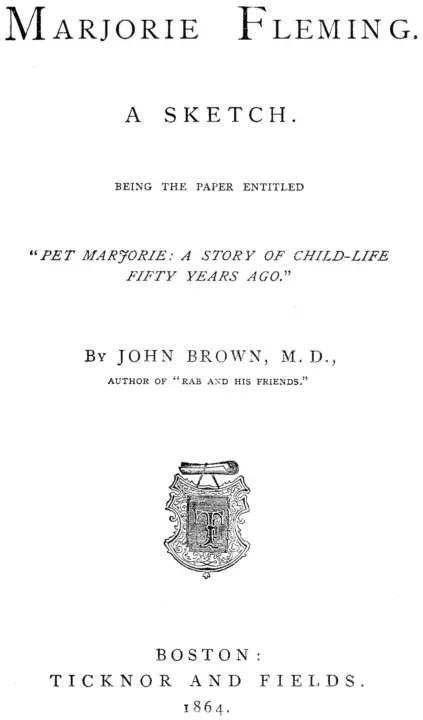
Marjorie Fleming
John Brown
THE CLASSIC COLLECTION · 1861
"Spare Hours" by John Brown is a collection of essays inspired by the author's reflections on life, humanity, and the bond between people and animals, written in the mid-19th century. The opening reflects Brown's warm and humorous style, showcasing his knack for storytelling while exploring themes of mortality, affection, and the quirks of human nature. The book features anecdotes and musings that highlight Brown's deep connection to the world around him, calling attention to the wisdom found in everyday experiences. At the start of the collection, Brown introduces the charming story of a young ass who wanders into a lady's parlor, leading to a series of comedic and poignant events that illustrate the unpredictable nature of life. As the narrative unfolds, readers encounter colorful characters, including a steadfast doctor and a beloved dog named Rab, who symbolize loyalty and affection. The author skillfully balances humor with deeper philosophical insights about life, death, and the importance of companionship, setting the tone for the heartfelt essays that follow.
Introduction adapted from the source catalogue; source summaries may be automatically generated.
Free to read · English · 123,720 words · No account needed
MAKE TIME FOR A GOOD BOOK
On by default. Untick to stop anonymous reading totals. Each page counts after 10 seconds in view. How this works.
Anonymous counting is on unless you have switched it off.
Sir Joshua Reynolds was taken by a friend to see a picture. He was anxious to admire it, and he looked it over with a keen and careful but favorable eye. "Capital composition; correct drawing; the color, tone, chiaroscuro excellent; but--but--it wants, hang it, it wants--That!" snapping his fingers; and, wanting "that," though it had everything else, it was worth nothing.
Again, Etty was appointed teacher of the students of the Royal Academy, having been preceded by a clever, talkative, scientific expounder of aesthetics, who delighted to tell the young men how everything was done, how to copy this, and how to express that. A student came up to the new master, "How should I do this, sir?" "Suppose you try." Another, "What does this mean, Mr. Etty?" "Suppose you look." "But I have looked." "Suppose you look again." And they did try, and they did look, and looked again; and they saw and achieved what they never could have done, had the how or the what (supposing this possible, which it is not in its full and highest meaning) been told them, or done for them; in the one case, sight and action were immediate, exact, intense, and secure; in the other mediate, feeble, and lost as soon as gained. But what are "Brains"? what did Opie mean? and what is Sir Joshua's "That"? What is included in it? and what is the use, or the need of trying and trying, of missing often before you hit, when you can be told at once and be done with it; or of looking when you may be shown? Everything in medicine and in painting--practical arts--as means to ends, let their scientific enlargement be ever so rapid and immense, depends upon the right answers to these questions.
First of all, "brains," in the painter, are not diligence, knowledge, skill, sensibility, a strong will, or a high aim,--he may have all these, and never paint anything so truly good and effective as the rugged woodcut we must all remember, of Apollyon bestriding the whole breadth of the way, and Christian girding at him like a man, in the old sixpenny Pilgrim's Progress; and a young medical student may have zeal, knowledge, ingenuity, attention, a good eye and a steady hand--he may be an accomplished anatomist, stethoscopist, histologist, and analyst; and yet, with all this, and all the lectures, and all the books, and all the sayings, and all the preparations, drawings, tables, and other helps of his teachers, crowded into his memory or his note-books, he may be beaten in treating a whitlow or a colic, by the nurse in the wards where he was clerk, or by the old country doctor who brought him into the world, and who listens with such humble wonder to his young friend's account, on his coming home after each session, of all he had seen and done,--of all the last astonishing discoveries and operations of the day. What the painter wants, in addition to, and as the complement of, the other elements, is genius and sense; what the doctor needs to crown and give worth and safety to his accomplishments, is sense and genius: in the first case, more of this, than of that; in the second, more of that, than of this. These are the "Brains" and the "That."
Your reading position is saved on this browser. Take it to another device with a library code. Reading pages adapt to text, rather than matching a printed edition.
BEHIND THE BOOK
This eBook is for the use of anyone anywhere in the United States and most other parts of the world at no cost and with almost no restrictions whatsoever. You may copy it, give it away or re-use it under the terms of the Project Gutenberg License included with this eBook or online at www.gutenberg.org. If you are not located in the United States, you will have to check the laws of the country where you are located before using this eBook. Read the source licence.
The original source file, including credits and licence, is retained by this library. Request an original-format copy at no charge. Please include the book title and Project Gutenberg identifier #27153.
KEEP YOUR CURIOSITY GOING

David Patterson (Spirit) Hatch

David Patterson (Spirit) Hatch

David Patterson (Spirit) Hatch
John L. Ransom

Ralph Waldo Emerson

Maurice Baring