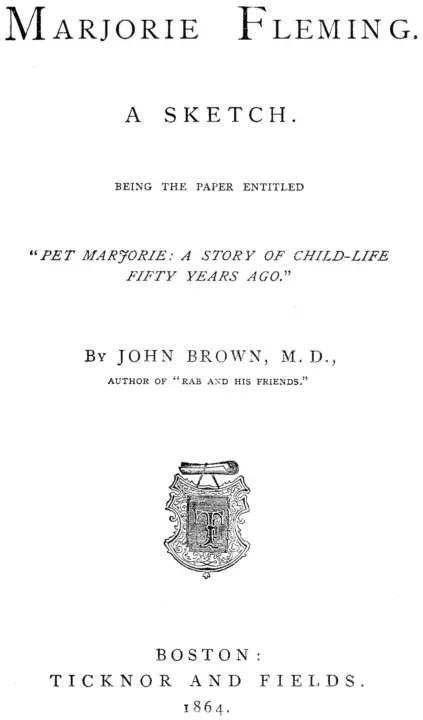
Marjorie Fleming
John Brown
THE CLASSIC COLLECTION · 1861
"Spare Hours" by John Brown is a collection of essays inspired by the author's reflections on life, humanity, and the bond between people and animals, written in the mid-19th century. The opening reflects Brown's warm and humorous style, showcasing his knack for storytelling while exploring themes of mortality, affection, and the quirks of human nature. The book features anecdotes and musings that highlight Brown's deep connection to the world around him, calling attention to the wisdom found in everyday experiences. At the start of the collection, Brown introduces the charming story of a young ass who wanders into a lady's parlor, leading to a series of comedic and poignant events that illustrate the unpredictable nature of life. As the narrative unfolds, readers encounter colorful characters, including a steadfast doctor and a beloved dog named Rab, who symbolize loyalty and affection. The author skillfully balances humor with deeper philosophical insights about life, death, and the importance of companionship, setting the tone for the heartfelt essays that follow.
Introduction adapted from the source catalogue; source summaries may be automatically generated.
Free to read · English · 123,720 words · No account needed
MAKE TIME FOR A GOOD BOOK
On by default. Untick to stop anonymous reading totals. Each page counts after 10 seconds in view. How this works.
Anonymous counting is on unless you have switched it off.
"But vainly there they seek their soul's relief, And of th' obdurate Grave its prey implore; Till Death himself shall medicine their grief, Closing their eyes by those they wept before.
"All that have died, the Earth's whole race, repose Where Death collects his Treasures, heap on heap; O'er each one's busy day, the nightshades close; Its Actors, Sufferers, Schools, Kings, Armies--sleep."
The lines in italics are of the highest quality, both in thought and word; the allusion to Him who by dying abolished death, seems to us wonderfully fine--sudden, simple,--it brings to our mind the lines already quoted from Vaughan:--
"But there was One
Who search'd it quite through to and fro,
And then returning like the Sun,
Discover'd all that there is done."
What a rich line this is!
"And pour their woe the loaded air along."
"The insuperable threshold!"
Do our readers remember the dying Corinne's words? Je mourrais seule--au reste, ce moment se passe de secours; nos amis ne peuvent nous suivre que jusqu'au seuil de la vie. La, commencent des pensees dont le trouble et la profondeur ne sauraient se confier.
We have only space for one more--verses entitled "Heart's-Ease."
"Oh, Heart's-Ease, dost thou lie within that flower? How shall I draw thee thence?--so much I need The healing aid of thine enshrined power To veil the past--and bid the time good speed!
"I gather it--it withers on my breast;
The heart's-ease dies when it is laid on mine;
Methinks there is no shape by Joy possess'd,
Would better fare than thou, upon that shrine.
"Take from me things gone by--oh! change the past-- Renew the lost--restore me the decay'd,-- Bring back the days whose tide has ebb'd so fast-- Give form again to the fantastic shade!
"My hope, that never grew to certainty,--
My youth, that perish'd in its vain desire,--
My fond ambition, crush'd ere it could be
Aught save a self-consuming, wasted fire:
"Bring these anew, and set me once again
In the delusion of Life's Infancy--
I was not happy, but I knew not then
That happy I was never doom'd to be.
"Till these things are, and powers divine descend-- Love, kindness, joy, and hope, to gild my day, In vain the emblem leaves towards me bend, Thy Spirit, Heart's-Ease, is too far away!"
We would fain have given two poems entitled "Bessy" and "Youth and Age." Everything in this little volume is select and good. Sensibility and sense in right measure and proportion and keeping, and in pure, strong classical language; no intemperance of thought or phrase. Why does not "V." write more?
Your reading position is saved on this browser. Take it to another device with a library code. Reading pages adapt to text, rather than matching a printed edition.
BEHIND THE BOOK
This eBook is for the use of anyone anywhere in the United States and most other parts of the world at no cost and with almost no restrictions whatsoever. You may copy it, give it away or re-use it under the terms of the Project Gutenberg License included with this eBook or online at www.gutenberg.org. If you are not located in the United States, you will have to check the laws of the country where you are located before using this eBook. Read the source licence.
The original source file, including credits and licence, is retained by this library. Request an original-format copy at no charge. Please include the book title and Project Gutenberg identifier #27153.
KEEP YOUR CURIOSITY GOING

David Patterson (Spirit) Hatch

David Patterson (Spirit) Hatch

David Patterson (Spirit) Hatch
John L. Ransom

Ralph Waldo Emerson

Maurice Baring