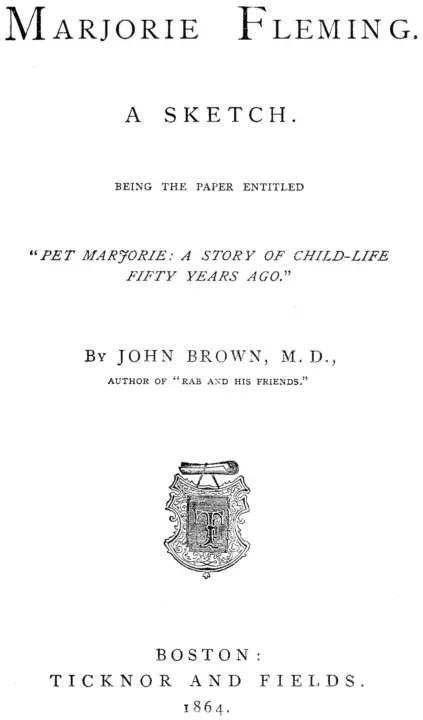
Marjorie Fleming
John Brown
THE CLASSIC COLLECTION · 1861
"Spare Hours" by John Brown is a collection of essays inspired by the author's reflections on life, humanity, and the bond between people and animals, written in the mid-19th century. The opening reflects Brown's warm and humorous style, showcasing his knack for storytelling while exploring themes of mortality, affection, and the quirks of human nature. The book features anecdotes and musings that highlight Brown's deep connection to the world around him, calling attention to the wisdom found in everyday experiences. At the start of the collection, Brown introduces the charming story of a young ass who wanders into a lady's parlor, leading to a series of comedic and poignant events that illustrate the unpredictable nature of life. As the narrative unfolds, readers encounter colorful characters, including a steadfast doctor and a beloved dog named Rab, who symbolize loyalty and affection. The author skillfully balances humor with deeper philosophical insights about life, death, and the importance of companionship, setting the tone for the heartfelt essays that follow.
Introduction adapted from the source catalogue; source summaries may be automatically generated.
Free to read · English · 123,720 words · No account needed
MAKE TIME FOR A GOOD BOOK
On by default. Untick to stop anonymous reading totals. Each page counts after 10 seconds in view. How this works.
Anonymous counting is on unless you have switched it off.
No wonder that the bewildered beings whom I have seen wandering through these rooms, yawned more frequently and more desperately than I ever observed even in church.
So then, cultivate observation, energy, handicraft, ingenuity, outness in boys, so as to give them a pursuit as well as a study. Look after the blade, and don't coax or crush the ear out too soon, and remember that the full corn in the ear is not due till the harvest, when the great School breaks up, and we must all dismiss and go our several ways.
VAUGHAN'S POEMS, &c.
{Hosa esti prosphile--tauta logizesthe}.--ST. PAUL.
"What do you think of Dr. Channing, Mr. Coleridge?" said a brisk young gentleman to the mighty discourser, as he sat next him at a small tea-party. "Before entering upon that question, sir," said Coleridge, opening upon his inquirer those 'noticeable gray eyes,' with a vague and placid stare, and settling himself in his seat for the night, "I must put you in possession of my views, in extenso, on the origin, progress, present condition, future likelihoods, and absolute essence of the Unitarian controversy, and especially the conclusions I have, upon the whole, come to on the great question of what may be termed the philosophy of religious difference." In like manner, before telling our readers what we think of Henry Vaughan, the Silurist, or of "V.," or of Henry Ellison, the Bornnatural, or of E. V. K., it would have been very pleasant (to ourselves) to have given, in extenso, our views de Re Poetica, its nature, its laws and office, its means and ends; and to have made known how much and how little we agreed on these points with such worthies as Aristotle and Plato, Horace and Richard Baxter, Petronius Arbiter and Blaise Pascal, Ulric von Huetten and Boileau, Hurdis and Hurd, Dr. Arnold and Montaigne, Harris of Salisbury and his famous uncle, Burke and "John Buncle," Montesquieu and Sir Philip Sidney, Dr. Johnson and the two Wartons, George Gascoyne and Spenser's friend Gabriel Harvey, Puttenham and Webbe, George Herbert and George Sand, Petrarch and Pinciano, Vida and Julius Caesar Scaliger, Pontanus and Savage Landor, Leigh Hunt and Quinctilian, or Tacitus (whichever of the two wrote the Dialogue De Oratoribus, in which there is so much of the best philosophy, criticism, and expression), Lords Bacon and Buchan and Dr. Blair, Dugald Stewart and John Dryden, Charles Lamb and Professor Wilson, Vinet of Lausanne and John Foster, Lord Jeffrey and the two brothers Hare, Drs. Fuller and South, John Milton and Dr. Drake, Dante and "Edie Ochiltree," Wordsworth and John Bunyan, Plutarch and Winkelman, the Coleridges, Samuel, Sara, Hartley, Derwent, and Henry Nelson, Sir Egerton Bridges, Victor Cousin and "the Doctor," George Moir and Madame de Stael, Dr. Fracastorius and Professor Keble, Martinus Scriblerus and Sir Thomas Browne, Macaulay and the Bishop of Cloyne, Collins and Gray and Sir James Mackintosh, Hazlitt and John Ruskin, Shakspeare and Jackson of Exeter, Dallas and De Quincey, and the six Taylors, Jeremy, William, Isaac, Jane, John Edward, and Henry. We would have had great pleasure in quoting what these famous women and men have written on the essence and the art of poetry, and to have shown how strangely they differ, and how as strangely at times they agree. But as it is not related at what time of the evening our brisk young gentleman got his answer regarding Dr. Channing, so it likewise remains untold what our readers have lost and gained in our not fulfilling our somewhat extensive desire.
Your reading position is saved on this browser. Take it to another device with a library code. Reading pages adapt to text, rather than matching a printed edition.
BEHIND THE BOOK
This eBook is for the use of anyone anywhere in the United States and most other parts of the world at no cost and with almost no restrictions whatsoever. You may copy it, give it away or re-use it under the terms of the Project Gutenberg License included with this eBook or online at www.gutenberg.org. If you are not located in the United States, you will have to check the laws of the country where you are located before using this eBook. Read the source licence.
The original source file, including credits and licence, is retained by this library. Request an original-format copy at no charge. Please include the book title and Project Gutenberg identifier #27153.
KEEP YOUR CURIOSITY GOING

David Patterson (Spirit) Hatch

David Patterson (Spirit) Hatch

David Patterson (Spirit) Hatch
John L. Ransom

Ralph Waldo Emerson

Maurice Baring