THE CLASSIC COLLECTION✦The Life of Mrs. Robert Louis StevensonCLASSIC FREE BOOKS
The Life of Mrs. Robert Louis Stevenson
Nellie Van de Grift Sanchez
THE CLASSIC COLLECTION · 1914
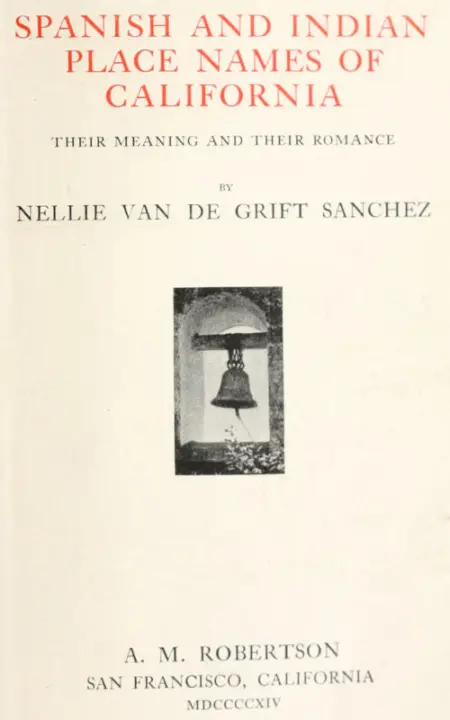
"Spanish and Indian Place Names of California: Their Meaning and Their Romance" by Nellie Van de Grift Sanchez is a historical reference work written in the early 20th century. This volume explores the origins and meanings of California's Spanish and Indian place names, intertwining them with captivating historical anecdotes and cultural narratives to contextualize the legacy of early explorers and settlers. The work aims to serve both as an informative guide for tourists and a resource for educational purposes. At the start of this reference work, the author introduces the purpose and intent behind compiling the stories and meanings of California’s diverse place names. Sanchez articulates the importance of preserving this heritage, emphasizing the romantic historical backdrop that these names convey. She acknowledges the challenges in tracing the origins of many names, particularly those of Indian descent, and highlights the differences in naming conventions between Spanish explorers and local indigenous tribes. The introduction sets the stage for a deeper exploration of specific regions, beginning with San Diego, and promises a wealth of fascinating tales connected to California's geographical names.
Introduction adapted from the source catalogue; source summaries may be automatically generated.
Free to read · English · 62,377 words · No account needed
MAKE TIME FOR A GOOD BOOK
On by default. Untick to stop anonymous reading totals. Each page counts after 10 seconds in view. How this works.
Anonymous counting is on unless you have switched it off.
San Ysidro. See San Isidro. See page 341.
Saticoy. See page 84.
Saucito (little alder).
Saucos (alder-trees).
Sausal (willow-grove).
Sausalito (little willow-grove). See page 218.
Sausal Redondo (round willow-grove). See Redondo Beach, page 82.
El Segundo (the second), so called because at that place the Standard Oil Company’s second refinery on the Pacific Coast is located. Modern.
Sequoia, the giant tree of California, was named for the Cherokee, Sequoyah, who invented an alphabet for his tribe. Sequoyah, also known as George Gist, or Guess, was the son of a white man and a Cherokee woman of mixed blood, and was, after all, more white man than Indian. He had a natural genius for mechanical invention, and, having been crippled for life in a hunting accident, he occupied his time in devising the alphabet, which was accepted with such enthusiasm by his people that every Cherokee, of whatever age, had learned to read and write in a few months. Sequoia, although not a place name, is given here for the interest it may have for tourists and other persons unacquainted with the origin of the name of the famous “big trees.”
Serena (serene). See page 113. This name is spelled on some maps as Sereno, but is called Serena by the people of the neighborhood.
Serra (a surname). See page 84.
Sespe, named for a former Chumash Indian village said by Indians to have been on Sespe Creek, in Ventura County.
Shasta. See page 251.
Sierra (saw, saw-toothed mountains). See page 293.
Sierra Madre (mother sierra). See page 293.
Sierra Morena (brown range) is the name of a spur of the Coast Range commencing about ten miles south of San Francisco and running through San Francisco County into Santa Clara County. This mountain range, which contains some very charming scenery, may have been so named on account of its color, or it may be the namesake of the Sierra Morena of Spain. The name is sometimes spelled Moreno, and one of the possibilities is that it was named for the pioneer Moreno family.
Sierra Nevada (snowy sierra). See page 293.
Simi, in Ventura County, is an Indian place name.
Siskiyou. See page 256.
Sis Quoc, a town and river in Santa Bárbara County, named from Souscoc, a former Chumash village near the Santa Inez Mission.
Sobrante (residue, surplus), a term applied to a piece of land left over after measuring off land grants.
Sobrante de San Jacinto, residue of the grant called St. Hyacinth.
Solano. See page 268.
Soledad (solitude). See page 151.
Somis, in Ventura County, is an Indian place name.
Sonoma. See page 241.
Sonora. See page 333.
Soquel, or Souquel, was probably derived from Usacalis, a Costanoan Indian village situated in 1819 within ten miles of the Santa Cruz Mission.
Your reading position is saved on this browser. Take it to another device with a library code. Reading pages adapt to text, rather than matching a printed edition.
BEHIND THE BOOK
This eBook is for the use of anyone anywhere in the United States and most other parts of the world at no cost and with almost no restrictions whatsoever. You may copy it, give it away or re-use it under the terms of the Project Gutenberg License included with this eBook or online at www.gutenberg.org. If you are not located in the United States, you will have to check the laws of the country where you are located before using this eBook. Read the source licence.
The original source file, including credits and licence, is retained by this library. Request an original-format copy at no charge. Please include the book title and Project Gutenberg identifier #59251.
KEEP YOUR CURIOSITY GOING
Cécile Tormay

Moritz Busch
John L. Ransom
Frances Wright
Cécile Tormay

Mabel Potter Daggett