THE CLASSIC COLLECTION✦The Life of Mrs. Robert Louis StevensonCLASSIC FREE BOOKS
The Life of Mrs. Robert Louis Stevenson
Nellie Van de Grift Sanchez
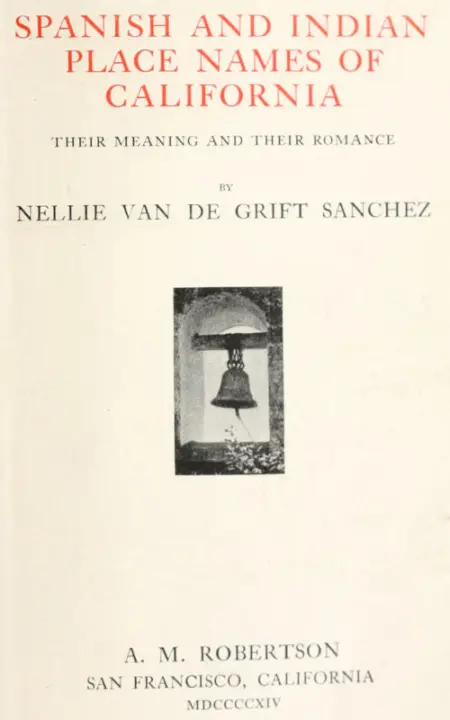
THE CLASSIC COLLECTION · 1914
"Spanish and Indian Place Names of California: Their Meaning and Their Romance" by Nellie Van de Grift Sanchez is a historical reference work written in the early 20th century. This volume explores the origins and meanings of California's Spanish and Indian place names, intertwining them with captivating historical anecdotes and cultural narratives to contextualize the legacy of early explorers and settlers. The work aims to serve both as an informative guide for tourists and a resource for educational purposes. At the start of this reference work, the author introduces the purpose and intent behind compiling the stories and meanings of California’s diverse place names. Sanchez articulates the importance of preserving this heritage, emphasizing the romantic historical backdrop that these names convey. She acknowledges the challenges in tracing the origins of many names, particularly those of Indian descent, and highlights the differences in naming conventions between Spanish explorers and local indigenous tribes. The introduction sets the stage for a deeper exploration of specific regions, beginning with San Diego, and promises a wealth of fascinating tales connected to California's geographical names.
Introduction adapted from the source catalogue; source summaries may be automatically generated.
Free to read · English · 62,377 words · No account needed
MAKE TIME FOR A GOOD BOOK
On by default. Untick to stop anonymous reading totals. Each page counts after 10 seconds in view. How this works.
Anonymous counting is on unless you have switched it off.
Pecho Rock, near San Luís Obispo. The reason for this name has not been discovered, but it may be a reference to the shape of the rock. Pecho means “breast.”
Pedernales (flints). See page 104.
Los Peñasquitos (the little cliffs), in San Diego County.
Peralta (a surname), that of a pioneer family.
Peras (pears) Creek, in Los Ángeles County.
Los Perros (the dogs), possibly Indian dogs.
Pescadero Point (fishing-place point). See page 231.
Petaluma. See page 261.
Picachos Mountains, a ridge east of San Francisco Bay. Pichacos are frequent, isolated, conical peaks.
Picacho (top, sharp-pointed summit), is the name of a post village in
Imperial County.
Pico (a surname), ten miles from Los Ángeles. José María Pico of Sinaloa was the founder of this family, and its most notable member was his son, Pío Pico, at one time governor of California. According to Bancroft, the character of Pío Pico was a mixture of good and bad, in which the good predominated. “He was abused beyond his deserts; he was a man of ordinary intelligence and limited education; of a generous, jovial disposition, reckless and indolent, fond of cards and women; disposed to be fair and honorable in transactions, but not strong enough to avoid being made the tool of knaves. He did not run away with large sums of money obtained by sales of missions, as has been charged.”
Piedra (stone, rock), near Fresno.
Piedras Blancas (white rocks). See page 128.
Piedras Grandes (big rocks).
La Piedra Pintada (the painted rock). See page 108.
Pilar (literally “pillar of stone”). Point Pilar may have been named for Nuestra Señora del Pilar, (Our Lady of the pillar), from a church at Saragossa, Spain, where there is an image of the Virgin on a marble pillar. Pilar is also a surname, that of a pioneer family, for whom this point may have been named.
Pilarcitos (little pillars, or little Pilar Ranch).
Pilitas (basins or water-holes in rock).
El Pinal (the pine grove), in San Joaquín County.
Pino Blanco (white pine), in Mariposa County.
Pino Grande (big pine), in El Dorado County, near Placerville.
Pinole (parched corn ground into meal). Point Pinole was so named because the expedition under Lieutenant Vallejo had nothing to eat but pinole while they waited at that spot for the return of the cargadores with provisions from Monterey.—(Memoirs of the Vallejos, edited by James H. Wilkins, San Francisco Bulletin, January, 1914.)
Piñón (pine kernel, also the scrub pine, a very picturesque tree
bearing a delicious nut).
Point Pinos (point of pines). See page 148.
Tres Pinos (three pines). See page 163.
Pintado (painted, mottled).
Pinto Range (painted or mottled range). See page 332.
Your reading position is saved on this browser. Take it to another device with a library code. Reading pages adapt to text, rather than matching a printed edition.
BEHIND THE BOOK
This eBook is for the use of anyone anywhere in the United States and most other parts of the world at no cost and with almost no restrictions whatsoever. You may copy it, give it away or re-use it under the terms of the Project Gutenberg License included with this eBook or online at www.gutenberg.org. If you are not located in the United States, you will have to check the laws of the country where you are located before using this eBook. Read the source licence.
The original source file, including credits and licence, is retained by this library. Request an original-format copy at no charge. Please include the book title and Project Gutenberg identifier #59251.
KEEP YOUR CURIOSITY GOING
Cécile Tormay

Moritz Busch
John L. Ransom
Frances Wright
Cécile Tormay

Mabel Potter Daggett