THE CLASSIC COLLECTION✦The Life of Mrs. Robert Louis StevensonCLASSIC FREE BOOKS
The Life of Mrs. Robert Louis Stevenson
Nellie Van de Grift Sanchez
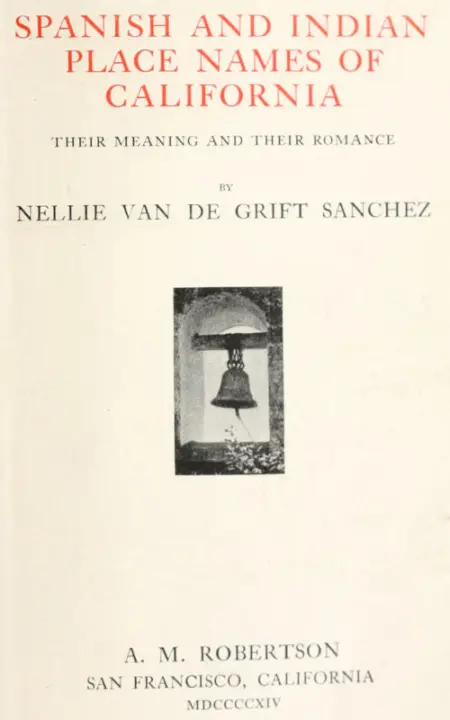
THE CLASSIC COLLECTION · 1914
"Spanish and Indian Place Names of California: Their Meaning and Their Romance" by Nellie Van de Grift Sanchez is a historical reference work written in the early 20th century. This volume explores the origins and meanings of California's Spanish and Indian place names, intertwining them with captivating historical anecdotes and cultural narratives to contextualize the legacy of early explorers and settlers. The work aims to serve both as an informative guide for tourists and a resource for educational purposes. At the start of this reference work, the author introduces the purpose and intent behind compiling the stories and meanings of California’s diverse place names. Sanchez articulates the importance of preserving this heritage, emphasizing the romantic historical backdrop that these names convey. She acknowledges the challenges in tracing the origins of many names, particularly those of Indian descent, and highlights the differences in naming conventions between Spanish explorers and local indigenous tribes. The introduction sets the stage for a deeper exploration of specific regions, beginning with San Diego, and promises a wealth of fascinating tales connected to California's geographical names.
Introduction adapted from the source catalogue; source summaries may be automatically generated.
Free to read · English · 62,377 words · No account needed
MAKE TIME FOR A GOOD BOOK
On by default. Untick to stop anonymous reading totals. Each page counts after 10 seconds in view. How this works.
Anonymous counting is on unless you have switched it off.
Mendota (a surname), is in Fresno County.
Merced (mercy). See pages 276 and 340.
Mesa (table, table-land). See pages 45 and 340.
La Mesa (the table or table-land), is in San Diego County.
Mesa Grande (big table-land). See page 46.
Mesa de Ojo de Agua (table-land of the spring).
Mesquite (a native shrub of the locust variety).
Milpitas (little patches of corn). This word is said to be the diminutive of milpa (a patch of maize or corn), but in that case must have referred to corn cultivated by Mexicans, since the California Indians raised no cultivated crops, but subsisted entirely on the natural products of the land. Milpitas is a village in Santa Clara County, which for some unexplained reason, has come to be used as a term of derision, the “jumping off place of creation.” It was probably the name of a land grant.
La Mirada (the view). See page 80.
Miramar (sea-view), is the name of a post town in San Diego County and of a summer resort near Santa Bárbara.
Miramontes (a surname). Candelario Miramontes, a native of Mexico, was the grantee of the Pilarcitos Rancho in ’41.
Misión Vieja, or La Paz (old mission or the peace). Land grant.
Misión Vieja de la Purísima (old mission of the Immaculate Conception).
Mocho Peak, in Santa Clara County. Mocho means “cropped, cut off.”
Modesto (modest). See page 288.
Modoc (people of the south). See page 250.
Mojave, or Mohave. Mojave, also spelled Mohave, is an Indian tribal name of disputed meaning. It has been stated that it comes from hamucklihabi (three hills), but this view is positively contradicted by scientists. In the documents of the Spanish explorers the Mojaves are referred to as Amajabas. The Mojave River is remarkable in that it has no true outlet, but sinks into the alkaline soil of the desert near the middle of San Bernardino County.
Mokelumne. See Moquelumne.
Molino (mill, or mill-stone). See page 80.
Los Molinos (the mills, or mill-stones). See page 80.
El Río de los Molinos (the river of the mill-stones), now called Mill Creek, in Tehama County. See page 80.
Mono. See page 324.
Montalvo (a surname), in Ventura County. See page 81.
Monte (hill or wood). Monte was generally used in the sense of “wood” or “forest” by the Spanish-Americans of the eighteenth century.
El Monte (the hill or the wood).
Del Monte (of the wood or hill). In the case of the Hotel del Monte, near Monterey, the name refers to the grove of fine live-oaks in the center of which the hotel stands.
Montecito (little hill or wood). See page 101.
Monterey (hill or wood of the king). See page 133.
Your reading position is saved on this browser. Take it to another device with a library code. Reading pages adapt to text, rather than matching a printed edition.
BEHIND THE BOOK
This eBook is for the use of anyone anywhere in the United States and most other parts of the world at no cost and with almost no restrictions whatsoever. You may copy it, give it away or re-use it under the terms of the Project Gutenberg License included with this eBook or online at www.gutenberg.org. If you are not located in the United States, you will have to check the laws of the country where you are located before using this eBook. Read the source licence.
The original source file, including credits and licence, is retained by this library. Request an original-format copy at no charge. Please include the book title and Project Gutenberg identifier #59251.
KEEP YOUR CURIOSITY GOING
Cécile Tormay

Moritz Busch
John L. Ransom
Frances Wright
Cécile Tormay

Mabel Potter Daggett