THE CLASSIC COLLECTION✦The Life of Mrs. Robert Louis StevensonCLASSIC FREE BOOKS
The Life of Mrs. Robert Louis Stevenson
Nellie Van de Grift Sanchez
THE CLASSIC COLLECTION · 1914
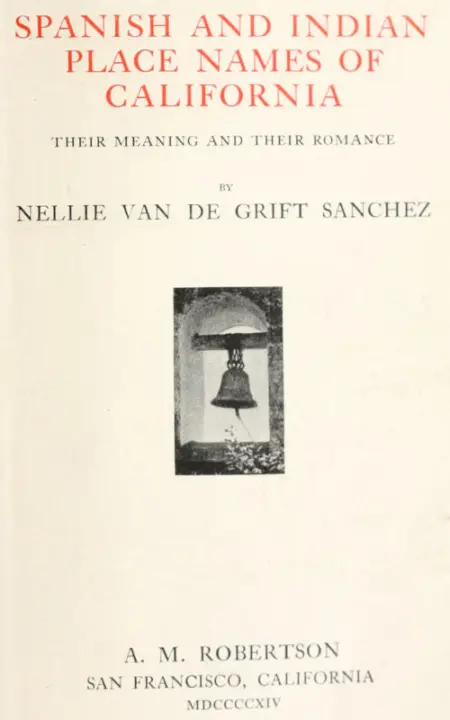
"Spanish and Indian Place Names of California: Their Meaning and Their Romance" by Nellie Van de Grift Sanchez is a historical reference work written in the early 20th century. This volume explores the origins and meanings of California's Spanish and Indian place names, intertwining them with captivating historical anecdotes and cultural narratives to contextualize the legacy of early explorers and settlers. The work aims to serve both as an informative guide for tourists and a resource for educational purposes. At the start of this reference work, the author introduces the purpose and intent behind compiling the stories and meanings of California’s diverse place names. Sanchez articulates the importance of preserving this heritage, emphasizing the romantic historical backdrop that these names convey. She acknowledges the challenges in tracing the origins of many names, particularly those of Indian descent, and highlights the differences in naming conventions between Spanish explorers and local indigenous tribes. The introduction sets the stage for a deeper exploration of specific regions, beginning with San Diego, and promises a wealth of fascinating tales connected to California's geographical names.
Introduction adapted from the source catalogue; source summaries may be automatically generated.
Free to read · English · 62,377 words · No account needed
MAKE TIME FOR A GOOD BOOK
On by default. Untick to stop anonymous reading totals. Each page counts after 10 seconds in view. How this works.
Anonymous counting is on unless you have switched it off.
Chowchilla was the name of a Yokuts tribe of the Central Valley. See
page 283.
Chualar. See page 157.
Chula Vista (pretty view). See page 42.
Ciénega (swamp), is in Los Ángeles County.
Las Ciénegas (the swamps).
Las Cienegitas (the little swamps).
Ciénega del Gabilán (the swamp of the hawk).
Ciénega de los Paicines, swamp of the Paicines (Indian tribe).
Cima (summit), between San Bernardino and Las Vegas.
Cimarrón (wild, unruly). The Spaniards applied this word to plants or animals indiscriminately, sometimes using it in reference to the wild grapes which they found growing in such profusion in California, sometimes in reference to wild Indians. The writer who translated it as “lost river” must have drawn upon his imagination for that definition.
Cisco. See page 329.
Los Coches (the pigs).
Codornices Creek (quail creek).
Cojo (lame). See page 106.
Ranchería del Cojo (village of the lame one), so-called from a lame
Indian seen there.
Coloma, a town in El Dorado County, so-named from the Koloma tribe, a division of the Nishinam family. It was at this place that Sutter’s Mill, where gold was discovered in 1848, was situated, and it is also there that the native sons erected a monument to John W. Marshall.
Colorado (red).
Colusa, an Indian word, meaning not ascertained. See page 265.
Concepción. See page 106.
Conejo (rabbit), is the name of several places. See pages 79 and 339.
Conejo Peak (rabbit peak), is in Ventura County.
Contra Costa (opposite coast). See page 229.
Cordero (literally “lamb”), but probably a surname here.
Córdova, near Sacramento. Córdova or Córdoba is the name of a province of the Argentine Republic, in South America. Cattle raising is its chief industry. The California town may have been directly named for the city of Córdova in Mexico.
Corona (crown).
Coronado Beach, see page 29.
Corral (yard, enclosed piece of ground). See pages 157 and 339.
Los Corralitos (the little yards).
Corral de Piedra (yard enclosed by a stone fence). See page 158.
Corral de Tierra (earth corral). See page 158.
Cortina, a town in Colusa County. Cortina, the Spanish word for “curtain,” is a corruption of Kotina, the name of the chief of a former village near the east bank of Cortina Creek.
Coso Mountains, in Inyo County, were named for the Coso or Cosho
Indians.
La Costa (the coast). See page 42.
Cosumne, a word of Indian derivation, said to mean “fish, salmon.” See page 272. If the theory that the suffix umne means “place of” be correct, then it may be that the meaning of Cosumne is “place of fish,” probably referring to salmon fisheries.
Your reading position is saved on this browser. Take it to another device with a library code. Reading pages adapt to text, rather than matching a printed edition.
BEHIND THE BOOK
This eBook is for the use of anyone anywhere in the United States and most other parts of the world at no cost and with almost no restrictions whatsoever. You may copy it, give it away or re-use it under the terms of the Project Gutenberg License included with this eBook or online at www.gutenberg.org. If you are not located in the United States, you will have to check the laws of the country where you are located before using this eBook. Read the source licence.
The original source file, including credits and licence, is retained by this library. Request an original-format copy at no charge. Please include the book title and Project Gutenberg identifier #59251.
KEEP YOUR CURIOSITY GOING
Cécile Tormay

Moritz Busch
John L. Ransom
Frances Wright
Cécile Tormay

Mabel Potter Daggett