THE CLASSIC COLLECTION✦Queer peopleCLASSIC FREE BOOKS
Queer people
Basil Thomson
THE CLASSIC COLLECTION · 1894
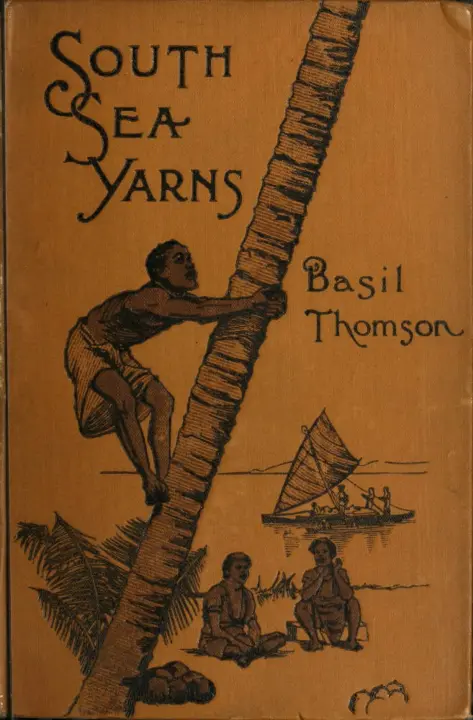
"South Sea Yarns" by Basil Thomson is a collection of narratives illustrated with vivid descriptions, likely written in the late 19th century. The book explores life in the South Pacific Islands, focusing on the customs, court systems, and interactions between local inhabitants and foreign influences. Through a blend of storytelling and observation, Thomson sheds light on the complexities of cultural exchanges and the impact of colonialism. The opening of "South Sea Yarns" introduces a gathering in the traditional "bure" (a Fijian house) where elders recount tales of the past, reflecting on their experiences with foreigners and the changes brought about by outside influences. As the characters discuss recent encounters with Europeans, their skepticism and admiration surface, showcasing the tension between tradition and modernity. The scene is rich with sensory details, from the smell of the cooking meats to the murmurs of the assembled crowd, establishing an intimate setting where story and culture intertwine, setting the stage for further exploration of life in Fiji.
Introduction adapted from the source catalogue; source summaries may be automatically generated.
Free to read · English · 71,024 words · No account needed
MAKE TIME FOR A GOOD BOOK
On by default. Untick to stop anonymous reading totals. Each page counts after 10 seconds in view. How this works.
Anonymous counting is on unless you have switched it off.
Benion had had alternate fits of deep dejection and impotent fury since the destruction of the schooner. He spoke to no one, and would not eat his ration of biscuit though he drank his water greedily. At times he would start up, kneeling on the sand and shaking his fist at the sky and sea, shouting blasphemies learned at the diggings but forgotten till now; at others he lay for hours, face downwards, on the sand, pillowing his head upon his arm. The men thought him mad and avoided him, and Allen was glad of any excuse for keeping away from him. But on the day before the projected start he had shown no violence, but had lain motionless on the ground hour after hour. They discussed him over the fire at night.
“A chap as won’t eat, and has the jimmies, ain’t long for this world,” said the boatswain, summing up.
“Wish he’d look sharp about it,” growled another; “we don’t want chaps seein’ snakes aboard that craft.” And he pointed to the boat. Allen had been the first to notice Benion’s change of manner, and it filled him with something like remorse. But it was too late to turn back now. After all, if the box had been really lost, as it well might have been, Benion would have had to bear his loss, and he must learn to bear it now. Besides, perhaps he would tell him if they got safe out of the island. Yes; he would tell him, but not now while he was in this state. But however he tried to comfort himself, he was too uneasy to lie down with the other men, who were laying in a stock of sleep for their journey on the morrow. In the dim light of the stars he could see, just beyond the shadow of the trees, a figure sitting on the sand looking seaward, and could hear a few broken words brought to him by the night breeze. He could feel, though he could not see, the fierce eyes with a life’s longing written in them. He got up once intending to go and speak to Benion, but abandoned the idea before he reached him, so terrible did he seem in his despair; so he lay down watching him, and trying to drive back his better feelings. About midnight he was almost dozing when he sprang into wakefulness at the sound of his own name coupled with a horrible blasphemy. Benion was kneeling erect, his right arm extended seawards and clutching the back of his neck with his left, declaiming passionately. Suddenly he turned, and falling on his hands and knees, began to crawl towards the tree under which the captain and officers of the ship were asleep. He passed into the shadow of the trees, and for a moment was lost to sight. A horrible fear seized Allen that he was mad and intended to kill some one, but uncertainty prevented him from moving. A ray of light from one of the fires faintly illumined the tree-trunk, and into this the crawling figure emerged from the darkness. Yes; it must be murder that he intended, for now he saw him grasp the captain’s gun that was leaning against the tree, but before he could start forward he was crawling away as swiftly and noiselessly as he had come, dragging the gun after him. Then it was not murder of another but of himself. Now he was out again on the sand, and scuffling along the beach upon his left foot and his right knee, nearly as fast as a man could walk. Allen was too horrified to act--he could only watch the receding figure with terror and bewilderment; and with that strange perversity of humour it crossed his mind how funny Benion looked scuffling along with his gun over his shoulder. But when the figure disappeared behind a protruding tree, he yielded to the impulse to follow and watch him. Perhaps he did not mean to kill himself after all. He came out upon the sands, keeping in the shadow of the trees, and near enough to Benion to distinguish his figure in the dim light. After going a couple of hundred yards the hobbling figure became more distinct, and Allen saw that he had stopped. There was not more than twenty yards between them, and he sought for a deeper shadow in which to stand. Just before him was a tree with low widespreading branches, that threw the trunk into profound darkness. He crept towards it, lifting his feet high and planting them softly on the sand. Something struck him as familiar in the trunk as he neared it. Yes. Surely it was the tree under which the box was buried! Had Benion halted there by chance, or because he knew the spot? He turned to look for him, and saw that he was creeping towards the tree on the other side of the trunk. Then he must know the spot, and he had brought the gun to defend him from interference. Allen would have run away but for the fear of being overheard. Benion was on his knees now not five yards from him. He could hear his labouring breath, and the rustle of the sand as he dragged his wounded leg over it. As he came up Allen moved so as to keep the tree between them. He stopped at the very edge of the pile of sand and vines that hid the box, and sat down. How did he know so well that it was there without feeling for it? He was going to dig it up with his hands! He must get his breath first, though. Was this the time to rest when any of the men might interrupt him? But no, he was not resting, he was doing something. He was measuring the distance with his gun, pushing the butt forward in the sand, so; or was he going to dig with it that he leaned forward and put his foot against the trigger-guard as a fulcrum? Good God! No; his head is against the muzzle! “Benion!”
Your reading position is saved on this browser. Take it to another device with a library code. Reading pages adapt to text, rather than matching a printed edition.
Basil Thomson

Basil Thomson
Basil Thomson
BEHIND THE BOOK
This eBook is for the use of anyone anywhere in the United States and most other parts of the world at no cost and with almost no restrictions whatsoever. You may copy it, give it away or re-use it under the terms of the Project Gutenberg License included with this eBook or online at www.gutenberg.org. If you are not located in the United States, you will have to check the laws of the country where you are located before using this eBook. Read the source licence.
The original source file, including credits and licence, is retained by this library. Request an original-format copy at no charge. Please include the book title and Project Gutenberg identifier #66195.
KEEP YOUR CURIOSITY GOING
Wilfrid Scawen Blunt
Wilfrid Scawen Blunt

E. W. (Edgar Watson) Howe
Coulson Kernahan

Maurice Baring
Frances Wright