THE CLASSIC COLLECTION✦Queer peopleCLASSIC FREE BOOKS
Queer people
Basil Thomson
THE CLASSIC COLLECTION · 1894
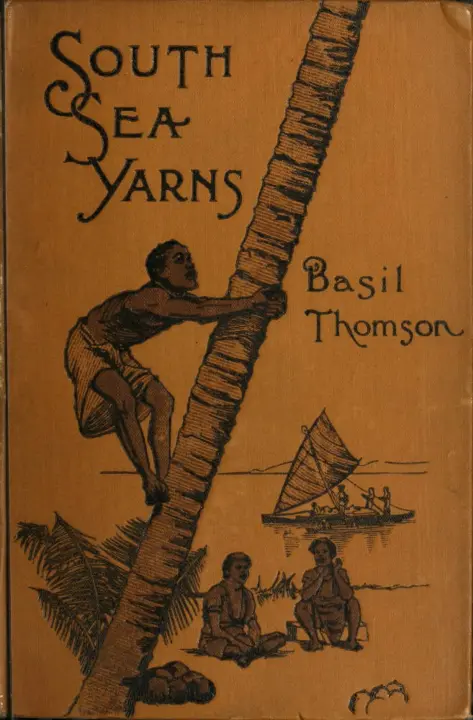
"South Sea Yarns" by Basil Thomson is a collection of narratives illustrated with vivid descriptions, likely written in the late 19th century. The book explores life in the South Pacific Islands, focusing on the customs, court systems, and interactions between local inhabitants and foreign influences. Through a blend of storytelling and observation, Thomson sheds light on the complexities of cultural exchanges and the impact of colonialism. The opening of "South Sea Yarns" introduces a gathering in the traditional "bure" (a Fijian house) where elders recount tales of the past, reflecting on their experiences with foreigners and the changes brought about by outside influences. As the characters discuss recent encounters with Europeans, their skepticism and admiration surface, showcasing the tension between tradition and modernity. The scene is rich with sensory details, from the smell of the cooking meats to the murmurs of the assembled crowd, establishing an intimate setting where story and culture intertwine, setting the stage for further exploration of life in Fiji.
Introduction adapted from the source catalogue; source summaries may be automatically generated.
Free to read · English · 71,024 words · No account needed
MAKE TIME FOR A GOOD BOOK
On by default. Untick to stop anonymous reading totals. Each page counts after 10 seconds in view. How this works.
Anonymous counting is on unless you have switched it off.
As she came up into the wind a sea struck her forward and stopped her dead, the next seemed to hurl her sideways, and before she could get way on she fell with a reeling shock upon the reef, rolled sideways amid the boiling surf, and each successive wave fell upon her with a hungry yell and swept her from stem to stern, hammering and grinding the wounded hull upon the sharp coral.
At the first shock Benion fell against the starboard bulwarks, and before he could grasp the slippery rail a great sea swept the deck and washed him to leeward into the darkness. Dazed and without power of reasoning, he allowed himself to drift, instinctively keeping his body upright in the water.
Allen meanwhile was still on the doomed ship. He was asleep when she struck, and the shock flung him out of his bunk against the opposite bulk-head. Bruised and stunned as he was, he realised what had happened. The floor of the cabin was at a sharp angle, and the bilge timbers groaned and cracked as each pitiless sea lifted the ship and dashed her on the reef with a grinding crash. To steady himself against the shocks he planted his foot against a box over which the water was washing. It was Benion’s strong box, that had slid from its lashings under the bunk. What were life worth, he thought, to either of them if this were lost? It were better to die trying to save their fortune than to battle for life, leaving this to certain destruction in the wreck. He grasped it by the iron handle and dragged it up the companion, using all his strength, for it was heavy, and the ladder slanted at a sharp angle. Holding on by the brass rail, he looked out upon the slippery decks. The top-mast, with all its ruin of yards, ropes, and blocks, swung heavily by the wire-rigging and thrashed the deck at every heave of the hull, and several of the crew were hacking at the foremast with an axe. Nearer to him, in the waist of the ship, three men seemed to be making a raft by lashing some spare planks and spars together. Suddenly, with a splitting noise, the foremast with all its wreckage went overboard, and the schooner partly righted herself. As each sea lifted her she gradually came up head to wind, for both anchors had been let go; and she lay there for a space without lifting to the seas, for she was now waterlogged. The crest of every sea swept the decks; but Allen, though blinded and suffocated by the spray, still held firmly to the cabin-trunk, which protected him from the waves. But a huge sea, gathering volume in the shallow water, swept roaring down upon them, and trembling over the bows, carried everything before it. The whole cabin-trunk gave way with the wrench, and Allen suddenly found himself up to his neck in the water, away from the ship, but still clinging to the brass rail of the cabin-trunk, and still holding the iron handle of Benion’s box in his right hand. The water splashing in his face impeded both breath and vision, but he thought he could see the dim outline of the ship to windward. The water was almost calm around him, for he was floating inside the reef, but there was sufficient “send” in the waves to set him steadily inshore. At last the cabin-trunk grounded, rose again for the next wave, struck more heavily, and remained immovable, while the waves surged powerlessly round it. The water was only waist-deep, and Allen, still grasping the precious box, stumbled over the rough coral until he found himself on dry sand, dripping and chilled to the bone by the wind, warm though it was. A dark wall of bush close to him recalled grim stories of cannibal natives. If he was in danger, the first thing to be done was to hide the box. Full of this one thought, he dragged it by the handle through the soft sand into the shadow of the trees. The ground was carpeted with the leaves of some trailing vine, that caught his feet and would have thrown him had he not recovered himself against the trunk of a tree. He felt it with his hands. It was gnarled and knotted, and of so great a girth that his extended arms would not reach the half of its circumference. This would be a landmark, he thought, for it must be larger than its fellows. He knelt down and plunged his hands into the sand at the root, tearing up the vines, and scooping out a hole large enough to hold the box; but when he began to lower it into the hole the corners caught the loose sand and half-filled the hole. A third of the box remained above ground, but he dared not delay, for a nervous terror of interruption had seized him. Through the roar of the wind he fancied that he heard other sounds. He shovelled the loose sand against the sides of the box, and, tearing up the vines within his reach, he piled them above it. Then he stood up with a strange feeling of safety and self-reliance. Come what might, if he and Benion escaped, their money was safe. But where was Benion? He remembered for the first time that he had not seen him since the evening. What if he was the only man left alive? It was a new thought, terrible at first until he remembered the box buried at his feet. If Benion were dead, then all would be his lawfully and without blame. What possibilities would life then have? He had often dreamed on the diggings of what it would be to be rich, but the possibility of riches for him had never seemed near until this moment. He knew the disloyalty of the thought, for close upon its heels came a half-formed wish that Benion might be dead. Gratitude had not died out before this great temptation, for he could be grateful to his benefactor’s memory if he could no longer show gratitude to him in the flesh.
Your reading position is saved on this browser. Take it to another device with a library code. Reading pages adapt to text, rather than matching a printed edition.
Basil Thomson

Basil Thomson
Basil Thomson
BEHIND THE BOOK
This eBook is for the use of anyone anywhere in the United States and most other parts of the world at no cost and with almost no restrictions whatsoever. You may copy it, give it away or re-use it under the terms of the Project Gutenberg License included with this eBook or online at www.gutenberg.org. If you are not located in the United States, you will have to check the laws of the country where you are located before using this eBook. Read the source licence.
The original source file, including credits and licence, is retained by this library. Request an original-format copy at no charge. Please include the book title and Project Gutenberg identifier #66195.
KEEP YOUR CURIOSITY GOING
Wilfrid Scawen Blunt
Wilfrid Scawen Blunt

E. W. (Edgar Watson) Howe
Coulson Kernahan

Maurice Baring
Frances Wright