THE CLASSIC COLLECTION✦The art of fictionCLASSIC FREE BOOKS
The art of fiction
Walter Besant
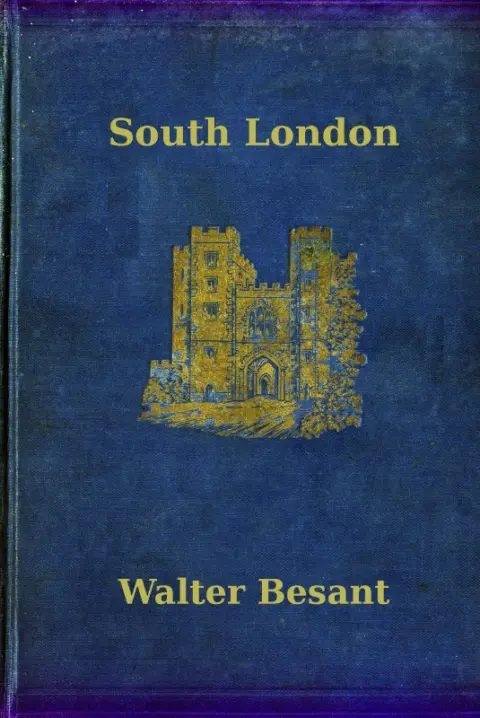
THE CLASSIC COLLECTION · 1898
"South London" by Walter Besant is a historical account written in the late 19th century. The work explores the history and evolution of South London, presenting a vivid picture of its geography, settlements, and the daily lives of its inhabitants from the earliest times through significant historical events. Through a series of episodes and characters, Besant aims to bring to life the conditions, customs, and social fabric of this area, which was characterized by its marshy landscape and rich history. At the start of the book, the author outlines the purpose of the work, clarifying that he does not intend to provide a continuous history but rather a collection of episodes that illustrate the life and character of South London. He describes the geographical boundaries of the region, which stretches from Battersea to Greenwich and emphasizes its original state as an extensive marsh. Besant traces the early settlements and trade routes that began to emerge as the land was gradually inhabited, highlighting the establishment of causeways and the first signs of human life amid the natural landscape. The writing sets a tone of exploration and admiration for the area’s history, positioning South London not just as a setting but as a dynamic entity shaped by the countless stories of its people through the ages.
Introduction adapted from the source catalogue; source summaries may be automatically generated.
Free to read · English · 91,365 words · No account needed
MAKE TIME FOR A GOOD BOOK
On by default. Untick to stop anonymous reading totals. Each page counts after 10 seconds in view. How this works.
Anonymous counting is on unless you have switched it off.
There was a Palace, or House, here of some kind in very ancient times. The historian says that he cannot ascertain when the Palace was built (see p. 74). Since the origin of the House is unknown, he argues that it must have been ancient. Now, concerning its connections with our Kings and Queens, there is quite a long list. All these lists would have to be catalogued, and even then be forgotten. For instance, the following list of visits I borrow from Lysons. But I cannot pretend that it is of much interest.
In the year 1270 Henry III. kept Christmas at his Palace of Eltham with the Queen and his nobles. After this the name of Anthony Bec, Bishop of Durham and Patriarch of Jerusalem, is connected with the place. He built a great deal, but I know not if any ruins of his yet remain. He died at Eltham in 1311, presumably in the Palace, for there seem to have been no other buildings. Now we come back to the kings, and we find historical associations in plenty, though not of a kind which is moving or interesting. It does not excite our curiosity much to learn that this king or that king kept Christmas here, and yet that is the kind of association which I have to offer. Edward the Second was often here: perhaps the seclusion of the place enabled him to play his favourite games with his followers without being overseen. One of his sons, John of Eltham, was born here. Edward III., when still under age, had a Parliament at Eltham in 1329. In 1347 his son Lionel kept Christmas for him at Eltham. In 1364 he entertained here the French king John, his prisoner. In 1375 he held another Parliament here, when the Commons petitioned him to make Richard, his grandson, Prince of Wales. Richard the Second, as we should expect, regarded Eltham with a peculiar affection; it was beautiful; the buildings were splendid. It was a long way from the City which took upon itself to remonstrate with his extravagance. Three times at least he kept Christmas here: on the last he entertained Leo, King of Armenia, with great splendour and profusion. Henry the Fourth kept Christmas four times in the Palace. On the first, the Aldermen of London and their children went down from the City to perform a masque before the King, who received it well. At that moment he was certain to receive everything well that came from the City. On his last visit the disease broke out which killed him. Henry the Fifth was here once, in 1414: Henry the Sixth once, in 1429. Edward the Fourth was a second Founder, so much did he add to the buildings. Among other things, he built a new front to the Palace and is said to have built the Banqueting Hall itself. His festivities rivalled those of Richard the Second. Here his daughter Bridget, afterwards a nun of Dartford, was born. Henry the Seventh was another builder: he stayed at Eltham often. Henry the Eighth came here once at least, but he preferred Greenwich as a residence as soon as that house was built. Elizabeth also came here only once or twice, preferring Greenwich, and James the First is only recorded to have visited Eltham once. After this time Eltham ceased to be a Palace. In 1646 Robert Earl of Essex died here[1]; the Manor was sold after Charles's death. After the Restoration it reverted to the Crown; the rest of the history concerns its occupancy by private families. On the death of Charles the Palace was surveyed; it is described as being built of brick, stone, and timber; it contained (see p. 74) one chapel, a hall, 36 rooms and offices below stairs, with two large cellars; and above stairs 17 lodging houses on the King's side, 12 on the Queen's side, and 9 on the Prince's side; and 78 rooms in the offices round the courtyard, which contained one acre of ground: the house was out of repair and uninhabitable. There were gardens attached to the house. A moat surrounded the house, of width 60 feet, except in the forest, where it was 115 feet. The moat still exists on the north side, and can be traced all round. Of the buildings little remains except the old Banqueting Hall, a truly beautiful ruin; the roof, with its fine woodwork, is happily still standing, but shored up and supported. The windows are mostly blocked up; fragments only remain of the other buildings; but it is said to be possible, in the gardens at the back, to trace out the courts and the foundations of the chapel and offices. The Palace is approached by a bridge of about the same date as the Palace, viz. the fourteenth century. It crosses the moat, and with its picturesque ivy-clad arches and the Banqueting Hall on one side, and the Court House on the other, it is as lovely an approach to the ruin as could well be imagined or created.
Your reading position is saved on this browser. Take it to another device with a library code. Reading pages adapt to text, rather than matching a printed edition.
Walter Besant
Walter Besant

Walter Besant

Walter Besant
BEHIND THE BOOK
This eBook is for the use of anyone anywhere in the United States and most other parts of the world at no cost and with almost no restrictions whatsoever. You may copy it, give it away or re-use it under the terms of the Project Gutenberg License included with this eBook or online at www.gutenberg.org. If you are not located in the United States, you will have to check the laws of the country where you are located before using this eBook. Read the source licence.
The original source file, including credits and licence, is retained by this library. Request an original-format copy at no charge. Please include the book title and Project Gutenberg identifier #44683.
KEEP YOUR CURIOSITY GOING
Wilfrid Scawen Blunt
Wilfrid Scawen Blunt

E. W. (Edgar Watson) Howe
Cécile Tormay

Moritz Busch
John L. Ransom