READ · DISCOVER · ENJOYClassic literature · Always free
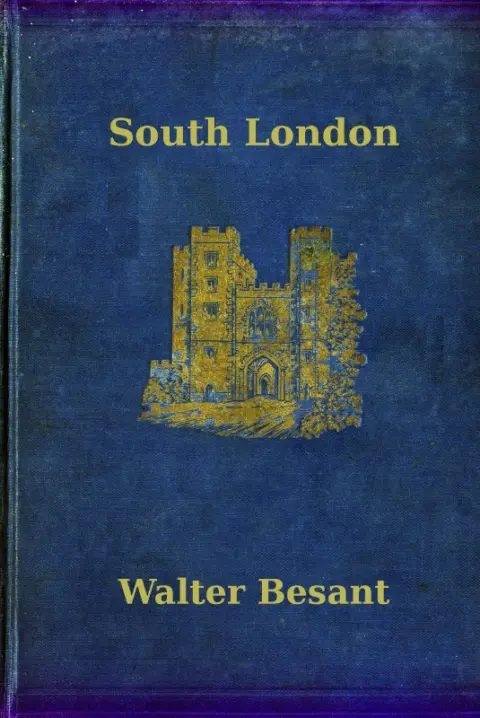
South London — digital edition cover

THE CLASSIC COLLECTION · 1898

South London

"South London" by Walter Besant is a historical account written in the late 19th century. The work explores the history and evolution of South London, presenting a vivid picture of its geography, settlements, and the daily lives of its inhabitants from the earliest times through significant historical events. Through a series of episodes and characters, Besant aims to bring to life the conditions, customs, and social fabric of this area, which was characterized by its marshy landscape and rich history. At the start of the book, the author outlines the purpose of the work, clarifying that he does not intend to provide a continuous history but rather a collection of episodes that illustrate the life and character of South London. He describes the geographical boundaries of the region, which stretches from Battersea to Greenwich and emphasizes its original state as an extensive marsh. Besant traces the early settlements and trade routes that began to emerge as the land was gradually inhabited, highlighting the establishment of causeways and the first signs of human life amid the natural landscape. The writing sets a tone of exploration and admiration for the area’s history, positioning South London not just as a setting but as a dynamic entity shaped by the countless stories of its people through the ages.

Introduction adapted from the source catalogue; source summaries may be automatically generated.

Start reading ↓

Free to read · English · 91,365 words · No account needed

MAKE TIME FOR A GOOD BOOK

South London

On by default. Untick to stop anonymous reading totals. Each page counts after 10 seconds in view. How this works.

Anonymous counting is on unless you have switched it off.

South London

There is a passage quoted in Chambers's 'Book of Days,' which I should like to transfer with acknowledgments to this page. It is from the 'Connoisseur' of 1755, and discusses a Vauxhall slice of ham.

'When it was brought, our honest friend twirled the dish about three or four times, and surveyed it with a settled countenance. Then taking up a slice of the ham on the point of his fork, and dangling it to and fro, he asked the waiter how much there was of it. "A shilling's worth, sir," said the fellow. "Prithee," said the cit, "how much dost think it weighs?" "An ounce, sir." "Ah! a shilling an ounce, that is sixteen shillings per pound; a reasonable profit, truly! Let me see. Suppose, now, the whole ham weighs thirty pounds: at a shilling per ounce, that is sixteen shillings per pound. Why, your master makes exactly twenty-four pounds off of every ham; and if he buys them at the best hand, and salts and cures them himself, they don't stand him in ten shillings a-piece!"'

In 1841 there seemed every prospect that the gardens would be closed; they were not closed, however, but were reopened and continued open until the year 1859, where they were finally closed and the farewell night was celebrated.

The scare, however, in 1841 produced in June a brief history of Vauxhall Gardens in one of the morning papers--I do not know which--I have it as a cutting only. It is as follows:

'Vauxhall Gardens are announced for public sale under Gye and Hughes's bankruptcy, and their past celebrity deserves a notice, if only as a memento of the pleasure the old and young have experienced in their delightful retreats, while their hundredfold associations, such as the journey of Sir Roger de Coverley to the gardens, old Jonathan Tyers, and the paintings in the pavilions by Hayman and Hogarth, create an interest seldom to be met with. The gardens derive their name from the manor of Vauxhall, or Faukeshall, but the tradition that the property belonged to Guy Fawkes is erroneous. The premises were in 1615 the property of Jane Vaux, and the mansion was then called Stockdens. The gardens appear to have been originally planted with trees and laid out into walks for the pleasure of a private gentleman, Sir Samuel Moreland, who displayed in his house and gardens many whimsical proofs of his skill in mechanics. It is said these gardens were planted in the reign of Charles I.; nor is it improbable, since, according to Aubrey, they were well known in 1667, when Sir Samuel Moreland, the proprietor, added a public room to them, "the inside of which," he says, "is all looking-glass and fountains and very pleasant to behold, and which is much visited by strangers." The time when they were first opened for the entertainment of the public is involved in some uncertainty; their celebrity is, however, established to be upwards of a century and a half old. In the reign of Queen Anne they appear to have been a place of great public resort, for in the "Spectator," No. 383, dated May 20, 1712, Addison has introduced Sir Roger de Coverley as accompanying him in a voyage from Temple-stairs to Vauxhall, then called Spring Gardens. He says: "We made the best of our way to Foxhall;" and describes the gardens as "exceedingly pleasant at this time of the year. When I considered the fragrancy of the walks and bowers with the choirs of birds that sung upon the trees and the tribe of people that walked under their shades, I could not but look on this place as a sort of Mohammedan Paradise." Masks were then worn, at least by some visitors, for Addison talks of "a mask tapping Sir Roger on the shoulder and inviting him to drink a bottle of mead with her." A glass of Burton ale and a slice of hung beef formed the supper of the party. The place, however, resembled a tea-garden of our days till the year 1730, when Mr. Jonathan Tyers took a lease of the premises, and shortly afterwards opened Vauxhall with a Ridotto al Fresco. The novelty of the term attracted great numbers, and Mr. Tyers was so successful in occasional repetitions as to be induced to open the gardens every evening during the summer. Hogarth at this time had lodgings at Lambeth-terrace, and, becoming intimate with Tyers, was induced to embellish the gardens with his designs, in which he was joined by Hayman. The house which he occupied is still shown, and a vine pointed out which he planted. Tyers's improvements consisted of sweeps of pavilions and saloons, in which these paintings were placed. He also erected an orchestra, engaged a band of music, and placed a fine statue of Handel by Roubiliac in a conspicuous part of the gardens. Mr. Cunningham dates the appearance of this statue, which was Roubiliac's earliest work, at 1732. Mr. Tyers afterwards purchased the whole of the estate, which is copyhold of inheritance, and held of the Prince of Wales, as lord of Kennington manor, in right of his Duchy of Cornwall. The gardens were originally opened daily (Sunday excepted), and till the year 1792 the admission was 1s.; it was then raised to 2s.; including tea and coffee; in 1809 several improvements were made, lamps added, &c., the price was raised to 3s. 6d., and the gardens were only opened three nights in the week; in 1821 the price was again raised to 4s. Upon the death of Mr. Jonathan Tyers, the gardens became the property of Mr. Bryant Barrett, who married the granddaughter of the original proprietor. They next descended to Mr. Barrett's sons, and from them by right of purchase to the late proprietors. Mr. Thomas Tyers, a son of the famous Jonathan Tyers, and author of "Biographical Sketches of Johnson," and "Political Conferences," who died on February 1, 1787, contributed many poetic trifles to the gardens. The representation of the Ridotto al Fresco is thus described by one of the newspapers of June 21, 1732: "On Wednesday, at the Ridotto al Fresco at Vauxhall, there was not one half of the company as was expected, being no more than 203 persons, amongst whom were several persons of distinction, but more ladies than gentlemen, and the whole was managed with great order and decency; a detachment of 100 of the Foot Guards being posted round the gardens. A waiter belonging to the house having got drunk put on a dress and went to fresco with the rest of the company, but being discovered he was immediately turned out of doors." The season of 1739 was for three months, and the admittance was by silver tickets. The proprietors then announced that "1,000 tickets would only be delivered at 25s. each, the silver of every ticket to be worth 3s. 2d., and to admit two persons every evening (Sunday excepted) during the season." It appears that these silver tickets were struck after designs by Hogarth, and a plate of some of them shows the following:--Mr. John Hinton, 212, 1794; on the reverse side the figure of Calliope. Mr. Wood, 63, 1750; on the reverse side three boys playing with a lyre, and the motto "Jocosæ conveniunt Lyræ." Mr. R. Frankling, 70; on the reverse side figure of Euterpe. Mr. Samuel Lewes, 87; on the reverse side the figure of Erato. Mr. Carey, 11; on the reverse side the figure of Thalia. This plate also exhibits the gold ticket, a perpetual admission given to Hogarth by Jonathan Tyers, in gratitude for his advice and assistance in decorating the gardens. After his decease it remained in the hands of Mrs. Hogarth, his widow, who bequeathed it to her relation, Mrs. Mary Lewis, who subsequently left it to Mr. P. F. Hart, who in his will, in 1823, bequeathed it to Mr. John Tuck. It is hardly necessary to say that the ticket is after Hogarth's own design. The face of it presents the word "Hogarth," in a bold hand, beneath which is "In perpetuam beneficii memoriam." On the reverse there are two figures, surrounded with the motto, "Virtus voluptas felices una." It also appears that Roubiliac furnished a statue of Milton for the gardens. Among the singers Beard and Lowe were early favourites; then came Dignum, Mrs. Weichsel, Mrs. Billington, Signora Storace, Incledon, Mrs. Bland, &c. In later years, Misses Tunstall, Noel, Melville, and Williams; Stephens, Love, Madame Cornega, and Madame Vestris; Mr. Braham, Mr. Sinclair, Mr. Robinson, and Signor de Begnis, &c., with Signor Spagnoletti as leader.'

Your reading position is saved on this browser. Take it to another device with a library code. Reading pages adapt to text, rather than matching a printed edition.

More from this author

BEHIND THE WORDS

About Walter Besant

Walter Besant (1836–1901). Explore The art of fiction, The Master Craftsman, London in the Time of the Tudors and other works in this collection. These books span classic fiction, essays & ideas, history.

Explore this author’s books →

THE READERS’ VERDICT

How did this story stay with you?

Not rated yet
Your rating for South London

Be the first to share your verdict.

One rating per browser, which you can change or remove. A necessary browser identifier remembers your vote. How ratings work

A GOOD STORY DESERVES COMPANY

Pass this book along.

A great read is even better when it’s shared.

SEND A LITTLE INSPIRATION

Share this book

BEHIND THE BOOK

Edition & source details.

Title
South London
Author
Walter Besant
First publication (Open Library catalogue match)
1898
Digital edition publisher
Project Gutenberg
Gutenberg release date
2014-01-16
Language
English
Source edition imprint
Not stated in source catalogue
Source identifier
Project Gutenberg #44683
Contributors
Francis Sylvester Walker (ill)

Public-domain source & licence

This eBook is for the use of anyone anywhere in the United States and most other parts of the world at no cost and with almost no restrictions whatsoever. You may copy it, give it away or re-use it under the terms of the Project Gutenberg License included with this eBook or online at www.gutenberg.org. If you are not located in the United States, you will have to check the laws of the country where you are located before using this eBook. Read the source licence.

Full source licence and obtaining an original copy

The original source file, including credits and licence, is retained by this library. Request an original-format copy at no charge. Please include the book title and Project Gutenberg identifier #44683.

the full Project Gutenberg License must appear
prominently whenever any copy of a Project Gutenberg work (any work
on which the phrase “Project Gutenberg” appears, or with which the
phrase “Project Gutenberg” is associated) is accessed, displayed,
performed, viewed, copied or distributed:

This eBook is for the use of anyone anywhere in the United States and most
other parts of the world at no cost and with almost no restrictions
whatsoever. You may copy it, give it away or re-use it under the terms
of the Project Gutenberg™ License included with this eBook or online
at www.gutenberg.org. If you
are not located in the United States, you will have to check the laws
of the country where you are located before using this eBook.

1.E.2. If an individual Project Gutenberg electronic work is
derived from texts not protected by U.S. copyright law (does not
contain a notice indicating that it is posted with permission of the
copyright holder), the work can be copied and distributed to anyone in
the United States without paying any fees or charges. If you are
redistributing or providing access to a work with the phrase “Project
Gutenberg” associated with or appearing on the work, you must comply
either with the requirements of paragraphs 1.E.1 through 1.E.7 or
obtain permission for the use of the work and the Project Gutenberg
trademark as set forth in paragraphs 1.E.8 or 1.E.9.

1.E.3. If an individual Project Gutenberg electronic work is posted
with the permission of the copyright holder, your use and distribution
must comply with both paragraphs 1.E.1 through 1.E.7 and any
additional terms imposed by the copyright holder. Additional terms
will be linked to the Project Gutenberg License for all works
posted with the permission of the copyright holder found at the
beginning of this work.

1.E.4. Do not unlink or detach or remove the full Project Gutenberg
License terms from this work, or any files containing a part of this
work or any other work associated with Project Gutenberg.

1.E.5. Do not copy, display, perform, distribute or redistribute this
electronic work, or any part of this electronic work, without
prominently displaying the sentence set forth in paragraph 1.E.1 with
active links or immediate access to the full terms of the Project
Gutenberg License.

1.E.6. You may convert to and distribute this work in any binary,
compressed, marked up, nonproprietary or proprietary form, including
any word processing or hypertext form. However, if you provide access
to or distribute copies of a Project Gutenberg work in a format
other than “Plain Vanilla ASCII” or other format used in the official
version posted on the official Project Gutenberg website
(www.gutenberg.org), you must, at no additional cost, fee or expense
to the user, provide a copy, a means of exporting a copy, or a means
of obtaining a copy upon request, of the work in its original “Plain
Vanilla ASCII” or other form. Any alternate format must include the
full Project Gutenberg License as specified in paragraph 1.E.1.

1.E.7. Do not charge a fee for access to, viewing, displaying,
performing, copying or distributing any Project Gutenberg works
unless you comply with paragraph 1.E.8 or 1.E.9.

1.E.8. You may charge a reasonable fee for copies of or providing
access to or distributing Project Gutenberg electronic works
provided that:

• You pay a royalty fee of 20% of the gross profits you derive from
the use of Project Gutenberg works calculated using the method
you already use to calculate your applicable taxes. The fee is owed
to the owner of the Project Gutenberg trademark, but he has
agreed to donate royalties under this paragraph to the Project
Gutenberg Literary Archive Foundation. Royalty payments must be paid
within 60 days following each date on which you prepare (or are
legally required to prepare) your periodic tax returns. Royalty
payments should be clearly marked as such and sent to the Project
Gutenberg Literary Archive Foundation at the address specified in
Section 4, “Information about donations to the Project Gutenberg
Literary Archive Foundation.”

• You provide a full refund of any money paid by a user who notifies
you in writing (or by e-mail) within 30 days of receipt that s/he
does not agree to the terms of the full Project Gutenberg™
License. You must require such a user to return or destroy all
copies of the works possessed in a physical medium and discontinue
all use of and all access to other copies of Project Gutenberg™
works.

• You provide, in accordance with paragraph 1.F.3, a full refund of
any money paid for a work or a replacement copy, if a defect in the
electronic work is discovered and reported to you within 90 days of
receipt of the work.

• You comply with all other terms of this agreement for free
distribution of Project Gutenberg™ works.


1.E.9. If you wish to charge a fee or distribute a Project
Gutenberg™ electronic work or group of works on different terms than
are set forth in this agreement, you must obtain permission in writing
from the Project Gutenberg Literary Archive Foundation, the manager of
the Project Gutenberg™ trademark. Contact the Foundation as set
forth in Section 3 below.

1.F.

1.F.1. Project Gutenberg volunteers and employees expend considerable
effort to identify, do copyright research on, transcribe and proofread
works not protected by U.S. copyright law in creating the Project
Gutenberg™ collection. Despite these efforts, Project Gutenberg™
electronic works, and the medium on which they may be stored, may
contain “Defects,” such as, but not limited to, incomplete, inaccurate
or corrupt data, transcription errors, a copyright or other
intellectual property infringement, a defective or damaged disk or
other medium, a computer virus, or computer codes that damage or
cannot be read by your equipment.

1.F.2. LIMITED WARRANTY, DISCLAIMER OF DAMAGES - Except for the “Right
of Replacement or Refund” described in paragraph 1.F.3, the Project
Gutenberg Literary Archive Foundation, the owner of the Project
Gutenberg™ trademark, and any other party distributing a Project
Gutenberg™ electronic work under this agreement, disclaim all
liability to you for damages, costs and expenses, including legal
fees. YOU AGREE THAT YOU HAVE NO REMEDIES FOR NEGLIGENCE, STRICT
LIABILITY, BREACH OF WARRANTY OR BREACH OF CONTRACT EXCEPT THOSE
PROVIDED IN PARAGRAPH 1.F.3. YOU AGREE THAT THE FOUNDATION, THE
TRADEMARK OWNER, AND ANY DISTRIBUTOR UNDER THIS AGREEMENT WILL NOT BE
LIABLE TO YOU FOR ACTUAL, DIRECT, INDIRECT, CONSEQUENTIAL, PUNITIVE OR
INCIDENTAL DAMAGES EVEN IF YOU GIVE NOTICE OF THE POSSIBILITY OF SUCH
DAMAGE.

1.F.3. LIMITED RIGHT OF REPLACEMENT OR REFUND - If you discover a
defect in this electronic work within 90 days of receiving it, you can
receive a refund of the money (if any) you paid for it by sending a
written explanation to the person you received the work from. If you
received the work on a physical medium, you must return the medium
with your written explanation. The person or entity that provided you
with the defective work may elect to provide a replacement copy in
lieu of a refund. If you received the work electronically, the person
or entity providing it to you may choose to give you a second
opportunity to receive the work electronically in lieu of a refund. If
the second copy is also defective, you may demand a refund in writing
without further opportunities to fix the problem.

1.F.4. Except for the limited right of replacement or refund set forth
in paragraph 1.F.3, this work is provided to you ‘AS-IS’, WITH NO
OTHER WARRANTIES OF ANY KIND, EXPRESS OR IMPLIED, INCLUDING BUT NOT
LIMITED TO WARRANTIES OF MERCHANTABILITY OR FITNESS FOR ANY PURPOSE.

1.F.5. Some states do not allow disclaimers of certain implied
warranties or the exclusion or limitation of certain types of
damages. If any disclaimer or limitation set forth in this agreement
violates the law of the state applicable to this agreement, the
agreement shall be interpreted to make the maximum disclaimer or
limitation permitted by the applicable state law. The invalidity or
unenforceability of any provision of this agreement shall not void the
remaining provisions.

1.F.6. INDEMNITY - You agree to indemnify and hold the Foundation, the
trademark owner, any agent or employee of the Foundation, anyone
providing copies of Project Gutenberg™ electronic works in
accordance with this agreement, and any volunteers associated with the
production, promotion and distribution of Project Gutenberg™
electronic works, harmless from all liability, costs and expenses,
including legal fees, that arise directly or indirectly from any of
the following which you do or cause to occur: (a) distribution of this
or any Project Gutenberg work, (b) alteration, modification, or
additions or deletions to any Project Gutenberg work, and (c) any
Defect you cause.

Section 2. Information about the Mission of Project Gutenberg

Project Gutenberg is synonymous with the free distribution of
electronic works in formats readable by the widest variety of
computers including obsolete, old, middle-aged and new computers. It
exists because of the efforts of hundreds of volunteers and donations
from people in all walks of life.

Volunteers and financial support to provide volunteers with the
assistance they need are critical to reaching Project Gutenberg’s
goals and ensuring that the Project Gutenberg collection will
remain freely available for generations to come. In 2001, the Project
Gutenberg Literary Archive Foundation was created to provide a secure
and permanent future for Project Gutenberg and future
generations. To learn more about the Project Gutenberg Literary
Archive Foundation and how your efforts and donations can help, see
Sections 3 and 4 and the Foundation information page at www.gutenberg.org.

Section 3. Information about the Project Gutenberg Literary Archive Foundation

The Project Gutenberg Literary Archive Foundation is a non-profit
501(c)(3) educational corporation organized under the laws of the
state of Mississippi and granted tax exempt status by the Internal
Revenue Service. The Foundation’s EIN or federal tax identification
number is 64-6221541. Contributions to the Project Gutenberg Literary
Archive Foundation are tax deductible to the full extent permitted by
U.S. federal laws and your state’s laws.

The Foundation’s business office is located at 41 Watchung Plaza #516,
Montclair NJ 07042, USA, +1 (862) 621-9288. Email contact links and up
to date contact information can be found at the Foundation’s website
and official page at www.gutenberg.org/contact

Section 4. Information about Donations to the Project Gutenberg
Literary Archive Foundation

Project Gutenberg™ depends upon and cannot survive without widespread
public support and donations to carry out its mission of
increasing the number of public domain and licensed works that can be
freely distributed in machine-readable form accessible by the widest
array of equipment including outdated equipment. Many small donations
($1 to $5,000) are particularly important to maintaining tax exempt
status with the IRS.

The Foundation is committed to complying with the laws regulating
charities and charitable donations in all 50 states of the United
States. Compliance requirements are not uniform and it takes a
considerable effort, much paperwork and many fees to meet and keep up
with these requirements. We do not solicit donations in locations
where we have not received written confirmation of compliance. To SEND
DONATIONS or determine the status of compliance for any particular state
visit www.gutenberg.org/donate.

While we cannot and do not solicit contributions from states where we
have not met the solicitation requirements, we know of no prohibition
against accepting unsolicited donations from donors in such states who
approach us with offers to donate.

International donations are gratefully accepted, but we cannot make
any statements concerning tax treatment of donations received from
outside the United States. U.S. laws alone swamp our small staff.

Please check the Project Gutenberg web pages for current donation
methods and addresses. Donations are accepted in a number of other
ways including checks, online payments and credit card donations. To
donate, please visit: www.gutenberg.org/donate.

Section 5. General Information About Project Gutenberg electronic works

Professor Michael S. Hart was the originator of the Project
Gutenberg concept of a library of electronic works that could be
freely shared with anyone. For forty years, he produced and
distributed Project Gutenberg eBooks with only a loose network of
volunteer support.

Project Gutenberg eBooks are often created from several printed
editions, all of which are confirmed as not protected by copyright in
the U.S. unless a copyright notice is included. Thus, we do not
necessarily keep eBooks in compliance with any particular paper
edition.

Most people start at our website which has the main PG search
facility: www.gutenberg.org.

This website includes information about Project Gutenberg,
including how to make donations to the Project Gutenberg Literary
Archive Foundation, how to help produce our new eBooks, and how to
subscribe to our email newsletter to hear about new eBooks.


KEEP YOUR CURIOSITY GOING

Your next chapter awaits.