THE CLASSIC COLLECTION✦The art of fictionCLASSIC FREE BOOKS
The art of fiction
Walter Besant
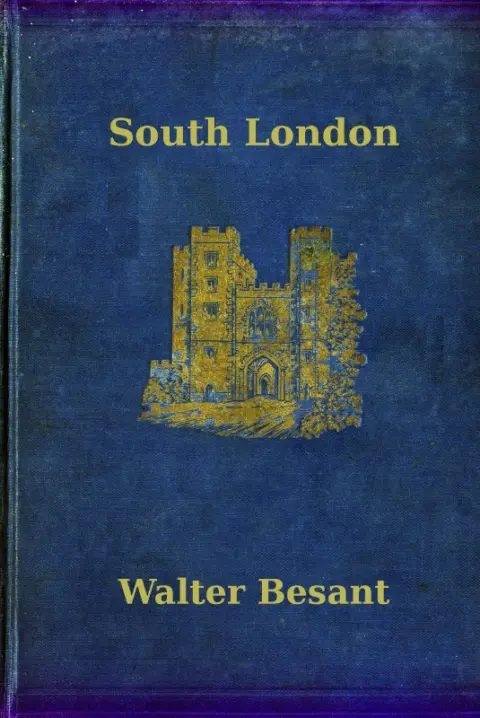
THE CLASSIC COLLECTION · 1898
"South London" by Walter Besant is a historical account written in the late 19th century. The work explores the history and evolution of South London, presenting a vivid picture of its geography, settlements, and the daily lives of its inhabitants from the earliest times through significant historical events. Through a series of episodes and characters, Besant aims to bring to life the conditions, customs, and social fabric of this area, which was characterized by its marshy landscape and rich history. At the start of the book, the author outlines the purpose of the work, clarifying that he does not intend to provide a continuous history but rather a collection of episodes that illustrate the life and character of South London. He describes the geographical boundaries of the region, which stretches from Battersea to Greenwich and emphasizes its original state as an extensive marsh. Besant traces the early settlements and trade routes that began to emerge as the land was gradually inhabited, highlighting the establishment of causeways and the first signs of human life amid the natural landscape. The writing sets a tone of exploration and admiration for the area’s history, positioning South London not just as a setting but as a dynamic entity shaped by the countless stories of its people through the ages.
Introduction adapted from the source catalogue; source summaries may be automatically generated.
Free to read · English · 91,365 words · No account needed
MAKE TIME FOR A GOOD BOOK
On by default. Untick to stop anonymous reading totals. Each page counts after 10 seconds in view. How this works.
Anonymous counting is on unless you have switched it off.
'21 September, 1668. To Southwark Fair, very dirty, and there saw the puppet-show of Whittington, which is pretty to see; and how that idle thing do work upon people that see it, and even myself too! And thence to Jacob Hall's dancing on the ropes, where I saw such action as I never saw before, and mightily worth seeing; and here took acquaintance with a fellow who carried me to a tavern, whither came the music of this booth, and by and by Jacob Hall himself, with whom I had a mind to speak, whether he ever had any mischief by falls in his time. He told me, "Yes, many, but never to the breaking of a limb." He seems a mighty strong man. So giving them a bottle or two of wine, I away.'
Hogarth has preserved for us and for our posterity a faithful picture of Lady Fair as it was in the year 1733. As it was in the daytime, remember, not the evening. Hogarth did not shrink from depicting scenes because they were brutal, or debauched--the pen that drew the Rake's midnight orgies could not plead that anything was too coarse or violent or abandoned for representation. Had Hogarth drawn a picture of the Fair in the evening as well as the afternoon we should have known why the City grew more and more disgusted at the orgies of the Lady Fair until it became impossible to tolerate it any longer.
The Fair was held in the open street, between St. Margaret's Hill and St. George's Church. Beyond St. George's Church was open country, with a few houses, &c., as shown in Hogarth's picture which appeared in 1733. That part of the Fair which is shown contains two theatrical booths, Punch's opera, and a waxwork. At one of the theatres, that of Lee and Harper, is about to be performed Elkanah Settle's Droll of 'The Siege of Troy.' At the other Theatre, there is a great show cloth called the Stage Mutiny, referring to a recent dispute at Drury Lane, and the piece promised is the 'Fall of Bajazet.' The youngest and most beautiful of the actresses is out before the Booth with a drum, a black boy playing a cornet, and an actor dressed for the principal part with a magnificent wig and a towering plumed helmet. Alas! the great man is arrested at the moment of taking the picture: at the same moment the stage outside the booth gives way, and actors and actresses are precipitated headlong: there will be no performance this day of 'The Fall of Bajazet.' There is a peep show in the picture: Figg the Prizefighter rides across the stage, his wig off, so as to show the wounds he has received: the dwarf Savoyard plays his bagpipe and makes his dolls jump: there is the cook's shop under the falling stage: the rope dancer Violante tumbles on the slack rope: Cardman the aerial performer descends from the tower of St. George's: a quack eats lighted tow: the conjurer shows some of his tricks outside, but promises marvels inside the booth; the rustics gaze in speechless admiration in the face of the drummer-actress: beyond, we see the beginning of the line of booths, where everything was sold that was of no value--toys, chapbooks, gingerbread, ribbons, cakes, whips, canes, snuff-boxes, tobacco-boxes, worthless rings, cloth slippers, night-caps, shoe laces, buckles, soap by the yard, singing birds and cages for them, tinder-boxes, pewter platters and mugs. All day long the noise went on: it began at noon: the people came from the country and from the city: they dined in one of the booths, off roast sucking pig, for choice, a diet consecrated to all the Fairs from time immemorial: the children were brought and treated to a fairing, the peep-show, and the play, and some gingerbread. In the afternoon the country lads wrestled for a hat--you can see the hat in the picture; and the girls ran a race for a smock--you can see the smock in the picture. When the sun grew low the children were taken home, and the real fun of the fair began. Then all the quiet people within hearing stopped their ears: and all the decent people ran away: and the prentices, the rustics, the roughs of the Mint with their correspondencies of the other sex, had their own way until the weary players put out their footlights and lay down to sleep as they could among the properties and scenes of their theatre, and the people of the booths put their wares under the counters and lay down to sleep upon them like the grocers' assistants. And then, one supposes, the prentices, the rustics, and the rogues went home again. And in the morning repentance and an aching head, and an empty purse.
Your reading position is saved on this browser. Take it to another device with a library code. Reading pages adapt to text, rather than matching a printed edition.
Walter Besant
Walter Besant

Walter Besant

Walter Besant
BEHIND THE BOOK
This eBook is for the use of anyone anywhere in the United States and most other parts of the world at no cost and with almost no restrictions whatsoever. You may copy it, give it away or re-use it under the terms of the Project Gutenberg License included with this eBook or online at www.gutenberg.org. If you are not located in the United States, you will have to check the laws of the country where you are located before using this eBook. Read the source licence.
The original source file, including credits and licence, is retained by this library. Request an original-format copy at no charge. Please include the book title and Project Gutenberg identifier #44683.
KEEP YOUR CURIOSITY GOING
Wilfrid Scawen Blunt
Wilfrid Scawen Blunt

E. W. (Edgar Watson) Howe
Cécile Tormay

Moritz Busch
John L. Ransom