THE CLASSIC COLLECTION✦My diaries, being a personal narrative of events 1888-1914, Part 2 (1900-1914)CLASSIC FREE BOOKS
My diaries, being a personal narrative of events 1888-1914, Part 2 (1900-1914)
Wilfrid Scawen Blunt
THE CLASSIC COLLECTION · 1911
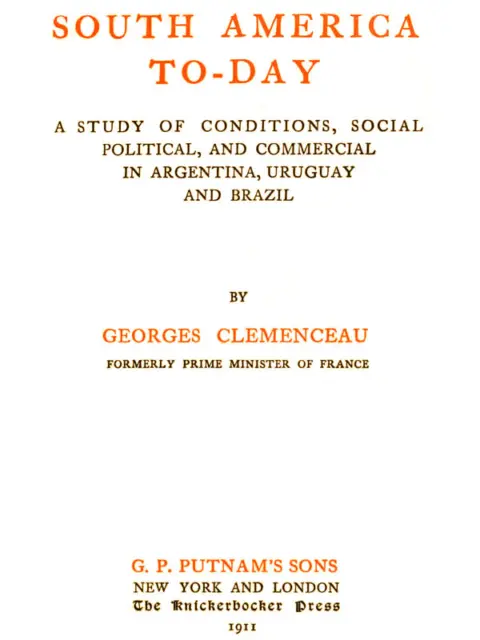
"South America To-Day" by Georges Clemenceau is a detailed travelogue and sociopolitical study written in the early 20th century. The book explores the conditions prevailing in Argentina, Uruguay, and Brazil, focusing on social, political, and commercial aspects of these South American nations. Clemenceau, drawing from his observations as a traveler and former Prime Minister of France, aims to provide insights into the rich yet complex realities of South America, countering prevailing stereotypes of the continent. The opening of the work provides an engaging prelude to Clemenceau's journey. Written with a reflective tone, he expresses his apprehensions about recounting his travel experiences without formal notes, yet he is eager to explore the intersection of his own identity with the cultural landscape of South America. As he boards the ship "Regina Elena", his contemplations on the outgoing voyage allow readers to witness his anticipatory thrill, combining humor and historical references. Through vivid descriptions of fellow passengers, the dynamic environment of the ship, and the diverse cultures he encounters, Clemenceau sets the stage for a profound exploration of the emerging identities in Latin America that will unfold in ensuing chapters.
Introduction adapted from the source catalogue; source summaries may be automatically generated.
Free to read · English · 86,272 words · No account needed
MAKE TIME FOR A GOOD BOOK
On by default. Untick to stop anonymous reading totals. Each page counts after 10 seconds in view. How this works.
Anonymous counting is on unless you have switched it off.
And now, how can I resist the temptation to draw some sort of conclusion from these rambling notes, made with the sole desire to make use of the knowledge acquired for the benefit of French extension, and this in the interest of humanity at large? In every calling there is but one road to success--work. When Candide returned from Buenos Ayres, he brought back from his travels the lesson that we must work in our gardens. Since his days our gardens have grown considerably, and since we are ourselves the first elemental instrument for all work, the first condition of improvement must be the improvement of the material. Therefore let us work.
[54] "Brazil," by Pierre Denis. Translated by Bernard Miall. London: T.
Fisher Unwin.
[55] The reader who desires further information will find it in the article written by my travelling companion, Dr. Segard, on the Butantan Institute.
Aborigines of Patagonia, n. 52-54
Agricultural Society of Buenos Ayres, the shows of, 78-79
Agriculture:
Waste entailed by system in vogue in the Pampas, 364
Wasteful Brazilian methods, 364-66, 376-78
See Cattle, Cereals, Coffee, Horses, Pampas, etc.
Alcorta, Señor Figueroa, President of the Argentine Republic, 180
Algeciras Conference, 67
Alienism, see Open Door, The
America, South:
Impressions of, iii
Cities of, vii, viii
Architecture, vii
Races of, viii
Early culture, ix
People of, unjustly ridiculed, 62-63
Produce of, 73-75
America, United States of, 64
Americans, South, characteristics of, 11-12
Anarchists, 85
Russian, 86
Oppressive measures against, 88-89
Argentine Exposition, 69-70
Argentine Republic, The, 18-20
Arrival in, 27-28
Maté, trade of, 45-46
Agricultural produce, 75-76
Foreigners in, 81
Patriotism, 91-93
Powers of assimilation, 94-97
Officials, 113-14
Types and manners, 142-74
Women of, 151-56
Exaggerated conventionality of society, 155-56
Girls of, 158-59
Fathers, 160
Gambling, 161-62
Land speculation in, 162
Cookery, 173-74
Politics, 175-203
Parliament, 184-86
The Executive, 188-89
The Press, 191-92
Society, 201-3
The Pampas, 204-32
Argo, Alpha of, 16
Aristocracy of Brazil, 355-56
Armadillo, The (tatou), 114
Army, The Brazilian, 342
Arrowheads, Primitive, n. 53-56
Arts, The, in the Argentine, 58-62
Asylums:
Excellence of, in the
Argentine, 114
For aged, 123
For widows, 124
For lunatics, 124-35
Avenida Central, Rio, 325
Bacteriological research, 345-47
Ball, Official, at Rio, 359
Band, Oriental, 18
See Uruguay.
Bangu, Factories at, 364-65
Battleships, Extensive purchases of, 291
Belgrano, General, n. 59
Betting in the Argentine, 166-67
Black Pot, The, 14
Bon Vista, 368
Botanical Gardens:
Of Buenos Ayres, 38-40, 44
Of Rio, 368
Bouvard, M., 57
Brazil, 144, (226-425)
Recent troubles in, 178
Domestic architecture, n. 318, 321
French culture in, 331
Products of, 333
Politics, 337
Federal Government, 342
Saint Paul, 341-42
Society, 352-63
Planters, 356
Women of, 358
Agricultural methods, 364-66
See Coffee, Rio de Janeiro, Saint Paul
Brazil, Dr., his antitoxins for snake-bites, 403-4
Buckle, his prophecy relating to Brazil, 143-44
Your reading position is saved on this browser. Take it to another device with a library code. Reading pages adapt to text, rather than matching a printed edition.
BEHIND THE BOOK
This eBook is for the use of anyone anywhere in the United States and most other parts of the world at no cost and with almost no restrictions whatsoever. You may copy it, give it away or re-use it under the terms of the Project Gutenberg License included with this eBook or online at www.gutenberg.org. If you are not located in the United States, you will have to check the laws of the country where you are located before using this eBook. Read the source licence.
The original source file, including credits and licence, is retained by this library. Request an original-format copy at no charge. Please include the book title and Project Gutenberg identifier #45621.
KEEP YOUR CURIOSITY GOING
Wilfrid Scawen Blunt
Wilfrid Scawen Blunt

E. W. (Edgar Watson) Howe
Francis Greenleaf Allinson & Anne C. E. (Anne Crosby Emery) Allinson
Cyrenus Cole

John Martineau