THE CLASSIC COLLECTION✦Sketches in BedlamCLASSIC FREE BOOKS
Sketches in Bedlam
John Haslam
THE CLASSIC COLLECTION · 1819
"Sound Mind" by John Haslam is a scientific publication written in the early 19th century. This work delves into the natural history and physiology of the human intellect, exploring various aspects of mental functioning, including perception, memory, and reason. Haslam aims to establish a clearer understanding of the faculties of the mind, contrasting its healthy state with mental derangement. The opening of "Sound Mind" offers insight into the author's perspective on the importance of understanding a sound mind before discussing its disorders. Haslam introduces the concept that knowledge of the intellect's healthy functionalities is crucial for defining its aberrations. He proposes a comprehensive study of the human mind through careful observation and analysis of mental faculties, setting the stage for a detailed examination of topics such as perception and memory. The preface reveals Haslam's scholarly intent to contribute positively to the field of psychology and psychiatry, emphasizing the need for a better grasp of the intellect's normal states as foundational to the understanding of its pathologies.
Introduction adapted from the source catalogue; source summaries may be automatically generated.
Free to read · English · 24,792 words · No account needed
MAKE TIME FOR A GOOD BOOK
On by default. Untick to stop anonymous reading totals. Each page counts after 10 seconds in view. How this works.
Anonymous counting is on unless you have switched it off.
In order to proceed regularly with this subject, it appears that our reasonings may be employed concerning things, or the objects in nature, and on terms which are not the immediate representatives of natural phenomena, but as they have been denominated general or abstract; and which are intended to be the verbal representatives of multitudes of objects arbitrarily classed, or of opinions comprised under such term.
That reason is not an inherent, peculiar, and independent faculty of the human mind, receives a strong confirmation from considering, that it cannot be voluntarily exerted on subjects of discussion, but requires, as the indispensable condition of its operation, the basis of knowledge, which is to be understood to mean, the result of observation and experiment: for the mere employment of language, on a subject with which we are unacquainted, is but idle prating and a lavishment of words. To reason, is to adapt our means, that is, our knowledge, for the attainment of the end or object proposed: it is the estimate or admeasurement of these means. If, for example, a military commander intended effectually to bombard a city;--such being the object proposed, he would immediately proceed to estimate, admeasure, or calculate his means to produce the effect, and his success would depend on the knowledge he possessed of the nature and properties of the materials employed: he must calculate the distance, elevation, proportionate quantity of powder, and the time the fuzee should burn previously to the explosion of the shell; with various other necessary circumstances. This is an example of a very pure process of reasoning as applied to things, and accords with the definition that has been attempted. If it were necessary to multiply instances of the reasoning on things, perhaps the construction of a thermometer would be a well-adapted illustration; and it would likewise exhibit that which I am very anxious to impress, namely, the very gradual manner in which knowledge, by the operation of reasoning has been applied to the purposes of utility. That many substances, and particularly metallic bodies, augmented in magnitude by being heated, or, as we now term it, expanded by heat, was known many centuries ago, and was a fact of hourly occurrence to the artificers in metals. A similar increment of bulk was also observed in fluids; and it was likewise known, that their dimensions contracted as they cooled. This fact appeared to obtain so generally, that it became an aphorism, that bodies expanded by heat and contracted by cold. Of the precise gradations of heat they were, however, ignorant. Most of the senses became tests, although they were inaccurate criteria. The sight conveyed some distinctive marks; so that when some metallic bodies were heated to a high degree, they were observed to become red, and as the heat was increased, they were rendered white. By the touch, a variety of discriminations of temperature was obtained, to which appropriate terms were annexed, explanatory of its effects, or according with the feelings; as burning, scorching, scalding, blistering hot;--descending to blood, loo, gently, or agreeably warm. The ear was not exempted from its share of information, by detecting the boiling of water, or by discovering when a heated metal was immersed in that fluid, that it was hissing-hot: even the smell detected some obscure traces, sufficient to discourage or invite an approach. These tests, although they might serve for ordinary purposes, were still wholly inadequate for philosophical accuracy. To ascertain quantity, it was necessary to associate number as the index of precision. Notwithstanding the construction of this instrument now appears so simple and easy of contrivance, it is only within a few years that it occurred to fill a tube, having a bulb, with a fluid; and to note the points at which snow dissolved, and water boiled: when these were fixed, the intermediate space might form a scale according to any subdivisions, so as to endow it with precision by the adjunct of numbers. On many occasions, our sensations deceive us, especially in a morbid state of the body: a person in the cold stage of an ague shivers at the temperature that oppresses his attendant with heat; but the instrument described is subject to no variations, by marking the gradations of warmth with the definite character of number. It will now be seen, that man possesses materials for conducting his reasonings, which animals do not enjoy;--by language, and from his capacity of numerating. Speech, of course, involves its record, whereby he can recall the transactions of former ages, and preserve the fruit of experience for his intellectual nurture, when the tree that produced it has perished. This record is the elaboration of the hand,--that wonderful instrument, the register of thought,--that active and and skilful agent that "turns to shape" the contrivances of the mind.
Your reading position is saved on this browser. Take it to another device with a library code. Reading pages adapt to text, rather than matching a printed edition.
John Haslam
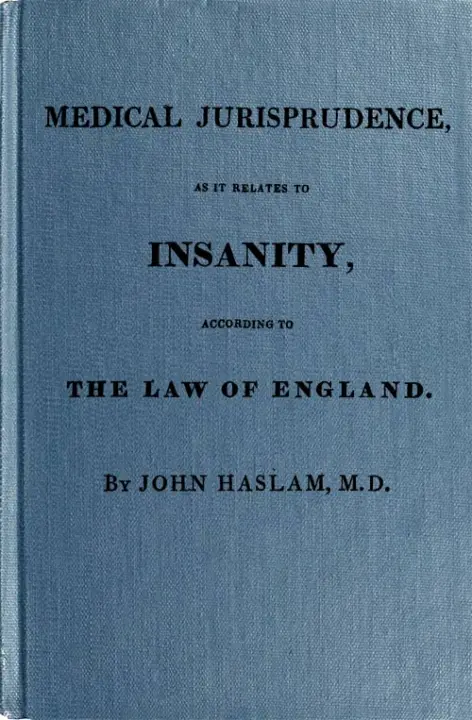
John Haslam
John Haslam
John Haslam
BEHIND THE BOOK
This eBook is for the use of anyone anywhere in the United States and most other parts of the world at no cost and with almost no restrictions whatsoever. You may copy it, give it away or re-use it under the terms of the Project Gutenberg License included with this eBook or online at www.gutenberg.org. If you are not located in the United States, you will have to check the laws of the country where you are located before using this eBook. Read the source licence.
The original source file, including credits and licence, is retained by this library. Request an original-format copy at no charge. Please include the book title and Project Gutenberg identifier #31747.
KEEP YOUR CURIOSITY GOING

Charles G. (Charles Griffith) Ross
Hannah Webster Foster

Emily Lawless
Edwin Hamlin Carr

Charles De Lano Hine
Andrew Ure