THE CLASSIC COLLECTION✦Sketches in BedlamCLASSIC FREE BOOKS
Sketches in Bedlam
John Haslam
THE CLASSIC COLLECTION · 1819
"Sound Mind" by John Haslam is a scientific publication written in the early 19th century. This work delves into the natural history and physiology of the human intellect, exploring various aspects of mental functioning, including perception, memory, and reason. Haslam aims to establish a clearer understanding of the faculties of the mind, contrasting its healthy state with mental derangement. The opening of "Sound Mind" offers insight into the author's perspective on the importance of understanding a sound mind before discussing its disorders. Haslam introduces the concept that knowledge of the intellect's healthy functionalities is crucial for defining its aberrations. He proposes a comprehensive study of the human mind through careful observation and analysis of mental faculties, setting the stage for a detailed examination of topics such as perception and memory. The preface reveals Haslam's scholarly intent to contribute positively to the field of psychology and psychiatry, emphasizing the need for a better grasp of the intellect's normal states as foundational to the understanding of its pathologies.
Introduction adapted from the source catalogue; source summaries may be automatically generated.
Free to read · English · 24,792 words · No account needed
MAKE TIME FOR A GOOD BOOK
On by default. Untick to stop anonymous reading totals. Each page counts after 10 seconds in view. How this works.
Anonymous counting is on unless you have switched it off.
That voluntary muscles may be converted into involuntary, has been already observed; but this conversion is to be considered a morbid state, and must be regarded as a degradation of our nature, instead of its perfection. Excess in the use of fermented liquors, will generally produce it; and the habitual practice of intemperance will destroy the influence of volition over the intellectual powers; so that the control over the succession of our thoughts can be no longer exerted, and when we give them utterance they are without connection, and we talk at random.
It is not to be expected, in a work which professes to be merely contributions to the Natural History and Physiology of Intelligent Beings, that a particular discussion of moral subjects should be instituted; and such is the question concerning the freedom of the human will: the reader is therefore referred to those writers who have fully, and with considerable acuteness, discussed this intricate and important topic. The nature of this attribute is however so interwoven with the philosophy of mind, so connected with the view which has been taken of its history and constitution, that it is impossible wholly to abstain from the consideration of its influence on the excellence and demerit of human actions. It has been endeavoured, throughout this chapter, to establish, that the power which goads or stimulates the muscles to action, and the mind to exertion, is not inherent, but acquired by practice; and this is exemplified by the state of the new-born infant, which, at that period, manifests no more of volition, than of perception, reflection, or reason. It has also been conjectured, that the possession of this influence must be subsequent to perception, for reasons which have been assigned. With its intimate nature we are unacquainted; but we see, as far as muscular motion is concerned, that the same effect is produced by the stimulus of galvanism after the head is removed, and when, according to our existing philosophy, consciousness is destroyed, and the power of willing is abolished. It is by no means intended to suppose that the stimulus of the will has any affinity with the galvanic fluid, because we are unable to prove it; although such opinion has been entertained. According to my own interpretation, Will is to be considered as the mere spur, the simple stimulus to action: it possesses no intelligence to direct; but in the healthy state, excites motion in consequence of being itself directed to such excitement. To invest Will with intelligence sufficient for its purposes, would render reason, the highest of our attainments, superfluous. Those who have most strenuously contended for the freedom of the will, have insisted that it possesses the liberty of choosing or preferring: allow this, and then enquire what must be the nature of that choice or preference, which is selected by an arbitrary decision, without the previous estimate or calculation of reason. Man, beyond all other beings, is endowed with superior means of accumulating knowledge, and of preserving experience; by these, therefore, his actions should be directed. If, independently of these, his will possessed a power of directing his actions, it would be equivalent to the instinct of animals: he would, like them, be stationary, and his conduct liable to no responsibility. The long period of infancy in man has been frequently adverted to; and it is a considerable time before he acquires sufficient experience to direct his conduct; and during which, many of the species of animals have completed several generations. For this reason, the wisest legislators, of all ages, have exempted children under a certain age, from the punishment of death for their actions; and although many of them have entertained erroneous notions concerning the nature of the will, yet they tacitly admit, in the instances of infants, idiots, and madmen,--that is, where the understanding is not sufficiently formed by experience, or where it is perverted by disease, that the acts of the will ought not to be visited by the severity of the law. This is perhaps the best practical illustration, that the will to act, is governed and directed by reason. Had the mind of man, like animals, been furnished with instinct, which, in them, implies a wise, preconcerted, and unvarying performance of important functions, for their individual preservation, and for the continuance of their race,--as may be exemplified in the construction of the habitations of the bee and beaver, together with their wonderful economy,--the fabrication of the spider's web, and many others,--he would, like them, have been stationary, having received from Infinite Bounty and Wisdom sufficient for his destination: his will would have been directed by unerring motives; and thus his conduct would have been absolved from all responsibility. But man is gifted with few instincts, which appear to decline as his reason advances: his intellect is more capacious, and of a finer staple; he possesses additional organs for the accumulation of knowledge; and, by the peculiarity of his construction, is enabled to preserve his acquirements, to avail himself of the treasures of those who have preceded him, and to transmit his collections to posterity. Man, in possession of ampler materials and superior capacity, becomes the architect of his own mind; and to him it is alone permitted, by the aid of experience, and the estimate of reason, to direct his actions: but this generous and exalted faculty involves him in awful responsibility. The same light which discovers to him that which is good and lawful, also exposes its opposite, which is evil and forbidden; and the nature of good and evil, as it forms the foundation of human institutions, has been derived from our experience of their effects, or a calculation of their tendencies. The will of man, therefore, is as free as his experience dictates, and his reason urges to action: yet, that he should often act in opposition to both, is as lamentable as certain: in the transport of immediate gratification, or in the hopes of enjoyment, precept ceases to influence, and example loses its warning.
Your reading position is saved on this browser. Take it to another device with a library code. Reading pages adapt to text, rather than matching a printed edition.
John Haslam
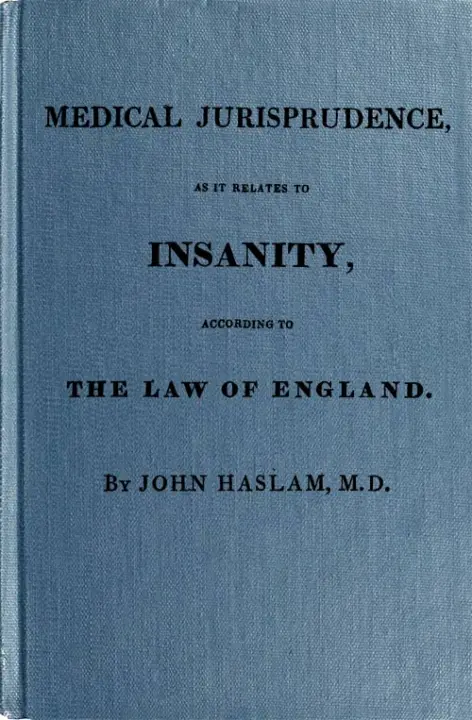
John Haslam
John Haslam
John Haslam
BEHIND THE BOOK
This eBook is for the use of anyone anywhere in the United States and most other parts of the world at no cost and with almost no restrictions whatsoever. You may copy it, give it away or re-use it under the terms of the Project Gutenberg License included with this eBook or online at www.gutenberg.org. If you are not located in the United States, you will have to check the laws of the country where you are located before using this eBook. Read the source licence.
The original source file, including credits and licence, is retained by this library. Request an original-format copy at no charge. Please include the book title and Project Gutenberg identifier #31747.
KEEP YOUR CURIOSITY GOING

Charles G. (Charles Griffith) Ross
Hannah Webster Foster

Emily Lawless
Edwin Hamlin Carr

Charles De Lano Hine
Andrew Ure