
Lucinda
Anthony Hope
THE CLASSIC COLLECTION · 1905
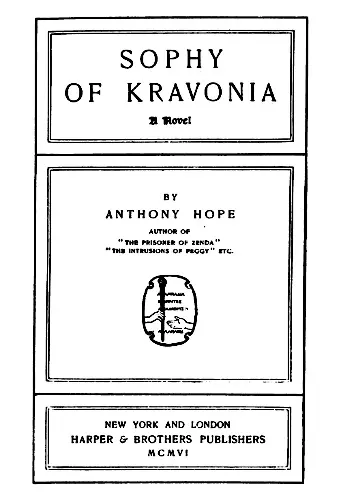
"Sophy of Kravonia: A Novel" by Anthony Hope is a fictional novel written during the early 20th century. The book follows the life of a young girl named Sophy Grouch, who grows up in a rural English village and eventually finds herself entwined in the romances and intrigues of high society in Paris and the fictional kingdom of Kravonia. Sophy's journey is characterized by her strong will, hope for a brighter future, and the unique birthmark that both marks her as different and attracts attention. The opening of the novel presents Sophy's childhood in the village of Morpingham, where she lives a simple life with her father until a tragic accident leaves her orphaned. The narrative introduces various characters from her village, including the kind-hearted Mrs. Brownlow and the exciting Julia Robins, who each impact Sophy's perception of her own future. The stage is set for a life of ambition as we watch her wrestle with her identity and dreams, along with the teasing nature of her unfortunate surname. It becomes clear that Sophy yearns for something beyond the life that has been laid out for her, a desire that will propel her into complexities and adventures that define her character throughout the story.
Introduction adapted from the source catalogue; source summaries may be automatically generated.
Free to read · English · 88,824 words · No account needed
MAKE TIME FOR A GOOD BOOK
On by default. Untick to stop anonymous reading totals. Each page counts after 10 seconds in view. How this works.
Anonymous counting is on unless you have switched it off.
"But I was told to repeat it," persisted the little man. He looked round on them. Lukovitch and Dunstanbury had finished reading the letter and were listening, too. "If you still hesitated, I was to impress upon you that the guns would certainly be in Slavna in less than a week--almost certainly on Sunday. You know the course of the river well, madame?"
"Not very well above Slavna, no."
"In that case, which General Stenovics didn't omit to consider, I was to remind you that Captain Lukovitch probably knew every inch of it."
"I know it intimately," said Lukovitch. "I spent two years on the
timber-barges of the Krath."
"Then you, sir, will understand that the guns will certainly reach Slavna not later than Sunday." He paused for a moment, seeming to collect his memory. "By Wednesday evening Colonel Stafnitz will be at Kolskoï. On Thursday morning he'll start back. On that evening he ought to reach Evena, on Friday Rapska." Lukovitch nodded at each name. Lepage went on methodically. "On Saturday the lock at Miklevni. Yes, on Saturday the lock at Miklevni!" He paused again and looked straight at Lukovitch.
"Exactly--the lock at Miklevni," said that officer, with another nod.
"Yes, the lock at Miklevni on Saturday. You see, it's not as if the Colonel had a large force to move. That might take longer. He'll be able to move his company as quick as the barges travel."
"The stream's very strong, they travel pretty well," said Lukovitch.
"But a hundred men--it's nothing to move, Captain Lukovitch." He looked round on them again, and then turned back to Sophy. "That's all my message, madame," he said.
There was a silence.
"So it's evident the guns will be in Slavna by Sunday," Lepage
concluded.
"If they reach Miklevni on Saturday--any time on Saturday--they will," said Lukovitch. "And up here very soon after!"
"The General intimated that also, Captain Lukovitch."
"The General gives us very careful information," observed Dunstanbury, looking rather puzzled. He was not so well versed in Stenovics's methods as the rest. Lukovitch smiled broadly, and even Zerkovitch gave a little laugh.
"How are things in Slavna, Monsieur Lepage?" the last named asked.
Lepage smiled a little, too. "General Stenovics is in full control of the city--during Colonel Stafnitz's absence, sir," he answered.
"They've quarrelled?" cried Lukovitch.
"Oh no, sir. Possibly General Stenovics is afraid they might." He spoke again to Sophy. "Madame, do you still blame me for being the General's messenger?"
"No, Monsieur Lepage; but there's much to consider in the message. Captain Lukovitch, if Monseigneur had read this message, what would he have thought the General meant?"
Your reading position is saved on this browser. Take it to another device with a library code. Reading pages adapt to text, rather than matching a printed edition.
Anthony Hope

Anthony Hope

Anthony Hope

Anthony Hope
BEHIND THE BOOK
This eBook is for the use of anyone anywhere in the United States and most other parts of the world at no cost and with almost no restrictions whatsoever. You may copy it, give it away or re-use it under the terms of the Project Gutenberg License included with this eBook or online at www.gutenberg.org. If you are not located in the United States, you will have to check the laws of the country where you are located before using this eBook. Read the source licence.
The original source file, including credits and licence, is retained by this library. Request an original-format copy at no charge. Please include the book title and Project Gutenberg identifier #40414.
KEEP YOUR CURIOSITY GOING
Coulson Kernahan

Maurice Baring
Frances Wright
Cécile Tormay

Frederic Jesup Stimson

W. H. P. (William Henry Pope) Jarvis