
Reflections on the death of a porcupine and other essays
D. H. (David Herbert) Lawrence
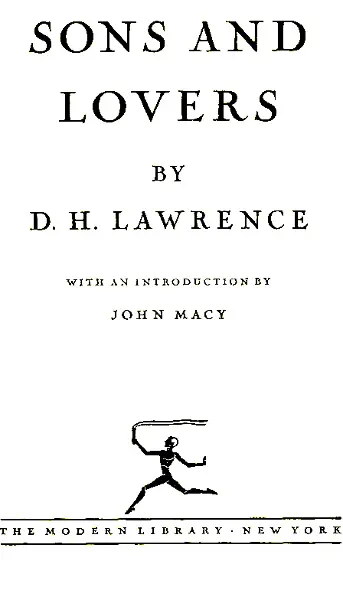
THE CLASSIC COLLECTION · 1913
"Sons and Lovers" by D. H. Lawrence is a novel published in 1913. It follows Paul Morel, a young man trapped between his possessive mother's suffocating love and his relationships with two contrasting women. As Paul struggles toward manhood, he finds himself unable to fully love anyone because his mother's hold on him remains strongest. The emotional conflict tears him between passion and duty, leaving him caught in a battle for his soul that threatens to destroy him.
Introduction adapted from the source catalogue; source summaries may be automatically generated.
Free to read · English · 162,018 words · No account needed
MAKE TIME FOR A GOOD BOOK
On by default. Untick to stop anonymous reading totals. Each page counts after 10 seconds in view. How this works.
Anonymous counting is on unless you have switched it off.
"You see," she said, taking his face and shutting it out against her shoulder--"you see--as we are--how can I get used to you? It would come all right if we were married."
He lifted her head and looked at her.
"You mean, now, it is always too much shock?"
"Yes--and----"
"You are always clenched against me."
She was trembling with agitation.
"You see," she said, "I'm not used to the thought----"
"You are lately," he said.
"But all my life. Mother said to me, 'There is one thing in marriage that is always dreadful, but you have to bear it.' And I believed it."
"And still believe," he said.
"No!" she cried hastily. "I believe, as you do, that loving, even in that way, is the high-water mark of living."
"That doesn't alter the fact that you never want it."
"No," she said, taking his head in her arms and rocking in despair. "Don't say so! You don't understand." She rocked with pain. "Don't I want your children?"
"But not me."
"How can you say so? But we must be married to have children----"
"Shall we be married, then? I want you to have my children."
He kissed her hand reverently. She pondered sadly, watching him.
"We are too young," she said at length.
"Twenty-four and twenty-three----"
"Not yet," she pleaded, as she rocked herself in distress.
"When you will," he said.
She bowed her head gravely. The tone of hopelessness in which he said these things grieved her deeply. It had always been a failure between them. Tacitly, she acquiesced in what he felt.
And after a week of love he said to his mother suddenly one Sunday night, just as they were going to bed:
"I shan't go so much to Miriam's, mother."
She was surprised, but she would not ask him anything.
"You please yourself," she said.
So he went to bed. But there was a new quietness about him which she had wondered at. She almost guessed. She would leave him alone, however. Precipitation might spoil things. She watched him in his loneliness, wondering where he would end. He was sick, and much too quiet for him. There was a perpetual little knitting of his brows, such as she had seen when he was a small baby, and which had been gone for many years. Now it was the same again. And she could do nothing for him. He had to go on alone, make his own way.
Your reading position is saved on this browser. Take it to another device with a library code. Reading pages adapt to text, rather than matching a printed edition.
D. H. (David Herbert) Lawrence
D. H. (David Herbert) Lawrence
D. H. (David Herbert) Lawrence
D. H. (David Herbert) Lawrence
BEHIND THE BOOK
This eBook is for the use of anyone anywhere in the United States and most other parts of the world at no cost and with almost no restrictions whatsoever. You may copy it, give it away or re-use it under the terms of the Project Gutenberg License included with this eBook or online at www.gutenberg.org. If you are not located in the United States, you will have to check the laws of the country where you are located before using this eBook. Read the source licence.
The original source file, including credits and licence, is retained by this library. Request an original-format copy at no charge. Please include the book title and Project Gutenberg identifier #47634.
KEEP YOUR CURIOSITY GOING
Coulson Kernahan

Maurice Baring
Frances Wright
Cécile Tormay

Frederic Jesup Stimson

W. H. P. (William Henry Pope) Jarvis