
Reflections on the death of a porcupine and other essays
D. H. (David Herbert) Lawrence
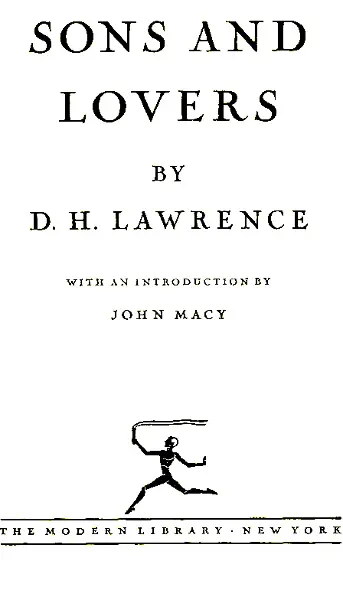
THE CLASSIC COLLECTION · 1913
"Sons and Lovers" by D. H. Lawrence is a novel published in 1913. It follows Paul Morel, a young man trapped between his possessive mother's suffocating love and his relationships with two contrasting women. As Paul struggles toward manhood, he finds himself unable to fully love anyone because his mother's hold on him remains strongest. The emotional conflict tears him between passion and duty, leaving him caught in a battle for his soul that threatens to destroy him.
Introduction adapted from the source catalogue; source summaries may be automatically generated.
Free to read · English · 162,018 words · No account needed
MAKE TIME FOR A GOOD BOOK
On by default. Untick to stop anonymous reading totals. Each page counts after 10 seconds in view. How this works.
Anonymous counting is on unless you have switched it off.
And then, the next day, Clara came. They were to have tea in the hayfield. Miriam watched the evening drawing to gold and shadow. And all the time Paul was sporting with Clara. He made higher and higher heaps of hay that they were jumping over. Miriam did not care for the game, and stood aside. Edgar and Geoffrey and Maurice and Clara and Paul jumped. Paul won, because he was light. Clara's blood was roused. She could run like an Amazon. Paul loved the determined way she rushed at the haycock and leaped, landed on the other side, her breasts shaken, her thick hair coming undone.
"You touched!" he cried. "You touched!"
"No!" she flashed, turning to Edgar. "I didn't touch, did I? Wasn't I
clear?"
"I couldn't say," laughed Edgar.
None of them could say.
"But you touched," said Paul. "You're beaten."
"I did not touch!" she cried.
"As plain as anything," said Paul.
"Box his ears for me!" she cried to Edgar.
"Nay," Edgar laughed. "I darn't. You must do it yourself."
"And nothing can alter the fact that you touched," laughed Paul.
She was furious with him. Her little triumph before these lads and men was gone. She had forgotten herself in the game. Now he was to humble her.
"I think you are despicable!" she said.
And again he laughed, in a way that tortured Miriam.
"And I knew you couldn't jump that heap," he teased.
She turned her back on him. Yet everybody could see that the only person she listened to, or was conscious of, was he, and he of her. It pleased the men to see this battle between them. But Miriam was tortured.
Paul could choose the lesser in place of the higher, she saw. He could be unfaithful to himself, unfaithful to the real, deep Paul Morel. There was a danger of his becoming frivolous, of his running after his satisfactions like any Arthur, or like his father. It made Miriam bitter to think that he should throw away his soul for this flippant traffic of triviality with Clara. She walked in bitterness and silence, while the other two rallied each other, and Paul sported.
And afterwards, he would not own it, but he was rather ashamed of himself, and protested himself before Miriam. Then again he rebelled.
"It's not religious to be religious," he said. "I reckon a crow is religious when it sails across the sky. But it only does it because it feels itself carried to where it's going, not because it thinks it is being eternal."
But Miriam knew that one should be religious in everything, have God, whatever God might be, present in every thing.
Your reading position is saved on this browser. Take it to another device with a library code. Reading pages adapt to text, rather than matching a printed edition.
D. H. (David Herbert) Lawrence
D. H. (David Herbert) Lawrence
D. H. (David Herbert) Lawrence
D. H. (David Herbert) Lawrence
BEHIND THE BOOK
This eBook is for the use of anyone anywhere in the United States and most other parts of the world at no cost and with almost no restrictions whatsoever. You may copy it, give it away or re-use it under the terms of the Project Gutenberg License included with this eBook or online at www.gutenberg.org. If you are not located in the United States, you will have to check the laws of the country where you are located before using this eBook. Read the source licence.
The original source file, including credits and licence, is retained by this library. Request an original-format copy at no charge. Please include the book title and Project Gutenberg identifier #47634.
KEEP YOUR CURIOSITY GOING
Coulson Kernahan

Maurice Baring
Frances Wright
Cécile Tormay

Frederic Jesup Stimson

W. H. P. (William Henry Pope) Jarvis