
Reflections on the death of a porcupine and other essays
D. H. (David Herbert) Lawrence
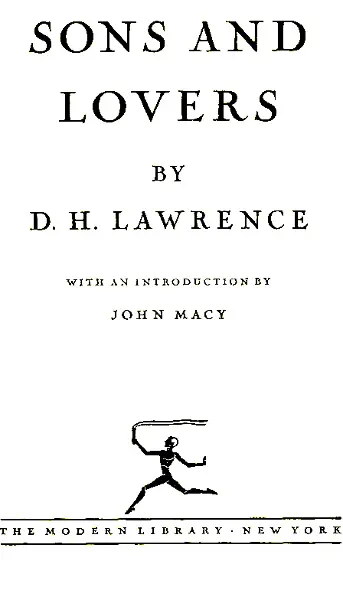
THE CLASSIC COLLECTION · 1913
"Sons and Lovers" by D. H. Lawrence is a novel published in 1913. It follows Paul Morel, a young man trapped between his possessive mother's suffocating love and his relationships with two contrasting women. As Paul struggles toward manhood, he finds himself unable to fully love anyone because his mother's hold on him remains strongest. The emotional conflict tears him between passion and duty, leaving him caught in a battle for his soul that threatens to destroy him.
Introduction adapted from the source catalogue; source summaries may be automatically generated.
Free to read · English · 162,018 words · No account needed
MAKE TIME FOR A GOOD BOOK
On by default. Untick to stop anonymous reading totals. Each page counts after 10 seconds in view. How this works.
Anonymous counting is on unless you have switched it off.
"Well," said Paul, "if she looks at a man she says haughtily 'Nevermore,' and if she looks at herself in the looking-glass she says disdainfully 'Nevermore,' and if she thinks back she says it in disgust, and if she looks forward she says it cynically."
Edgar considered this speech, failed to make much out of it, and said,
laughing:
"You think she's a man-hater?"
"She thinks she is," replied Paul.
"But you don't think so?"
"No," replied Paul.
"Wasn't she nice with you, then?"
"Could you imagine her nice with anybody?" asked the young man.
Edgar laughed. Together they unloaded the coal in the yard. Paul was rather self-conscious, because he knew Clara could see if she looked out of the window. She didn't look.
On Saturday afternoons the horses were brushed down and groomed. Paul and Edgar worked together, sneezing with the dust that came from the pelts of Jimmy and Flower.
"Do you know a new song to teach me?" said Edgar.
He continued to work all the time. The back of his neck was sun-red when he bent down, and his fingers that held the brush were thick. Paul watched him sometimes.
"'Mary Morrison'?" suggested the younger.
Edgar agreed. He had a good tenor voice, and he loved to learn all the songs his friend could teach him, so that he could sing whilst he was carting. Paul had a very indifferent baritone voice, but a good ear. However, he sang softly, for fear of Clara. Edgar repeated the line in a clear tenor. At times they both broke off to sneeze, and first one, then the other, abused his horse.
Miriam was impatient of men. It took so little to amuse them--even Paul. She thought it anomalous in him that he could be so thoroughly absorbed in a triviality.
It was teatime when they had finished.
"What song was that?" asked Miriam.
Edgar told her. The conversation turned to singing.
"We have such jolly times," Miriam said to Clara.
Mrs. Dawes ate her meal in a slow, dignified way. Whenever the men were present she grew distant.
"Do you like singing?" Miriam asked her.
"If it is good," she said.
Paul, of course, coloured.
"You mean if it is high-class and trained?" he said.
"I think a voice needs training before the singing is anything," she
said.
"You might as well insist on having people's voices trained before you allowed them to talk," he replied. "Really, people sing for their own pleasure, as a rule."
"And it may be for other people's discomfort."
"Then the other people should have flaps to their ears," he replied.
Your reading position is saved on this browser. Take it to another device with a library code. Reading pages adapt to text, rather than matching a printed edition.
D. H. (David Herbert) Lawrence
D. H. (David Herbert) Lawrence
D. H. (David Herbert) Lawrence
D. H. (David Herbert) Lawrence
BEHIND THE BOOK
This eBook is for the use of anyone anywhere in the United States and most other parts of the world at no cost and with almost no restrictions whatsoever. You may copy it, give it away or re-use it under the terms of the Project Gutenberg License included with this eBook or online at www.gutenberg.org. If you are not located in the United States, you will have to check the laws of the country where you are located before using this eBook. Read the source licence.
The original source file, including credits and licence, is retained by this library. Request an original-format copy at no charge. Please include the book title and Project Gutenberg identifier #47634.
KEEP YOUR CURIOSITY GOING
Coulson Kernahan

Maurice Baring
Frances Wright
Cécile Tormay

Frederic Jesup Stimson

W. H. P. (William Henry Pope) Jarvis