
Reflections on the death of a porcupine and other essays
D. H. (David Herbert) Lawrence
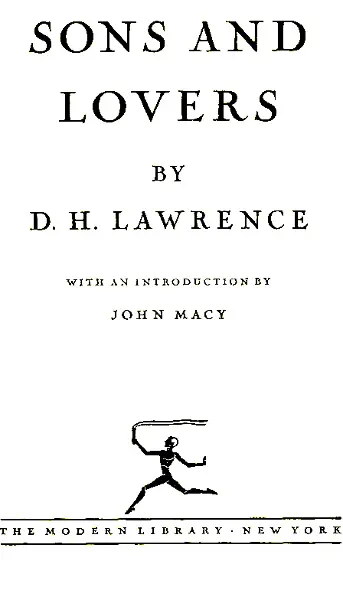
THE CLASSIC COLLECTION · 1913
"Sons and Lovers" by D. H. Lawrence is a novel published in 1913. It follows Paul Morel, a young man trapped between his possessive mother's suffocating love and his relationships with two contrasting women. As Paul struggles toward manhood, he finds himself unable to fully love anyone because his mother's hold on him remains strongest. The emotional conflict tears him between passion and duty, leaving him caught in a battle for his soul that threatens to destroy him.
Introduction adapted from the source catalogue; source summaries may be automatically generated.
Free to read · English · 162,018 words · No account needed
MAKE TIME FOR A GOOD BOOK
On by default. Untick to stop anonymous reading totals. Each page counts after 10 seconds in view. How this works.
Anonymous counting is on unless you have switched it off.
Paul did not realize William was dead; it was impossible, with such a bustle going on. The puller-off swung the small truck on to the turn-table, another man ran with it along the bank down the curving lines.
"And William is dead, and my mother's in London, and what will she be doing?" the boy asked himself, as if it were a conundrum.
He watched chair after chair come up, and still no father. At last, standing beside a waggon, a man's form! The chair sank on its rests, Morel stepped off. He was slightly lame from an accident.
"Is it thee, Paul? Is 'e worse?"
"You've got to go to London."
The two walked off the pit-bank, where men were watching curiously. As they came out and went along the railway, with the sunny autumn field on one side and a wall of trucks on the other, Morel said in a frightened voice:
"'E's niver gone, child?"
"Yes."
"When wor't?"
The miner's voice was terrified.
"Last night. We had a telegram from my mother."
Morel walked on a few strides, then leaned up against a truck side, his hand over his eyes. He was not crying. Paul stood looking around, waiting. On the weighing-machine a truck trundled slowly. Paul saw everything, except his father leaning against the truck as if he were tired.
Morel had only once before been to London. He set off, scared and peaked, to help his wife. That was on Wednesday. The children were left alone in the house. Paul went to work, Arthur went to school, and Annie had in a friend to be with her.
On Saturday night, as Paul was turning the corner, coming home from Keston, he saw his mother and father, who had come to Sethley Bridge Station. They were walking in silence in the dark, tired, straggling apart. The boy waited.
"Mother!" he said, in the darkness.
Mrs. Morel's small figure seemed not to observe. He spoke again.
"Paul!" she said, uninterestedly.
She let him kiss her, but she seemed unaware of him.
In the house she was the same--small, white, and mute. She noticed nothing, she said nothing, only:
"The coffin will be here tonight, Walter. You'd better see about some help." Then, turning to the children: "We're bringing him home."
Then she relapsed into the same mute looking into space, her hands folded on her lap. Paul, looking at her, felt he could not breathe. The house was dead silent.
"I went to work, mother," he said plaintively.
"Did you?" she answered dully.
After half an hour Morel, troubled and bewildered, came in again.
"Wheer s'll we ha'e him when he does come?" he asked his wife.
Your reading position is saved on this browser. Take it to another device with a library code. Reading pages adapt to text, rather than matching a printed edition.
D. H. (David Herbert) Lawrence
D. H. (David Herbert) Lawrence
D. H. (David Herbert) Lawrence
D. H. (David Herbert) Lawrence
BEHIND THE BOOK
This eBook is for the use of anyone anywhere in the United States and most other parts of the world at no cost and with almost no restrictions whatsoever. You may copy it, give it away or re-use it under the terms of the Project Gutenberg License included with this eBook or online at www.gutenberg.org. If you are not located in the United States, you will have to check the laws of the country where you are located before using this eBook. Read the source licence.
The original source file, including credits and licence, is retained by this library. Request an original-format copy at no charge. Please include the book title and Project Gutenberg identifier #47634.
KEEP YOUR CURIOSITY GOING
Coulson Kernahan

Maurice Baring
Frances Wright
Cécile Tormay

Frederic Jesup Stimson

W. H. P. (William Henry Pope) Jarvis