THE CLASSIC COLLECTION✦PoemsCLASSIC FREE BOOKS
Poems
William Blake
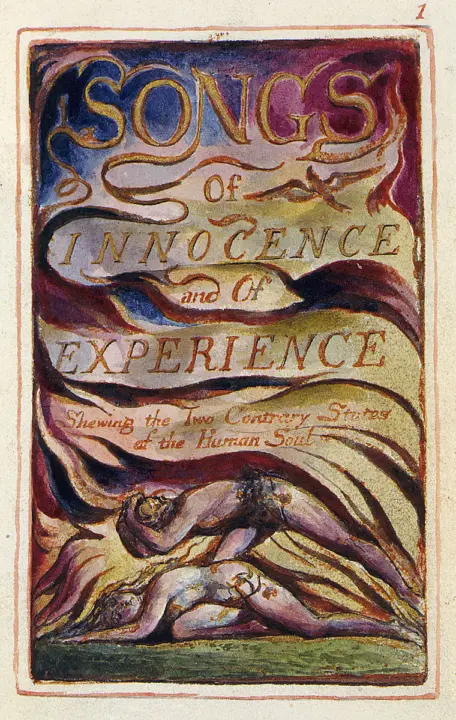
THE CLASSIC COLLECTION · 1794
"Songs of Innocence and of Experience" by William Blake is a collection of illustrated poems combined in 1794. Blake hand-engraved, printed, and colored unique artwork to accompany each poem, exploring childhood innocence and experience as contrary states of the human soul. Originally published as separate volumes, the combined work shows pastoral harmony alongside subtle dangers of naiveté. Each page features distinctive illustrations that intensify the poems' meanings, making Blake's vision inseparable from both visual art and verse. The collection became a hallmark of Romanticism and has inspired countless musical adaptations.
Introduction adapted from the source catalogue; source summaries may be automatically generated.
Free to read · English · 5,629 words · No account needed
MAKE TIME FOR A GOOD BOOK
On by default. Untick to stop anonymous reading totals. Each page counts after 10 seconds in view. How this works.
Anonymous counting is on unless you have switched it off.
When the stars threw down their spears,
And watered heaven with their tears,
Did He smile His work to see?
Did He who made the lamb make thee?
Tiger, tiger, burning bright
In the forests of the night,
What immortal hand or eye
Dare frame thy fearful symmetry?
A flower was offered to me,
Such a flower as May never bore;
But I said, ‘I’ve a pretty rose tree,’
And I passed the sweet flower o’er.
Then I went to my pretty rose tree,
To tend her by day and by night;
But my rose turned away with jealousy,
And her thorns were my only delight.
Ah, sunflower, weary of time,
Who countest the steps of the sun;
Seeking after that sweet golden clime
Where the traveller’s journey is done;
Where the Youth pined away with desire,
And the pale virgin shrouded in snow,
Arise from their graves, and aspire
Where my Sunflower wishes to go!
The modest Rose puts forth a thorn,
The humble sheep a threat’ning horn:
While the Lily white shall in love delight,
Nor a thorn nor a threat stain her beauty bright.
I went to the Garden of Love,
And saw what I never had seen;
A Chapel was built in the midst,
Where I used to play on the green.
And the gates of this Chapel were shut,
And ‘Thou shalt not’ writ over the door;
So I turned to the Garden of Love
That so many sweet flowers bore.
And I saw it was filled with graves,
And tombstones where flowers should be;
And priests in black gowns were walking their rounds,
And binding with briars my joys and desires.
Dear mother, dear mother, the Church is cold;
But the Alehouse is healthy, and pleasant, and warm.
Besides, I can tell where I am used well;
Such usage in heaven will never do well.
But, if at the Church they would give us some ale,
And a pleasant fire our souls to regale,
We’d sing and we’d pray all the livelong day,
Nor ever once wish from the Church to stray.
Then the Parson might preach, and drink, and sing, And we’d be as happy as birds in the spring; And modest Dame Lurch, who is always at church, Would not have bandy children, nor fasting, nor birch.
And God, like a father, rejoicing to see
His children as pleasant and happy as He,
Would have no more quarrel with the Devil or the barrel,
But kiss him, and give him both drink and apparel.
Your reading position is saved on this browser. Take it to another device with a library code. Reading pages adapt to text, rather than matching a printed edition.
William Blake
William Blake
BEHIND THE BOOK
This eBook is for the use of anyone anywhere in the United States and most other parts of the world at no cost and with almost no restrictions whatsoever. You may copy it, give it away or re-use it under the terms of the Project Gutenberg License included with this eBook or online at www.gutenberg.org. If you are not located in the United States, you will have to check the laws of the country where you are located before using this eBook. Read the source licence.
The original source file, including credits and licence, is retained by this library. Request an original-format copy at no charge. Please include the book title and Project Gutenberg identifier #1934.
KEEP YOUR CURIOSITY GOING

Eric Mackay
Edmund Gosse
Sophia Margaretta Hensley
Gilbert Parker
George MacDonald

Elizabeth Bibesco