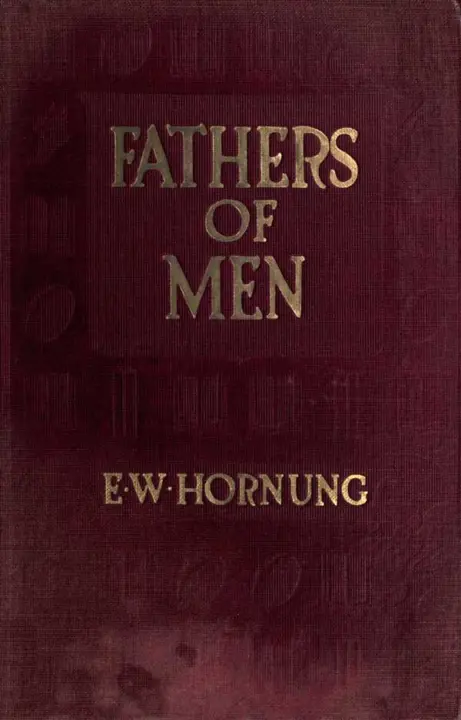
Fathers of Men
E. W. (Ernest William) Hornung
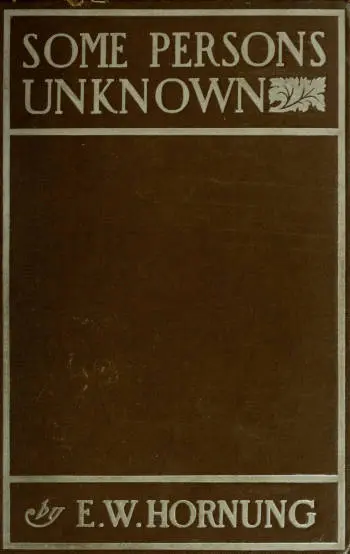
THE CLASSIC COLLECTION · 1898
"Some Persons Unknown" by E. W. Hornung is a novel written in the late 19th century. This story revolves around the Harwood family, particularly focusing on the delicate yet spirited young boy Kenyon and his interactions with his cricketing hero, C. J. Forrester, as they navigate themes of childhood, adventure, and familial bonds." "At the start of the novel, readers are introduced to Kenyon Harwood, an eleven-year-old boy with a passion for cricket, who is being looked after by his older sister Ethel. Kenyon's behavior is reckless, stemming from both his youthful exuberance and the trauma of losing his mother. As the day progresses, anticipation builds for the arrival of C. J. Forrester, a cricketer Kenyon idolizes, and this meeting becomes a pivotal moment for not only Kenyon's passion for the sport but also for his relationship with his father, Mr. Harwood, who struggles with connecting to his children. The opening chapters lay the groundwork for exploring Kenyon's vibrant spirit juxtaposed against his physical frailty and his hopeful aspirations—themes that become central to the narrative."
Introduction adapted from the source catalogue; source summaries may be automatically generated.
Free to read · English · 68,057 words · No account needed
MAKE TIME FOR A GOOD BOOK
On by default. Untick to stop anonymous reading totals. Each page counts after 10 seconds in view. How this works.
Anonymous counting is on unless you have switched it off.
The captain joined him, whereupon Deedes retreated to the house, with black looks that were blacker still a few minutes later when he returned. Instead of rejoining the captain, he now came aloft to my cross-trees, and I made up my mind that we were to have it out in mid-air. Deedes passed me, however, without a word, and I saw a telescope sticking out of his pocket as he climbed higher. I thought it as well to let him have the mast to himself, and left him sweeping the horizon from near the truck.
Yet my own eyes were pretty good, and they had descried no sign of sail or smoke to windward. Why then this change in Deedes? Thoroughly puzzled, I reached the deck and strolled idly to the house; and the puzzle solved itself even as I entered and saw who was seated at the table.
"Miss I'Anson!" I fairly shouted.
"Yes--it is I. He said I should not see you. Do go--do go before he
comes!"
"Go!" I cried. "Not see you! I shall see you and stay with you until I'm dragged out by force. That is"--I added suddenly--"unless you are here of your own free will. In that case----"
"No, no!" cried the girl. "By trickery! By wicked, heartless,
abominable lies! Nothing else--oh, nothing else would have brought me
to this!"
"Then we're in the same boat with a vengeance," said I, seating myself on the opposite side of the table. "Tell me how it happened--and quickly. He has talked already of putting me in irons; he'll do it after this."
"Oh, where am I to begin? There is so much to tell--but he shall not do it!" vowed Miss I'Anson. "He shall not separate the only two honest people in the ship! Oh, yes, it was lies, but lies so clever and so fiendish! Let me tell you everything. I'll try to be quick. He has been in the bank about a year. You know him perhaps better than I do. They say you were at school together. You must know his good points, Mr. Bower. I mean the points that would attract a girl. They attracted me. I made a fool of myself. You must have heard about it in Geelong. Well, it's quite true; but it wasn't yesterday, or the day before, or last week. It was in the very beginning. I got over it long ago. But he has always fascinated me. You know him--you can understand? Well, when the bank was robbed I knew he had done it; I can't tell you how I knew, but know I did. His voice was not real. I have been made love to in that voice--there! Well, I went to his rooms. He lunched there every day. I saw his landlady. He had come in to lunch as usual, and said he would ring when he wanted his pudding. He did ring, but was longer than usual in ringing; that was all. His room was the back-room of the house on the ground-floor; the landlady lives in front. Quite a short time ago it was the other way about, and he suggested the alteration. He also made her promise to keep the blinds down in the kitchen, and the windows shut, to keep out the flies and the sun in the heat of the day; he could make her do what he liked. Now listen. The bank garden adjoins his landlady's garden. I found soil on his window-sill, soil on the woodwork. This was in the afternoon when the excitement was at its height; he was in the bank. I came away, making the woman promise not to say a word; but she broke her promise that night, and that was what started the hue and cry. Meanwhile I wrote him a note telling him I knew all, refusing to see him, but solemnly undertaking that if he would put a note where he had once put other notes (because my mother couldn't endure him), and say in it where the money was, nobody should ever know from me that he had touched it. Remember, Mr. Bower, I was once fond of him; nay, you did much as I did yourself; you will understand. He has told me all that has passed between you; how he gave you the note to put in the tennis pavilion. And what do you think he said in it? That if I would come to the beach at ten last night he would tell me where the money was. He did tell me. He told me it was sunk among the rocks at Queenscliff. He told me he was escaping in the Mollyhawk--this vessel--but he would land me at Queenscliff, and show me where the place was; because he meant to take the gold, but the notes he dare not. It was the notes that mattered to my father and the bank. They were nine-tenths of the stolen sum. Oh, I know I was a fool to believe or listen to a word he said! I should have had him put in prison at the first. But I am punished as I deserve; they will never forgive me at home; it will break their hearts; they will never get over it. And here I am--and here I am!"
Your reading position is saved on this browser. Take it to another device with a library code. Reading pages adapt to text, rather than matching a printed edition.
E. W. (Ernest William) Hornung
E. W. (Ernest William) Hornung
E. W. (Ernest William) Hornung
E. W. (Ernest William) Hornung
BEHIND THE BOOK
This eBook is for the use of anyone anywhere in the United States and most other parts of the world at no cost and with almost no restrictions whatsoever. You may copy it, give it away or re-use it under the terms of the Project Gutenberg License included with this eBook or online at www.gutenberg.org. If you are not located in the United States, you will have to check the laws of the country where you are located before using this eBook. Read the source licence.
The original source file, including credits and licence, is retained by this library. Request an original-format copy at no charge. Please include the book title and Project Gutenberg identifier #45732.
KEEP YOUR CURIOSITY GOING
Coulson Kernahan

Maurice Baring
Frances Wright
Cécile Tormay

Frederic Jesup Stimson

W. H. P. (William Henry Pope) Jarvis