THE CLASSIC COLLECTION✦Scepticism and animal faithCLASSIC FREE BOOKS
Scepticism and animal faith
George Santayana
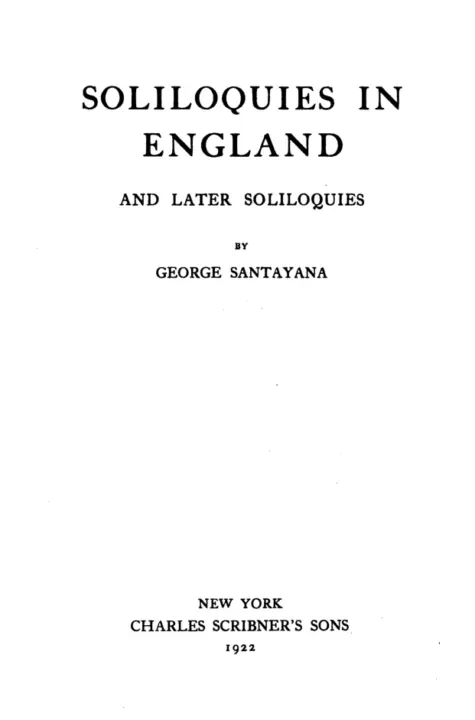
THE CLASSIC COLLECTION · 1922
"Soliloquies in England, and Later Soliloquies" by George Santayana is a philosophical collection of reflective essays written during the early 20th century. The central focus of the work is Santayana's musings and observations on English culture and his personal experiences in England amidst the backdrop of World War I. Through introspective soliloquies, he delves into topics of nature, philosophy, and the complexities of human existence, blending personal narrative with broader cultural commentary. The opening portion of the text introduces readers to the author's background and the context in which the essays were composed. Santayana shares his experiences in England from 1914 to 1918, portraying how the tranquility of nature contrasts sharply with the turmoil of war. He reflects on the significance of his surroundings, the beauty of the English landscape, and the nuanced character of the British people. The prose is rich with imagery and philosophical musings, offering a glimpse into not only the author's emotional state but also his admiration for the cultural and natural elements of England, setting the stage for deeper explorations of liberty, individuality, and the human condition throughout the rest of the collection.
Introduction adapted from the source catalogue; source summaries may be automatically generated.
Free to read · English · 97,788 words · No account needed
MAKE TIME FOR A GOOD BOOK
On by default. Untick to stop anonymous reading totals. Each page counts after 10 seconds in view. How this works.
Anonymous counting is on unless you have switched it off.
Nature, like a theatre, offers a double object to the mind. There is in the first place the play presented, the overt spectacle, which is something specious and ideal; and then there is something material and profound lying behind and only symbolically revealed, namely, the stage, the actors, and the author. The playful spectacular sort of reality we can pretty well dominate and exhaust, if we are attentive; indeed the prospect, in its sensuous and poetic essence, is plastic to attention, and alters its character according to the spectator's station and faculty; a poetic theme develops as interest in it is aroused, and offers different beauties and different morals to every new critic. The instrumentalities, on the contrary, which bring this spectacle before us, whether they be material or personal, are unfathomable. They are events, not ideas. Even putting together all that carpenters and chemists, biographers and psychologists, might learn about these events, we could never probe them to the bottom.
In the beginning, as for a child at his first pantomime, the play's the thing; and a human audience can never quite outgrow this initial illusion, since this world is a theatre nobody can visit twice. If we could become habitués, old theatre-goers amongst the worlds, we might grow more discriminating; on the whole we might enjoy the performances just as much or even more, perhaps; yet less breathlessly. We should see more and believe less. The pleasure of seeing is one, and the pleasure of believing is quite another; the first liberates our senses and fills the present with light; the second directs our conduct and relieves our anxiety or doubts about the past and future. When the spectator bethinks himself of destiny as well as of beauty, his sensibility becomes tragic, it becomes intelligence. Every picture is then regarded as a sign for the whole situation which has generated it or which it forebodes. The given image, for intelligence, expresses a problematic fact; and intelligence invents various grammatical forms and logical categories by which to describe its hidden enemy or fascinating prey. So spontaneous and dogmatic is the intellect in this interpretation of the scene that the conceived object (however abstractly sketched) is unhesitatingly judged to be, as we say, the real thing: it alone works and acts, whilst the given image is either disregarded altogether or despised as a mere word or phantasm of sense, such as only fools would stop to gaze at. And it is very true, whatever desperate efforts empiricism may make to deny it, that every figure crossing the stage of apprehension is a symbol, or may become a symbol; they all have some occasion and arise out of some deeper commotion in the material world. The womb of nature is full of crowding events, to us invisible; the ballet has machinery behind its vistas and its music; the dancers possess a character and fate in the daylight quite foreign to these fays and shepherds before the footlights; what to us is a pirouette to them is a twitch or a shilling. Shame to the impious egotism that would deny it, and, in order to spare itself the tension of faith and the labour of understanding, would pretend to find in experience nothing but a shadowy tapestry, a landscape without a substance. To its invisible substance the spectacle owes not only its existence but its meaning, since our interest in the scene is rooted in a hidden life within us, quite as much as the shifts and colours of the scenery are rooted in tricks of the stage. Nevertheless the roots of things are properly and decently hidden under ground, and it is as childish to be always pulling them up, to make sure that they exist, as it is to deny their existence. The flowers are what chiefly interests a man of taste; the spectacle is what liberal-minded people have come to see. Every image has its specific aspect and aesthetic essence, more or less charming in itself; the sensualist, the poet, the chronicler of his passing visions must take them at their face value, and be content with that. Fair masks, like flowers, like sunsets, like melodies wrung out of troubled brains and strung wire, cover for us appropriately the anatomical face of nature; and words and dogmas are other masks, behind which we, too, can venture upon the stage; for it is life to give expression to life, transmuting diffused movements into dear images. How blind is the zeal of the iconoclasts, and how profoundly hostile to religious impulse! They pour scorn upon eyes that see not and a mouth that cannot speak; they despise a work of art or of thought for being finished and motionless; as if the images of the retina were less idols than those of the sculptor, and as if words, of all things, were not conventional signs, grotesque counterfeits, dead messengers, like fallen leaves, from the dumb soul. Why should one art be contemptuous of the figurative language of another? Jehovah, who would suffer no statues, was himself a metaphor.
Your reading position is saved on this browser. Take it to another device with a library code. Reading pages adapt to text, rather than matching a printed edition.
George Santayana

George Santayana

George Santayana
George Santayana
BEHIND THE BOOK
This eBook is for the use of anyone anywhere in the United States and most other parts of the world at no cost and with almost no restrictions whatsoever. You may copy it, give it away or re-use it under the terms of the Project Gutenberg License included with this eBook or online at www.gutenberg.org. If you are not located in the United States, you will have to check the laws of the country where you are located before using this eBook. Read the source licence.
The original source file, including credits and licence, is retained by this library. Request an original-format copy at no charge. Please include the book title and Project Gutenberg identifier #48429.
KEEP YOUR CURIOSITY GOING

David Patterson (Spirit) Hatch

David Patterson (Spirit) Hatch

David Patterson (Spirit) Hatch
Cécile Tormay

Moritz Busch
Coulson Kernahan